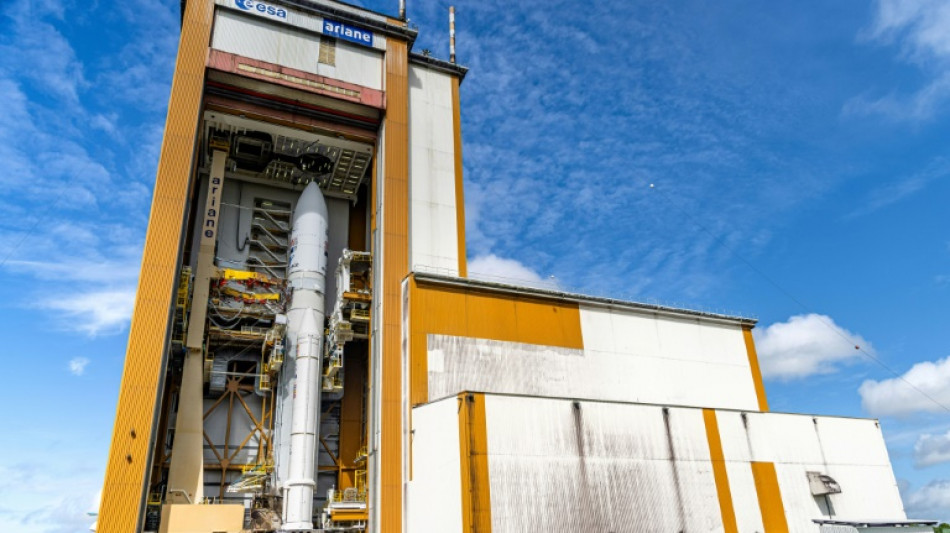
Final Ariane 5 blasts off amid Europe rocket crisis / Photo: jody amiet - AFP

 NASA scan discovers new, 'once in a century' Moon crater

 Most stocks rise as Fed hikes and indicates drive to curb inflation

 UK-Sudanese author pens book to give children 'African history of Africa'

 US Congress passes sweeping Russia sanctions bill

 US stocks fall, dollar gains after Fed lifts interest rates

 US Fed raises rates to tackle 'too high' inflation in move sure to rile Trump

 US Fed raises rates to battle inflation in move likely to rile Trump

 US House faces test on sweeping Russia sanctions bill

 British PM says to make 'difficult decisions' as inflation rises

 Global fuel price demos: a round-up

 Leverate Launches MCP for Traders to Connect AI Assistants With Trading Platforms

 MEXC Launches $1M "Discover Your Wall Street DNA" Campaign to Help Traders Find Their Market Fit

 Stocks edge higher ahead of US Fed rate call

 BASIS.pro Expands On-Chain Infrastructure with XDC Network Partnership and Zypher DAO as Auto Earn Goes Live

 Pickle-flavoured tart? AI inspires Japan's convenience stores

 EU chief hosts Canada's Carney in push to 'deepen' alliance

 Meta chief pushes back on AI slowdown calls

 US Fed to deliver rate decision with markets betting on hike

 i-payout Expands U.S. Money Transmitter Licensing Footprint and Advances European EMI Strategy

 US Senate crypto bill collapses amid partisan deadlock

 OpenAI, Anthropic and Google are working to create an AI standards body

 Protesting shepherds, farmers clash with Romanian police

 Foundation Lets Ledger Users Switch to Open Source Without Starting Over

 EU to propose curbing social media, online games for under 15s

 FX Junction Reaches 40,600 Members and 26 Million Trades

Europe's workhorse Ariane 5 rocket blasted off for a final time on Wednesday, with its farewell flight after 27 years of launches coming at a difficult time for European space efforts.
Faced with soaring global competition, the continent has unexpectedly found itself without a way to independently launch heavy missions into space due to delays to the next-generation Ariane 6 and Russia withdrawing its rockets.
The 117th and final flight of an Ariane 5 rockettook place at around 2200 GMT on Wednesdayfrom Europe's spaceport in Kourou, French Guiana.
The launch had been postponed twice. It was originally scheduled on June 16, but was called off because of problems with pyrotechnical lines in the rocket's booster, which have since been replaced.
Another launch planned for Tuesday was delayed by a day due to bad weather.
The final payload on an Ariane 5 is a French military communications satellite and a German communications satellite.
Marie-Anne Clair, the director of the Guiana Space Centre, told AFP that the final flight of an Ariane 5, whose launches have punctuated life in Kourou for nearly three decades, was "charged with emotion" for the teams there.
Though it would become a reliable rocket, Ariane 5 had a rocky start. Its maiden flight exploded moments after liftoff in 1996. Its only other such failure came in 2002.
Herve Gilibert, an engineer who was working on Ariane 5 at the time, said the 2002 explosion was a "traumatic experience" that "left a deep impression on us".
But the rocket would embark on what was ultimately a long string of successful launches.
The initial stumbles had "the positive effect of keeping us absolutely vigilant," Gilibert said.
- Webb and Juice -
Ariane 5 earned such a reputation for reliability that NASA trusted it to launch the $10 billion James Webb Space Telescope in late 2021.
The rocket's second-last launch was in April this year, blasting the European Space Agency's Juice spacecraft on its way to find out whether Jupiter's icy moons can host alien life.
Daniel Neuenschwander, the ESA's head of space transportation, said that in commercial terms, Ariane 5 had been "the spearhead of Europe's space activities".
The rocket was able to carry a far bigger load than its predecessor Ariane 4, giving Europe a competitive advantage and allowing the continent to establish itself in the communication satellite market.
While waiting for Ariane 6, whose first launch was initially scheduled for 2020, Europe had been relying on Russia's Soyuz rockets to get heavy-load missions into space.
But Russia withdrew space cooperation with Europe in response to sanctions imposed over Moscow's invasion of Ukraine in February 2022.
The number of launches from Kourou fell from 15 in 2021 to six last year.
Another blow came in December, when the first commercial flight of the next-generation Vega C light launcher failed. Last week, another problem was detected in the Vega C's engine, likely pushing its return further into the future.
- 'Difficult times' -
The launcher market has been increasingly dominated by billionaire Elon Musk's US firm SpaceX, whose rockets are now blasting off once a week.
Lacking other options, the ESA was forced to turn to rival SpaceX's Falcon 9 for the successful launch of its Euclid space telescope on Saturday.
The ESA will also use a SpaceX rocket to launch satellites for the EarthCARE observation mission.
It remains unclear how the agency will launch the next round of satellites for the European Union's Galileo global navigation system.
At the Paris Air Show earlier this month, ESA chief Josef Aschbacher acknowledged that these were "difficult times," adding that everyone was "working intensely" to get Ariane 6 and Vega-C ready.
Ariane 6 was unveiled on a launch pad in Kourou earlier this month ahead of an ignition test of its Vulcain 2.1 rocket engine.
Because the new rocket requires less staffing and maintenance, 190 out of 1,600 positions are being cut at the Kourou spaceport.
M.García--CPN