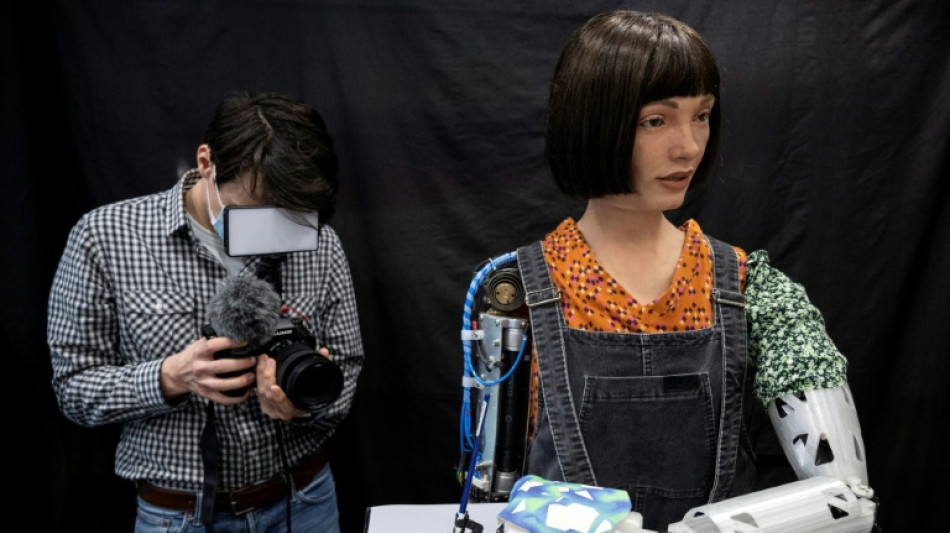
UN talks aim to harness AI power and potential / Photo: BEN STANSALL - AFP/File

 NASA scan discovers new, 'once in a century' Moon crater

 Most stocks rise as Fed hikes and indicates drive to curb inflation

 UK-Sudanese author pens book to give children 'African history of Africa'

 US Congress passes sweeping Russia sanctions bill

 US stocks fall, dollar gains after Fed lifts interest rates

 US Fed raises rates to tackle 'too high' inflation in move sure to rile Trump

 US Fed raises rates to battle inflation in move likely to rile Trump

 US House faces test on sweeping Russia sanctions bill

 British PM says to make 'difficult decisions' as inflation rises

 Global fuel price demos: a round-up

 Leverate Launches MCP for Traders to Connect AI Assistants With Trading Platforms

 MEXC Launches $1M "Discover Your Wall Street DNA" Campaign to Help Traders Find Their Market Fit

 Stocks edge higher ahead of US Fed rate call

 BASIS.pro Expands On-Chain Infrastructure with XDC Network Partnership and Zypher DAO as Auto Earn Goes Live

 Pickle-flavoured tart? AI inspires Japan's convenience stores

 EU chief hosts Canada's Carney in push to 'deepen' alliance

 Meta chief pushes back on AI slowdown calls

 US Fed to deliver rate decision with markets betting on hike

 i-payout Expands U.S. Money Transmitter Licensing Footprint and Advances European EMI Strategy

 US Senate crypto bill collapses amid partisan deadlock

 OpenAI, Anthropic and Google are working to create an AI standards body

 Protesting shepherds, farmers clash with Romanian police

 Foundation Lets Ledger Users Switch to Open Source Without Starting Over

 EU to propose curbing social media, online games for under 15s

 FX Junction Reaches 40,600 Members and 26 Million Trades

The United Nations is convening this week a global gathering to try to map out the frontiers of artificial intelligence and to harness its potential for empowering humanity.
The UN hopes to lay out a clear blueprint on the way forward for handling AI, as development of the technology races ahead the capacity to set its boundaries.
The "AI for Good Global Summit", being held in Geneva on Thursday and Friday, will bring together around 3,000 experts from companies like Microsoft and Amazon as well as from universities and international organisations to try to sculpt frameworks for handling AI.
"This technology is moving fast," said Doreen Bogdan-Martin, head of the International Telecommunication Union, the UN's information and communications technology agency that convened the summit.
"It's a real opportunity for the world's leading voices on AI to come together on the global stage and to address governance issues," she told reporters.
"Doing nothing is not an option. Humanity is dependent upon it. So we have to engage and try and ensure a responsible future with AI."
She said the summit would examine possible frameworks and guardrails to support safe AI use.
Listed participants include Amazon's chief technology officer Werner Vogels, Google DeepMind chief operating officer Lila Ibrahim and former Spain football captain Iker Casillas -- who suffered a heart attack in 2019 and now advocates for AI use in heart attack prevention.
They will be joined by dozens of robots, including several humanoids like Ai-Da, the first ultra-realistic robot artist; Ameca, the world's most advanced life-like robot; the humanoid rock singer Desdemona; and Grace, the most advanced healthcare robot.
- Benefiting humanity? -
The Geneva-based ITU feels it can bring its experience to bear on AI governance.
Founded in 1865, the ITU is the oldest agency in the UN fold. It established "SOS" as the Morse code international maritime distress call in 1906, and coordinates everything from radio frequencies to satellites and 5G.
The summit wants to identify ways of using AI to advance the UN's lagging sustainable development goals on issues such as health, the climate, poverty, hunger and clean water.
Bogdan-Martin said AI must not exacerbate social inequalities or introduce biases on race, gender, politics, culture, religion or wealth.
"This summit can help ensure that AI charts the course that benefits humanity," UN chief Antonio Guterres said.
However, while AI proponents hail the technology for how it can transform society, including work, healthcare and creative pursuits, others are worried by its potential to undermine democracy.
- 'Perfect storm' -
"We're kind of in a perfect storm of suddenly having this powerful new technology -- I don't think it's super-intelligent -- being spread very widely and empowered in our lives, and we're really not prepared," said serial AI entrepreneur Gary Marcus.
"We're at a critical moment in history when we can either get this right and build the global governance we need, or get it wrong and not succeed and wind up in a bad place where a few companies control the fates of many, many people without sufficient forethought," he said.
Last month, EU lawmakers pushed the bloc closer to passing one of the world's first laws regulating systems like OpenAI's ChatGPT chatbot. There is also growing clamour to regulate AI in the United States.
ChatGPT has become a global sensation since it was launched late last year for its ability to produce human-like content, including essays, poems and conversations from simple prompts.
It has sparked a mushrooming of generative AI content, leaving lawmakers scrambling to try to figure out how to regulate such bots.
Juan Lavista Ferres, chief data scientist of the Microsoft AI For Good Lab, gave an example of how AI could be used "to make our world a better place".
He compared the more than 400 million people diagnosed with diabetes, a major cause of blindness, with the small number of ophthalmologists.
"It's physically impossible to diagnose every patient. Yet we and others have built AI models that today can take this condition with an accuracy that matches a very good ophthalmologist. This is something can even be done from a smartphone.
"Here AI is not just a solution, but it's the only solution."
A.Leibowitz--CPN