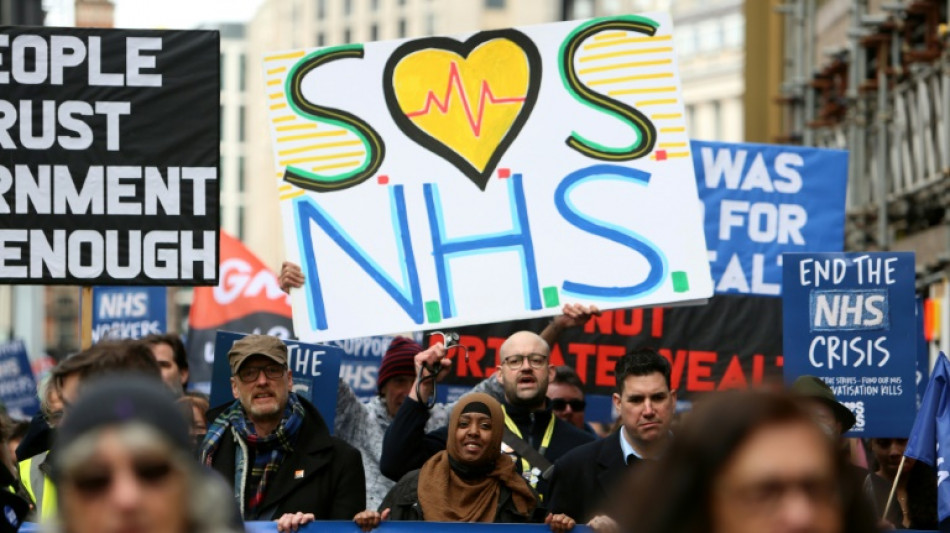
Britain's public health service at 75: on life support? / Photo: Susannah Ireland - AFP

 NASA scan discovers new, 'once in a century' Moon crater

 Most stocks rise as Fed hikes and indicates drive to curb inflation

 UK-Sudanese author pens book to give children 'African history of Africa'

 US Congress passes sweeping Russia sanctions bill

 US stocks fall, dollar gains after Fed lifts interest rates

 US Fed raises rates to tackle 'too high' inflation in move sure to rile Trump

 US Fed raises rates to battle inflation in move likely to rile Trump

 US House faces test on sweeping Russia sanctions bill

 British PM says to make 'difficult decisions' as inflation rises

 Global fuel price demos: a round-up

 Leverate Launches MCP for Traders to Connect AI Assistants With Trading Platforms

 MEXC Launches $1M "Discover Your Wall Street DNA" Campaign to Help Traders Find Their Market Fit

 Stocks edge higher ahead of US Fed rate call

 BASIS.pro Expands On-Chain Infrastructure with XDC Network Partnership and Zypher DAO as Auto Earn Goes Live

 Pickle-flavoured tart? AI inspires Japan's convenience stores

 EU chief hosts Canada's Carney in push to 'deepen' alliance

 Meta chief pushes back on AI slowdown calls

 US Fed to deliver rate decision with markets betting on hike

 i-payout Expands U.S. Money Transmitter Licensing Footprint and Advances European EMI Strategy

 US Senate crypto bill collapses amid partisan deadlock

 OpenAI, Anthropic and Google are working to create an AI standards body

 Protesting shepherds, farmers clash with Romanian police

 Foundation Lets Ledger Users Switch to Open Source Without Starting Over

 EU to propose curbing social media, online games for under 15s

 FX Junction Reaches 40,600 Members and 26 Million Trades

Deeply loved but wracked by crisis, Britain's National Health Service (NHS) on Wednesday marks 75 years since it was founded as the Western world's first universal, free healthcare system.
In a secular age, the NHS is the closest thing Britain has to a national religion -- devoutly cherished, with levels of public support higher than the royal family or any other British institution.
It was founded three years after World War II by a pioneering Labour government on the principle that everyone should access top-quality healthcare funded by general taxation, free at the point of care.
Prime Minister Rishi Sunak, whose parents were an NHS doctor and a pharmacist, paid tribute last week as he outlined a 15-year plan aimed at recruiting hundreds of thousands of new health staff.
"For every minute of every day of every one of those 75 years, the NHS has been kept going by the millions of people who've worked for it. To them on behalf of a grateful nation, I want to say: thank you," he said.
"I feel a powerful sense of responsibility to make sure that their legacy endures. And to make sure the NHS is there for our children and grandchildren, just as it was there for us."
Like Sunak's parents, immigrant staff were pivotal to the NHS's early growth, helping to remake the face of Britain itself in the decades after the war.
Its centrality to national life was underscored in a memorable dance sequence featuring NHS staff and patients during the opening of the London Olympics in 2012.
Justin Bieber remixed his hit "Holy" with an NHS choir for Christmas 2020, in a year when the public, clapping on their doorsteps, paid tribute to medics battling the Covid pandemic.
- Sickly state -
Sunak's new workforce plan, however, is recognition that the NHS is under unprecedented strain following the pandemic, even though the government spends nearly 12 percent of its budget on healthcare -- by far its single biggest item.
Demoralised doctors and nurses have been striking for better pay, an ageing and unfit population needs ever-more complex treatment, cancers go undiagnosed for lack of scanners, and hospitals are crumbling.
Sumi Manirajan, deputy chair of the British Medical Association's junior doctors committee, accused Sunak's Conservative government of failing to value doctors.
"And what that leads to is doctors leaving the country, going abroad, Australia, New Zealand, Canada, and actually it's the public that loses out," she told AFP at a protest rally by striking doctors.
"The government (ministers), they may use private health care but the ordinary citizen in the UK uses the NHS, relies on the NHS."
In a report for the 75th anniversary, the King's Fund charity compared the health systems of 19 similar countries and found Britain's in a sickly state.
It cited data showing the UK performed worst in fatality rates for strokes and second-worst for heart attacks.
The UK has a "strikingly low number of both nurses and doctors per person compared to its peers" and four times fewer hospital and intensive care beds than Germany, the report said.
But opinion polls show scant support in Britain for radical reform such as switching to a mixed model of funding, with patients paying via insurance for some of their treatment, as is the norm elsewhere.
Fully 93 percent of more than 3,000 respondents believe the NHS should remain free at the point of care, based on general taxation, according to the annual British Social Attitudes Survey last year.
But the authoritative survey also found a record 51 percent were dissatisfied with their quality of care, especially with waiting times for appointments to see general practitioners and hospital doctors.
- Terminal decline? -
Sunak has been resisting the medics' pay demands as he battles to get soaring UK inflation under control, while insisting his government is investing "record sums" in the NHS.
But the service needs to be modernised via better use of digital technology including artificial intelligence, he said on Friday.
Sunak argued that his workforce plan would make the NHS fit "for decades to come". But some on the front lines give a far gloomier prognosis.
"Right now, as a functional, universal public service, the NHS is failing," geriatrics consultant David Oliver wrote in The BMJ, a medical journal.
He warned: "It may not quite be in end-of-life care, or about to have its financial or political life support removed, but without immediate action and longer-term thinking it won't see its 85th birthday."
A.Mykhailo--CPN