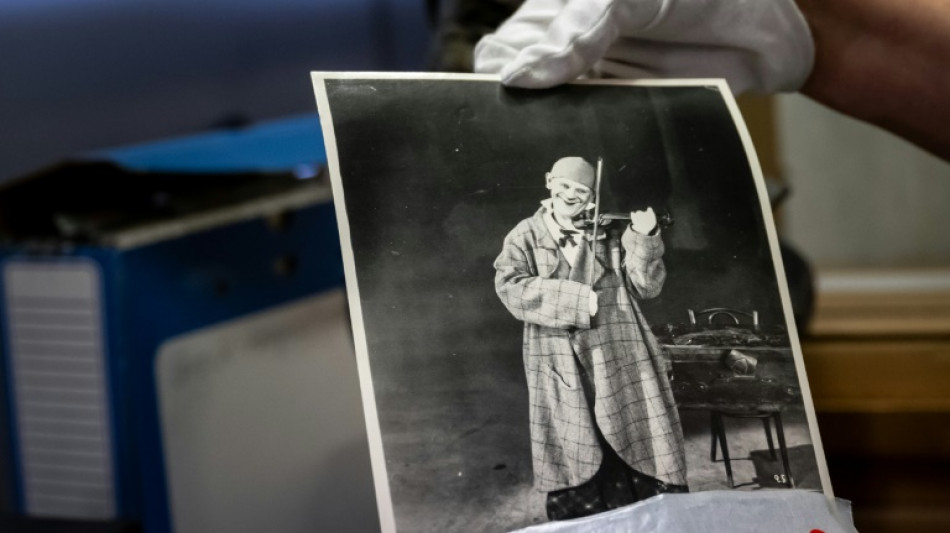
Swiss museum probes 'king of clowns' Nazi links / Photo: Fabrice COFFRINI - AFP

 NASA scan discovers new, 'once in a century' Moon crater

 Most stocks rise as Fed hikes and indicates drive to curb inflation

 UK-Sudanese author pens book to give children 'African history of Africa'

 US Congress passes sweeping Russia sanctions bill

 US stocks fall, dollar gains after Fed lifts interest rates

 US Fed raises rates to tackle 'too high' inflation in move sure to rile Trump

 US Fed raises rates to battle inflation in move likely to rile Trump

 US House faces test on sweeping Russia sanctions bill

 British PM says to make 'difficult decisions' as inflation rises

 Global fuel price demos: a round-up

 Leverate Launches MCP for Traders to Connect AI Assistants With Trading Platforms

 MEXC Launches $1M "Discover Your Wall Street DNA" Campaign to Help Traders Find Their Market Fit

 Stocks edge higher ahead of US Fed rate call

 BASIS.pro Expands On-Chain Infrastructure with XDC Network Partnership and Zypher DAO as Auto Earn Goes Live

 Pickle-flavoured tart? AI inspires Japan's convenience stores

 EU chief hosts Canada's Carney in push to 'deepen' alliance

 Meta chief pushes back on AI slowdown calls

 US Fed to deliver rate decision with markets betting on hike

 i-payout Expands U.S. Money Transmitter Licensing Footprint and Advances European EMI Strategy

 US Senate crypto bill collapses amid partisan deadlock

 OpenAI, Anthropic and Google are working to create an AI standards body

 Protesting shepherds, farmers clash with Romanian police

 Foundation Lets Ledger Users Switch to Open Source Without Starting Over

 EU to propose curbing social media, online games for under 15s

 FX Junction Reaches 40,600 Members and 26 Million Trades

Grock became known as the "king of clowns" but the Swiss entertainer who made the world laugh is now in the spotlight over his connections with Adolf Hitler.
A Swiss museum, which has recently acquired Grock's archive, is researching links between the performer -- considered by peers to be the greatest musical clown of his time -- and the dictator of Nazi Germany.
In the first half of the 20th century, Grock's success rivalled that of Charlie Chaplin. But while Chaplin satirised Hitler, Grock seems to have welcomed him into his dressing room.
Last month, the Neues Museum Biel took possession of around a thousand items from Grock's collection.
Sound recordings from shows, letters, photographs and musical scores were donated by Grock's 74-year-old great-nephew Raymond Naef.
Via Naef, Grock's stage costumes and musical instruments were donated by Switzerland's Knie family circus dynasty.
But the Neues Museum Biel did not want to put on a Grock exhibition without first exploring the artist's life off-stage, where he developed a reputation as a shrewd businessman.
"It's the museum's responsibility. It's absolutely necessary," the art and history museum's director Bernadette Walter told AFP.
- Hitler telegram -
Wettach published several autobiographies and his great-nephew Naef wrote a book and curated a 2002 exhibition about Grock's career -- but until now, no historian has investigated the nature of his Nazi connections.
"Grock says in his autobiography that Hitler came to his dressing room, and that Hitler saw his shows 13 times," said Walter, though the museum has not yet verified the claim.
The museum did not consider turning down his archive, which entails conducting lots of research -- something Walter compared to the investigations that cultural institutions carry out into artworks looted by the Nazis.
"A museum must also tell stories that are not always spotless," the director said, arguing that the past should not simply be forgotten.
At a May 12 online auction, the museum tried to buy, for research purposes, a seasonal greetings telegram that Grock sent to Hitler in 1942.
"We know that he met Hitler and (Joseph) Goebbels," the Nazi propaganda chief, and that he performed for wounded German soldiers, said Walter, but whether he had any political allegiances remains a mystery.
Grock performed in Germany before the Nazis came to power in 1933, and the museum wants to see whether he adapted his stage show afterwards.
Grock always said he was apolitical and his autobiography mentions his shows in Britain, France and the United States, said Walter.
"He played when he was paid. We know that Grock was opportunistic, but that cannot be used as an excuse."
- No joke -
Laurent Diercksen, who wrote the 1999 book "Grock: An Extraordinary Destiny", said the acrobat, juggler and multi-instrumentalist "didn't give a damn about politics" and focused on "success".
"We cannot judge him on a single letter, an isolated act or one revelation taken out of context," the journalist told AFP, finding it a shame that the great music hall artiste might primarily be remembered for his "so-called Nazi sympathies".
Born in 1880, Grock -- real name Adrien Wettach -- grew up in the Bernese Jura mountains above the city of Biel in northern Switzerland.
He chose his pseudonym in the early 1900s, when he replaced Brock in Brick and Brock, a famous duo of the time.
Grock died in 1959 aged 79, with his sketches known to audiences around the world.
"He brought laughter to an era when there wasn't much to laugh about," said his great-nephew, who nonetheless recalled that Grock's connections with the Nazis had caused family disputes.
But he wanted Grock's collection to be publicly accessible for historical research and potentially be exhibited, adding that people needed to distinguish between the art and the artiste.
"We do not destroy the houses built by the architect Le Corbusier simply because he was also a bit of a fascist," Naef concluded.
P.Schmidt--CPN