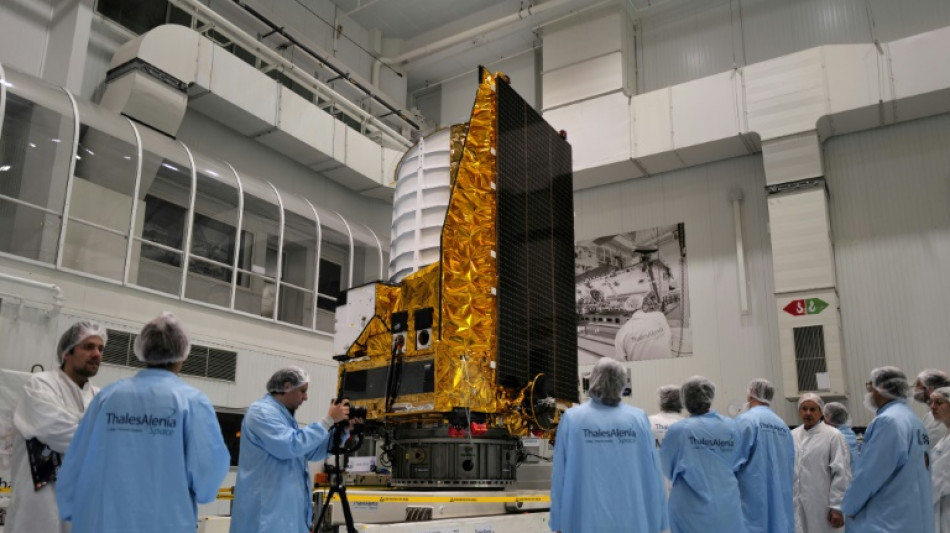
Europe's Euclid space telescope to launch on July 1 / Photo: Valery HACHE - AFP/File

 NASA scan discovers new, 'once in a century' Moon crater

 Most stocks rise as Fed hikes and indicates drive to curb inflation

 UK-Sudanese author pens book to give children 'African history of Africa'

 US Congress passes sweeping Russia sanctions bill

 US stocks fall, dollar gains after Fed lifts interest rates

 US Fed raises rates to tackle 'too high' inflation in move sure to rile Trump

 US Fed raises rates to battle inflation in move likely to rile Trump

 US House faces test on sweeping Russia sanctions bill

 British PM says to make 'difficult decisions' as inflation rises

 Global fuel price demos: a round-up

 Leverate Launches MCP for Traders to Connect AI Assistants With Trading Platforms

 MEXC Launches $1M "Discover Your Wall Street DNA" Campaign to Help Traders Find Their Market Fit

 Stocks edge higher ahead of US Fed rate call

 BASIS.pro Expands On-Chain Infrastructure with XDC Network Partnership and Zypher DAO as Auto Earn Goes Live

 Pickle-flavoured tart? AI inspires Japan's convenience stores

 EU chief hosts Canada's Carney in push to 'deepen' alliance

 Meta chief pushes back on AI slowdown calls

 US Fed to deliver rate decision with markets betting on hike

 i-payout Expands U.S. Money Transmitter Licensing Footprint and Advances European EMI Strategy

 US Senate crypto bill collapses amid partisan deadlock

 OpenAI, Anthropic and Google are working to create an AI standards body

 Protesting shepherds, farmers clash with Romanian police

 Foundation Lets Ledger Users Switch to Open Source Without Starting Over

 EU to propose curbing social media, online games for under 15s

 FX Junction Reaches 40,600 Members and 26 Million Trades

The European Space Agency said on Wednesday its space telescope Euclid is scheduled to launch on July 1, blasting off on a mission to shed light on the mysteries of dark matter and dark energy.
The mission will launch on a SpaceX Falcon 9 rocket from Cape Canaveral in Florida, with the broadcast beginning at 1430 GMT, the ESA said in a tweet.
Euclid was originally planned to ride into space on a Russian Soyuz rocket, but last year Moscow withdrew its launchers in response to sanctions over the invasion of Ukraine.
The ESA was forced to turn to its rival SpaceX, the US company of billionaire Elon Musk, to launch the 1.4-billion-euro ($1.5 billion) mission.
The two-tonne Euclid, which is 4.7 metres (15 feet) tall and 3.5 metres (11 feet) wide, will join fellow space telescope James Webb at a stable hovering spot 1.5 million kilometres from Earth called the second Lagrangian Point.
From there, Euclid will chart a 3D map of the universe encompassing two billion galaxies across more than a third of the sky.
Euclid's gaze will stretch out to 10 billion light years away. Because of how long it takes the light from distant stars to reach Earth, that means it will peer back 10 billion years into the cosmic past.
The mission will allow scientists to reconstruct the history of the 13.8-billion-year-old universe via "slices of time," astrophysicist Yannick Mellier told the Euclid consortium earlier this month.
Euclid's main objective is to better understand dark matter and dark energy, which together make up 95 percent of the universe.
The existence of both remains entirely theoretical -- although also necessary for scientists to construct a working understanding of the universe.
Dark matter is invisible, its existence inferred from the motion of objects affected by its gravitational pull.
Dark energy is the name given to the unknown force causing the expansion of the universe to accelerate.
Euclid is not expected to identify the true nature of these dark mysteries, but astronomers hope its unprecedented view of the universe will shed light on how they act and evolve over time.
Euclid's first images are expected to roll in quickly once scientific operations start in October, but it will take scientists longer to sift through the massive amount of data.
D.Avraham--CPN