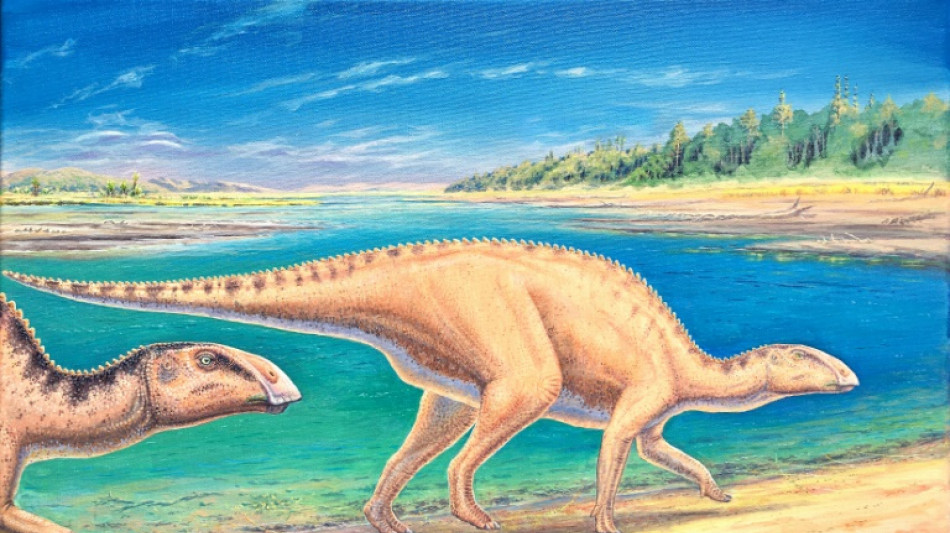
Remains of new species of duck-billed dinosaur found in Chile / Photo: Handout - Universidad de Chile/AFP

 NASA scan discovers new, 'once in a century' Moon crater

 Most stocks rise as Fed hikes and indicates drive to curb inflation

 UK-Sudanese author pens book to give children 'African history of Africa'

 US Congress passes sweeping Russia sanctions bill

 US stocks fall, dollar gains after Fed lifts interest rates

 US Fed raises rates to tackle 'too high' inflation in move sure to rile Trump

 US Fed raises rates to battle inflation in move likely to rile Trump

 US House faces test on sweeping Russia sanctions bill

 British PM says to make 'difficult decisions' as inflation rises

 Global fuel price demos: a round-up

 Leverate Launches MCP for Traders to Connect AI Assistants With Trading Platforms

 MEXC Launches $1M "Discover Your Wall Street DNA" Campaign to Help Traders Find Their Market Fit

 Stocks edge higher ahead of US Fed rate call

 BASIS.pro Expands On-Chain Infrastructure with XDC Network Partnership and Zypher DAO as Auto Earn Goes Live

 Pickle-flavoured tart? AI inspires Japan's convenience stores

 EU chief hosts Canada's Carney in push to 'deepen' alliance

 Meta chief pushes back on AI slowdown calls

 US Fed to deliver rate decision with markets betting on hike

 i-payout Expands U.S. Money Transmitter Licensing Footprint and Advances European EMI Strategy

 US Senate crypto bill collapses amid partisan deadlock

 OpenAI, Anthropic and Google are working to create an AI standards body

 Protesting shepherds, farmers clash with Romanian police

 Foundation Lets Ledger Users Switch to Open Source Without Starting Over

 EU to propose curbing social media, online games for under 15s

 FX Junction Reaches 40,600 Members and 26 Million Trades

Remains of a species of herbivorous dinosaur previously unknown in the southern hemisphere have been discovered in Chile, challenging long-held beliefs about the range of duck-billed dinosaurs, scientists said Friday.
Measuring up to four meters (13 feet) in length and weighing a ton, Gonkoken nanoi lived 72 million years ago in the extreme south of what is now Chilean Patagonia.
"These were slender-looking dinosaurs, which could easily adopt a bipedal and quadrupedal posture to reach the vegetation at height and at ground level," said Alexander Vargas, director of the paleontological network of the University of Chile and one of the authors of the study published by the journal Science Advances and presented in Santiago.
The discovery demonstrated that Chilean Patagonia served as a refuge for very ancient species of hadrosaurs, a type of duck-billed dinosaur common in North America, Asia and Europe during the Cretaceous period, from 145 to 66 million years ago.
Their presence in the remote southern lands surprised scientists, who will have to "understand how their ancestors got there," Vargas said.
Gonkoken nanoi, the fifth species of dinosaur discovered in Chile, was actually found in 2013, kicking off a decade-long investigation.
The name Gonkoken comes from the Tehuelche language, the first inhabitants of the region, and means "similar to a wild duck or a swan."
M.Davis--CPN