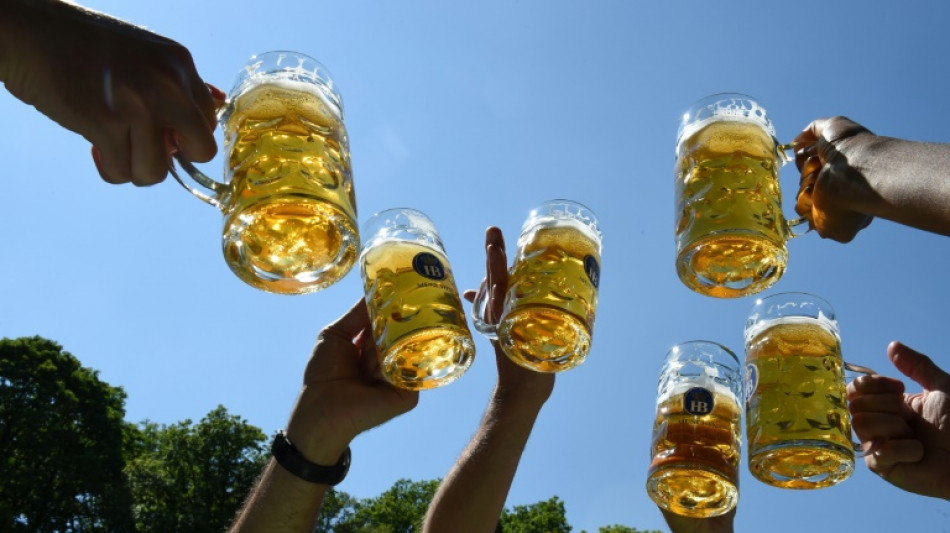
Scientists explain why peanuts 'dance' when dropped in beer / Photo: Christof STACHE - AFP/File

 NASA scan discovers new, 'once in a century' Moon crater

 Most stocks rise as Fed hikes and indicates drive to curb inflation

 UK-Sudanese author pens book to give children 'African history of Africa'

 US Congress passes sweeping Russia sanctions bill

 US stocks fall, dollar gains after Fed lifts interest rates

 US Fed raises rates to tackle 'too high' inflation in move sure to rile Trump

 US Fed raises rates to battle inflation in move likely to rile Trump

 US House faces test on sweeping Russia sanctions bill

 British PM says to make 'difficult decisions' as inflation rises

 Global fuel price demos: a round-up

 Leverate Launches MCP for Traders to Connect AI Assistants With Trading Platforms

 MEXC Launches $1M "Discover Your Wall Street DNA" Campaign to Help Traders Find Their Market Fit

 Stocks edge higher ahead of US Fed rate call

 BASIS.pro Expands On-Chain Infrastructure with XDC Network Partnership and Zypher DAO as Auto Earn Goes Live

 Pickle-flavoured tart? AI inspires Japan's convenience stores

 EU chief hosts Canada's Carney in push to 'deepen' alliance

 Meta chief pushes back on AI slowdown calls

 US Fed to deliver rate decision with markets betting on hike

 i-payout Expands U.S. Money Transmitter Licensing Footprint and Advances European EMI Strategy

 US Senate crypto bill collapses amid partisan deadlock

 OpenAI, Anthropic and Google are working to create an AI standards body

 Protesting shepherds, farmers clash with Romanian police

 Foundation Lets Ledger Users Switch to Open Source Without Starting Over

 EU to propose curbing social media, online games for under 15s

 FX Junction Reaches 40,600 Members and 26 Million Trades

When peanuts are dropped into a pint of beer, they initially sink to the bottom before floating up and "dancing" in the glass.
Scientists have dug deep seeking to investigate this phenomenon in a new study published on Wednesday, saying it has implications for understanding mineral extraction or bubbling magma in the Earth's crust.
Brazilian researcher Luiz Pereira, the study's lead author, told AFP that he first had the idea when passing through Argentina's capital Buenos Aires to learn Spanish.
It was a "bartender thing" in the city to take a few peanuts and pop them into beers, Pereira said.
Because the peanuts are denser than the beer, they first sink down to the bottom of the glass.
Then each peanut becomes what is called a "nucleation site". Hundreds of tiny bubbles of carbon dioxide form on their surface, acting as buoys to drag them upwards.
"The bubbles prefer to form on the peanuts rather than on the glass walls," explained Pereira, a researcher at Germany's Ludwig Maximilian University of Munich.
When the bubbles reach the surface, they burst.
The peanuts then dive down before being propelled up again by freshly formed bubbles, in a dance that continues until the carbon dioxide runs out -- or someone interrupts by drinking the beer.
In a series of experiments, the team of researchers in Germany, Britain and France examined how roasted, shelled peanuts fared in a lager-style beer.
- Next up: more beers -
The study, published in the journal Royal Society Open Science, describes two key factors in what the researchers dubbed the "beer–gas–peanut system".
They found that the larger the "contact angle" between the curve of an individual bubble and the surface of the peanut was, the more likely it was to form and grow.
But it cannot grow too much -- a radius of under 1.3 millimetres is ideal, the study said.
Pereira said he hoped that "by deeply researching this simple system, which everyone can grasp, we can understand a system" that would be useful for industry or explaining natural phenomena.
For example, he said the floatation process was similar to the one used to separate iron from ore.
Air is injected, in a controlled way, into a mixture in which a mineral -- such as iron -- "will rise because bubbles attach themselves more easily to it, while other (minerals) sink to the bottom," he said.
The same process could also explain why volcanologists find that the mineral magnetite rises to higher layers in the crystallised magma of the Earth's crust than would be expected.
Like peanuts, magnetite is denser, so should sit at the bottom. But due to a high contact angle, the researchers theorise, the mineral rises through the magma with help from gas bubbles.
Of course, science is never settled -- particularly when beer is involved.
Hoping to create a better model of the dancing peanut phenomenon, Pereira said the scientists will continue to "play with the characteristics of different peanuts and different beers".
H.Müller--CPN