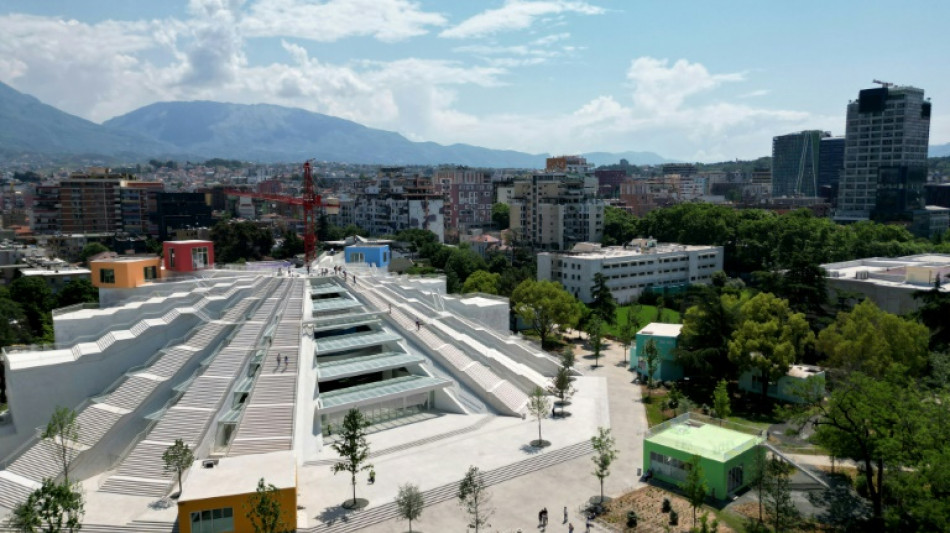
Albania's communist pyramid at last has a point / Photo: ADNAN BECI - AFP

 NASA scan discovers new, 'once in a century' Moon crater

 Most stocks rise as Fed hikes and indicates drive to curb inflation

 UK-Sudanese author pens book to give children 'African history of Africa'

 US Congress passes sweeping Russia sanctions bill

 US stocks fall, dollar gains after Fed lifts interest rates

 US Fed raises rates to tackle 'too high' inflation in move sure to rile Trump

 US Fed raises rates to battle inflation in move likely to rile Trump

 US House faces test on sweeping Russia sanctions bill

 British PM says to make 'difficult decisions' as inflation rises

 Global fuel price demos: a round-up

 Leverate Launches MCP for Traders to Connect AI Assistants With Trading Platforms

 MEXC Launches $1M "Discover Your Wall Street DNA" Campaign to Help Traders Find Their Market Fit

 Stocks edge higher ahead of US Fed rate call

 BASIS.pro Expands On-Chain Infrastructure with XDC Network Partnership and Zypher DAO as Auto Earn Goes Live

 Pickle-flavoured tart? AI inspires Japan's convenience stores

 EU chief hosts Canada's Carney in push to 'deepen' alliance

 Meta chief pushes back on AI slowdown calls

 US Fed to deliver rate decision with markets betting on hike

 i-payout Expands U.S. Money Transmitter Licensing Footprint and Advances European EMI Strategy

 US Senate crypto bill collapses amid partisan deadlock

 OpenAI, Anthropic and Google are working to create an AI standards body

 Protesting shepherds, farmers clash with Romanian police

 Foundation Lets Ledger Users Switch to Open Source Without Starting Over

 EU to propose curbing social media, online games for under 15s

 FX Junction Reaches 40,600 Members and 26 Million Trades

It was built as a bizarre memorial to Albania's paranoid communist dictator who cut the country off from the rest of the world.
Now a brutalist pyramid in the heart of Tirana hopes to become a beacon of the Balkan country's transformation.
The behemoth fit for a pharaoh was designed by Enver Hoxha's daughter as a museum to his memory just a few years after his death in 1985.
Inside the grey pyramid sat a huge gleaming statue of the "Great Teacher", who ruled the hermetically sealed country for four decades.
Now it is being turned into a hub to boost the country's embryonic tech sector.
"What used to serve to glorify an individual has been completely overturned, it's becoming a place designed to educate people, not dedicated to one person but to thousands," said Martin Mata, co-president of the Albanian-American Development Foundation (AADF), one of the project's major stakeholders.
The 15-million-euro project co-financed by the AADF and Albanian authorities will house an education centre to train youngsters in all things digital in an after-school programme that aims to attract 4,000 students a week.
- 'Money well spent' -
Later this year Tirana's teenagers will be able to take classes in 3D modelling, computer programing and digital design on state-of-the-art equipment in the old communist relic.
The building has had several lives since the fall of communism and become a marker of the fast-changing nation, serving as a nightclub, NATO offices and a television studio.
But its newest iteration may prove to be its most important, its backers hope, with Albania losing thousands of young people every year who leave to find work abroad.
"It's money well spent," Mata said. "If 10 years from now we see that 200,000 kids have participated -- and if 30 percent of those kids chose a career path because of what they learned... then mission accomplished."
The pyramid's once-dilapidated interior has been reimagined by Dutch and Albanian architects, with massive windows channelling natural light over colourful office blocks.
"Our ambition was to open it up to the public, to make it the people's pyramid both inside and out," said architect Gent Agolli.
- 'A mirror' -
The digital education programme known as Tumo -- which has been piloted in cities such as Paris, Yerevan, Beirut and Berlin -- already welcomes around a thousand young people a week to a complex at the national stadium in Tirana.
"All the knowledge acquired here will be useful to them now, but above all in the future, whatever profession they pursue," Tumo Tirana director Shqipe Berisha, 41, told AFP.
In September, the teenagers, mentors and professional trainers will pick up sticks and transfer their operations to the pyramid.
The 12,000-square-metre structure will also house an array of businesses, bars and cafes. The rents will be used to subsidise Tumo Tirana, making the courses as accessible as possible to Albanian students.
For Berisha, the pyramid has long served as a symbol of Albania's turbulent transformation.
"To me the pyramid is like a mirror of what Albania has been like over the years," she said.
For "our parents (it was used to) try to explain the regime. In my time we used to slide down the pyramid's [exterior], after that it was in bits and pieces just as the country was in bits and pieces. Now it is open. It reflects the openness of the country."
Tumo student Amina Xhembulla, 15, has taken an interest in graphic design since enrolling, with pupils encouraged to create a portfolio showing off their work for universities or potential employers in the future.
"It's helpful, not stressful," Xhembulla said as she scrolled through projects she had worked on recently. "You can use technology we can't use at school."
Asked for her opinion on the pyramid's dark past, the teenager shrugged.
"I don't know much about history."
A.Zimmermann--CPN