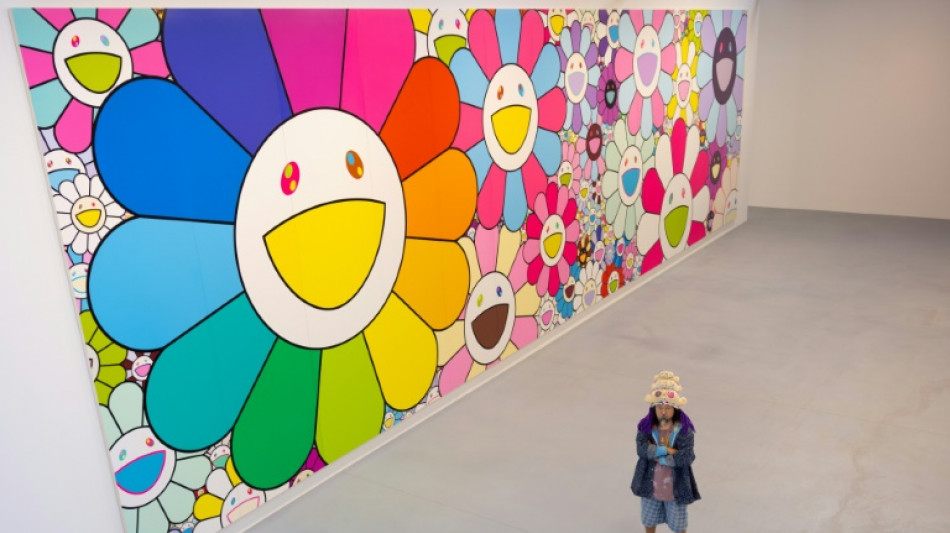
Takashi Murakami loves and fears AI / Photo: JOEL SAGET - AFP

 NASA scan discovers new, 'once in a century' Moon crater

 Most stocks rise as Fed hikes and indicates drive to curb inflation

 UK-Sudanese author pens book to give children 'African history of Africa'

 US Congress passes sweeping Russia sanctions bill

 US stocks fall, dollar gains after Fed lifts interest rates

 US Fed raises rates to tackle 'too high' inflation in move sure to rile Trump

 US Fed raises rates to battle inflation in move likely to rile Trump

 US House faces test on sweeping Russia sanctions bill

 British PM says to make 'difficult decisions' as inflation rises

 Global fuel price demos: a round-up

 Leverate Launches MCP for Traders to Connect AI Assistants With Trading Platforms

 MEXC Launches $1M "Discover Your Wall Street DNA" Campaign to Help Traders Find Their Market Fit

 Stocks edge higher ahead of US Fed rate call

 BASIS.pro Expands On-Chain Infrastructure with XDC Network Partnership and Zypher DAO as Auto Earn Goes Live

 Pickle-flavoured tart? AI inspires Japan's convenience stores

 EU chief hosts Canada's Carney in push to 'deepen' alliance

 Meta chief pushes back on AI slowdown calls

 US Fed to deliver rate decision with markets betting on hike

 i-payout Expands U.S. Money Transmitter Licensing Footprint and Advances European EMI Strategy

 US Senate crypto bill collapses amid partisan deadlock

 OpenAI, Anthropic and Google are working to create an AI standards body

 Protesting shepherds, farmers clash with Romanian police

 Foundation Lets Ledger Users Switch to Open Source Without Starting Over

 EU to propose curbing social media, online games for under 15s

 FX Junction Reaches 40,600 Members and 26 Million Trades

Neo-pop art superstar Takashi Murakami has always embraced new technology and was an early adopter of crypto and NFTs, but even he admits fearing that AI might make him obsolete.
Murakami, 61, has become a brand unto himself thanks to his loveable technicolour paintings that mix traditional Japanese art motifs with modern anime and manga.
His paintings have sold for millions of dollars, led to fashion collaborations with Louis Vuitton and Kanye West, and been shown at some of the world's great institutions, prized as insightful commentary on the fine line between art and commerce.
It has not always made him popular with Japan's art establishment, but Murakami likes being a disruptor.
He sees another wave of change coming thanks to AI-powered software.
"The generational change will be dramatic," he told AFP at the opening of a new exhibition at the Gagosian gallery on the outskirts of Paris.
It reminds him of the arrival of the Apple II computer in the 1980s that swept away an older generation of design professionals, but empowered those who embraced it.
"AI will certainly do damage to technical trades but I don't think it will be able to block our ideas," he said.
"The wackiest ideas, those that even AI cannot generate, will become even more valuable."
That does mean power perhaps shifting from artists to tech engineers, who will be able to explore things that are hard to imagine at the moment.
"Artists who create familiar things will be left behind," he said.
"I myself work with a certain kind of fear of one day being replaced."
- 'Not very appreciated' -
Ironically, Murakami says he was touched to finally receive some praise from a more traditional part of Japanese society with his recent work in homage to Kabuki theatre.
He spoke to AFP in front of an enormous 23-metres-long by 5-metres-high fresco that tells a Kabuki narrative in his dazzling, cartoonish style.
"I'm not very appreciated in Japan," he said, wearing Bermuda shorts and a jacket adorned with his famous smiling flowers.
"My reputation is fairly bad because I'm seen as presenting a false image of Japanese culture to the rest of the world.
"This is the first time I was welcomed in this way in Japan. I was very pleased."
- 'A new continent' -
Nonetheless, his commitment to technological change is clear.
Visitors to Saturday's gallery opening -- requiring some dedication since it was hidden away among the private jet hangars near Charles de Gaulle airport -- were set to receive an NFT of a flower-adorned virtual coin.
The show includes a wall of NFT-style pixelated portraits that draw a line from Karl Marx and Adam Smith to current tech honchos Vitalik Buterin and Elon Musk.
Like all his work, they are deceptively simple, seemingly printed, yet in fact painstakingly painted by hand and then lacquered to remove any sign of human involvement and create his renowned "Superflat" aesthetic.
He sees this work as building a bridge between traditional and digital art, but admits they can be a hard sell.
"Collectors who have been fans of mine for a long time clearly have some trouble with these pixelated drawings," he said.
"But I created my works following Japanese or Eastern styles, not Western, and I consider pixel art to be a sort of representation of Japanese culture from the video games of the 1970s."
The world of crypto is "like a new continent" still being discovered.
"It will take several more years for people to get used to it," he said.
P.Gonzales--CPN