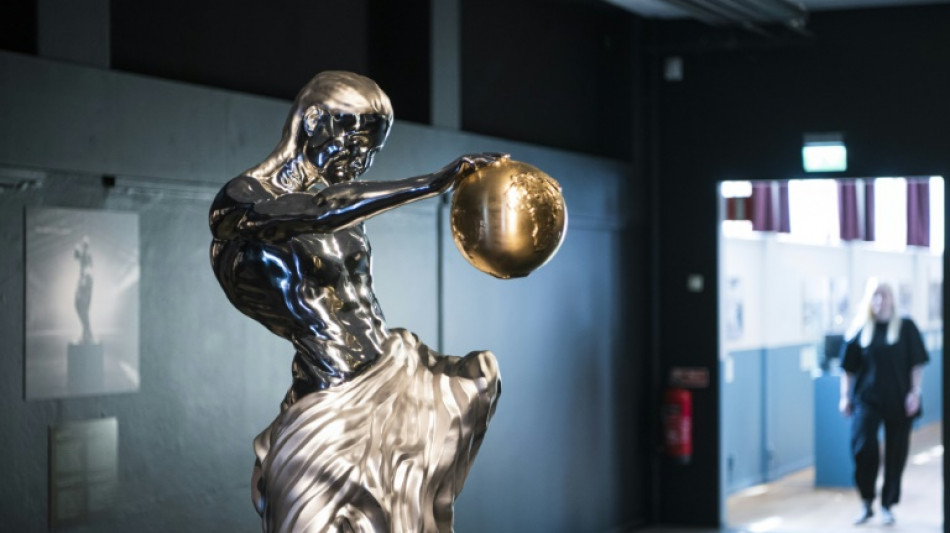
AI statue designed by Michelangelo on show in Sweden / Photo: Jonathan NACKSTRAND - AFP

 NASA scan discovers new, 'once in a century' Moon crater

 Most stocks rise as Fed hikes and indicates drive to curb inflation

 UK-Sudanese author pens book to give children 'African history of Africa'

 US Congress passes sweeping Russia sanctions bill

 US stocks fall, dollar gains after Fed lifts interest rates

 US Fed raises rates to tackle 'too high' inflation in move sure to rile Trump

 US Fed raises rates to battle inflation in move likely to rile Trump

 US House faces test on sweeping Russia sanctions bill

 British PM says to make 'difficult decisions' as inflation rises

 Global fuel price demos: a round-up

 Leverate Launches MCP for Traders to Connect AI Assistants With Trading Platforms

 MEXC Launches $1M "Discover Your Wall Street DNA" Campaign to Help Traders Find Their Market Fit

 Stocks edge higher ahead of US Fed rate call

 BASIS.pro Expands On-Chain Infrastructure with XDC Network Partnership and Zypher DAO as Auto Earn Goes Live

 Pickle-flavoured tart? AI inspires Japan's convenience stores

 EU chief hosts Canada's Carney in push to 'deepen' alliance

 Meta chief pushes back on AI slowdown calls

 US Fed to deliver rate decision with markets betting on hike

 i-payout Expands U.S. Money Transmitter Licensing Footprint and Advances European EMI Strategy

 US Senate crypto bill collapses amid partisan deadlock

 OpenAI, Anthropic and Google are working to create an AI standards body

 Protesting shepherds, farmers clash with Romanian police

 Foundation Lets Ledger Users Switch to Open Source Without Starting Over

 EU to propose curbing social media, online games for under 15s

 FX Junction Reaches 40,600 Members and 26 Million Trades

A historical dream team of five master sculptors, including Michelangelo, Rodin and Takamura, have trained artificial intelligence (AI) to design a sculpture dubbed "the Impossible Statue", now on show in a Swedish museum.
"This is a true statue created by five different masters that would never have been able to collaborate in real life," said Pauliina Lunde, a spokeswoman for Swedish machine engineering group Sandvik that used three AI software programmes to create the artwork.
Shaking up traditional conceptions about creativity and art, the stainless steel statue depicts an androgynous person with the lower half of the body covered by a swath of material, holding a bronze globe in one hand.
On show at Stockholm's National Museum of Science and Technology, the statue measures 150 centimetres (4 feet 11 inches) and weighs 500 kilograms (1,100 pounds).
The idea was to create a mix of styles from five famed sculptors who each made their mark on their era: Michelangelo (Italy 1475-1564), Auguste Rodin (France 1840-1917), Kathe Kollwitz (Germany 1867-1945), Kotaro Takamura (Japan 1883-1956) and Augusta Savage (US 1892-1962).
"Something about it makes me feel like this is not made by human being," Julia Olderius, in charge of concept development at the museum, told AFP.
Visitors will note the muscular body inspired by Michelangelo, and the hand holding the globe inspired by Takamura.
Sandvik's engineers trained the AI by feeding it a slew of images of sculptures created by the five artists.
The software then proposed several images in 2D which it believed reflected key aspects from each of the artists.
"In the end we had 2D images of the sculpture in which we could see the different masters reflected. Then we put these 2D images into 3D modeling," Olderius said.
But is it art, or technological prowess?
"I don't think you can define what art is. It's up to every human being to see, 'this is art, this is not art'. And it's up to the audience to decide," Olderius said.
Amid debate about the role of AI in the art world, Olderius said she was optimistic.
"I don't think you have to be afraid of what AI is doing with creativity or concepts or art and design," she said.
"I just think you have to adapt to a new future where technology is a part of how we create concepts and art."
M.P.Jacobs--CPN