Ukraine dam's destruction increases mines threat: Red Cross / Photo: Fabrice COFFRINI - AFP

 NASA scan discovers new, 'once in a century' Moon crater

 Most stocks rise as Fed hikes and indicates drive to curb inflation

 UK-Sudanese author pens book to give children 'African history of Africa'

 US Congress passes sweeping Russia sanctions bill

 US stocks fall, dollar gains after Fed lifts interest rates

 US Fed raises rates to tackle 'too high' inflation in move sure to rile Trump

 US Fed raises rates to battle inflation in move likely to rile Trump

 US House faces test on sweeping Russia sanctions bill

 British PM says to make 'difficult decisions' as inflation rises

 Global fuel price demos: a round-up

 Leverate Launches MCP for Traders to Connect AI Assistants With Trading Platforms

 MEXC Launches $1M "Discover Your Wall Street DNA" Campaign to Help Traders Find Their Market Fit

 Stocks edge higher ahead of US Fed rate call

 BASIS.pro Expands On-Chain Infrastructure with XDC Network Partnership and Zypher DAO as Auto Earn Goes Live

 Pickle-flavoured tart? AI inspires Japan's convenience stores

 EU chief hosts Canada's Carney in push to 'deepen' alliance

 Meta chief pushes back on AI slowdown calls

 US Fed to deliver rate decision with markets betting on hike

 i-payout Expands U.S. Money Transmitter Licensing Footprint and Advances European EMI Strategy

 US Senate crypto bill collapses amid partisan deadlock

 OpenAI, Anthropic and Google are working to create an AI standards body

 Protesting shepherds, farmers clash with Romanian police

 Foundation Lets Ledger Users Switch to Open Source Without Starting Over

 EU to propose curbing social media, online games for under 15s

 FX Junction Reaches 40,600 Members and 26 Million Trades

The destruction of the Kakhovka dam in Ukraine will have a catastrophic effect on locating landmines in the affected region, the Red Cross warned Wednesday.
"We knew where the hazards were," said Erik Tollefsen, head of the Weapon Contamination Unit at the International Committee of the Red Cross. "Now we don't know.
"All we know is that they are somewhere downstream."
"This is a major concern because it will affect not just the population, but also all of those that are coming in to help," he added.
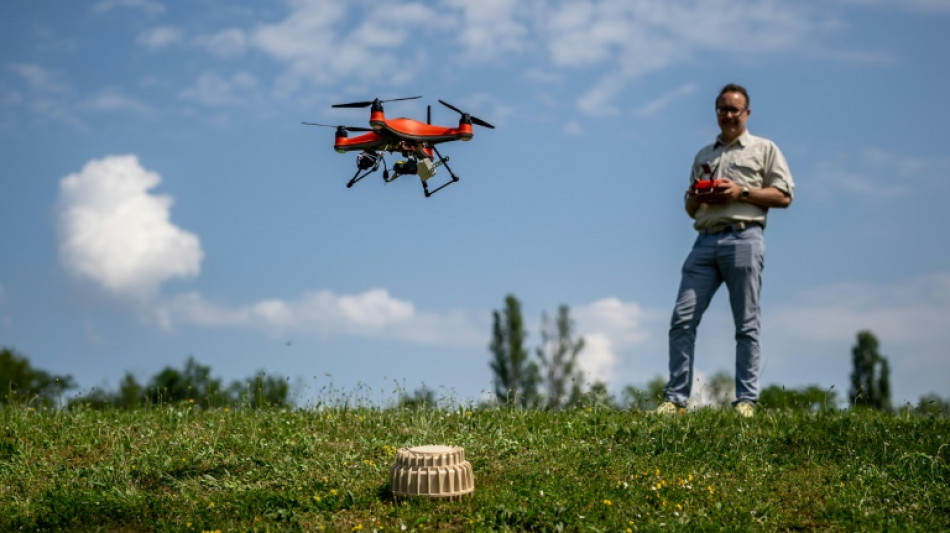
Tollefsen was speaking as the ICRC presented a new drone that uses artificial intelligence to locate mines and other explosive remnants of war from the heat they emit.
It could one day be used in Ukraine.
The ICRC had spent several months helping mine clearance operations in Ukraine, mapping and marking minefields and providing training and equipment, said Tollefsen.
"Now all of that has been washed away."
Anti-personnel and anti-tank mines such as the TM-57 will now have been dispersed into unknown locations, he said.
Ukraine's Kakhovka dam in Russian-held territory was destroyed on Tuesday, flooding dozens of villages and parts of a nearby city, and sparking fears of a humanitarian disaster.
- Mine numbers 'massive' -
Already on Tuesday the United Nations warned of the risks associated with the mines, which are numerous in Ukraine.
The ICRC noted that the floodwaters would not damage or deactivate these explosive devices, which means they could pose a threat for decades to come.
Downstream from the dam in the Kherson region "there has been a lot of what we call defensive minefields put up by parties to the conflict", said Norwegian specialist Tollefsen.
Normally, these are "very, very populated with both anti-personnel mines and anti-vehicle mines", he added.
The ICRC does not know how many mines might have been submerged or washed away by the floodwaters.
"The parties to conflict haven't declared any kind of numbers of mines that have been laid," said Tollefsen.
"We just know that the numbers are massive."
Moscow and Kyiv have blamed each other for the destruction of the 1950s Soviet-era dam on the Dnipro River.
The flooding has forced several thousand civilians to leave their homes.
- New drone 'a step forward' -
ICRC president Mirjana Spoljaric Egger said the destruction of the dam was "symbolic for the need to comply with international humanitarian law.
"The damage is already massive and I feel very concerned about how much more damage will be caused by this incident," she told reporters at the unveiling of the mine-hunting drone.
The new drone can cover in a day the same surface area a demining dog would in six months, has so far only been used in testing in Jordan.
The Geneva-based ICRC hopes to use it for the first time this year around the city of Aleppo in northwest Syria.
The drone if eventually used in Ukraine, could help trace the large numbers of mines laid there since Russia's full-scale invasion in February last year.
It will not remove mines itself but should accelerate their detection thanks to its cameras, heat detector and artificial intelligence software, which the ICRC intends to share.
"It is a step forward because it covers large areas at a much higher speed," said ICRC weapons specialist Martin Jebens.
Spoljaric Egger added: "Typically in mine clearance operations the average figure per day per deminer is 50 square metres.
"With this new technology being put together by the ICRC and its partners, conservative estimates suggest we will be able to survey and process 100,000 square metres a day for more efficient demining."
D.Avraham--CPN