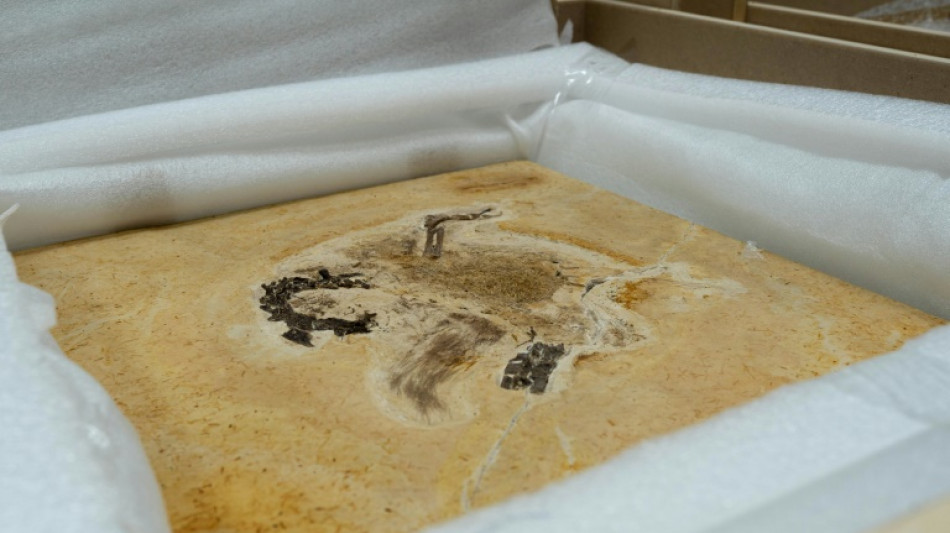
Germany returns 'stolen' dinosaur fossil to Brazil / Photo: Raul VASCONCELOS - BRAZIL'S MINISTRY OF SCIENCE AND TECHNOLOGY (MCTI)/AFP

 NASA scan discovers new, 'once in a century' Moon crater

 Most stocks rise as Fed hikes and indicates drive to curb inflation

 UK-Sudanese author pens book to give children 'African history of Africa'

 US Congress passes sweeping Russia sanctions bill

 US stocks fall, dollar gains after Fed lifts interest rates

 US Fed raises rates to tackle 'too high' inflation in move sure to rile Trump

 US Fed raises rates to battle inflation in move likely to rile Trump

 US House faces test on sweeping Russia sanctions bill

 British PM says to make 'difficult decisions' as inflation rises

 Global fuel price demos: a round-up

 Leverate Launches MCP for Traders to Connect AI Assistants With Trading Platforms

 MEXC Launches $1M "Discover Your Wall Street DNA" Campaign to Help Traders Find Their Market Fit

 Stocks edge higher ahead of US Fed rate call

 BASIS.pro Expands On-Chain Infrastructure with XDC Network Partnership and Zypher DAO as Auto Earn Goes Live

 Pickle-flavoured tart? AI inspires Japan's convenience stores

 EU chief hosts Canada's Carney in push to 'deepen' alliance

 Meta chief pushes back on AI slowdown calls

 US Fed to deliver rate decision with markets betting on hike

 i-payout Expands U.S. Money Transmitter Licensing Footprint and Advances European EMI Strategy

 US Senate crypto bill collapses amid partisan deadlock

 OpenAI, Anthropic and Google are working to create an AI standards body

 Protesting shepherds, farmers clash with Romanian police

 Foundation Lets Ledger Users Switch to Open Source Without Starting Over

 EU to propose curbing social media, online games for under 15s

 FX Junction Reaches 40,600 Members and 26 Million Trades

A fossil from a rare dinosaur that roamed South America 110 million years ago has been returned to Brazil from Germany, ending a diplomatic spat triggered by charges that researchers stole it.
The small dino, called Ubirajara jubatus, which had an early form of feathers and spearlike rods jutting from its shoulders, fascinated scientists, who identified it as previously unknown species in a paper published in 2020.
But it soon sparked a scientific and ethical scandal, when Brazilian researchers accused the German team behind the paper of illegally removing the fossil from Brazil.
After a nearly three-year standoff, a delegation led by German Foreign Minister Annalena Baerbock returned the fossil Sunday during a visit to Brasilia, officials said.
"The Ubirajara jubatus fossil, the first non-avian dinosaur with feather-like structures found in South America, has been returned to Brazil," the Brazilian science and technology ministry said in a statement Monday.
The fossil was found in 1990 by a team of paleontologists in the northeastern state of Ceara. They took it to Germany to study it, housing it in the State Museum of Natural History in Karlsruhe.
But Brazilian scientists cried foul after the publication of the December 2020 paper identifying the fossil as a new species, saying the specimen had been removed from the country irregularly.
Local legislation establishes that fossils found in Brazil belong to the state, and that foreign researchers must collaborate with a Brazilian institution if they want to export them.
Scientists launched an online campaign calling for the fossil to be returned, under the hashtag #UbirajarabelongstoBR.
"Without the mobilization of the Brazilian scientific community, we would not have been successful," Science and Technology Minister Inacio Arruda said.
The 11.5-kilo (25-pound) specimen will now be housed at a university paleontology museum in Ceara.
H.Müller--CPN