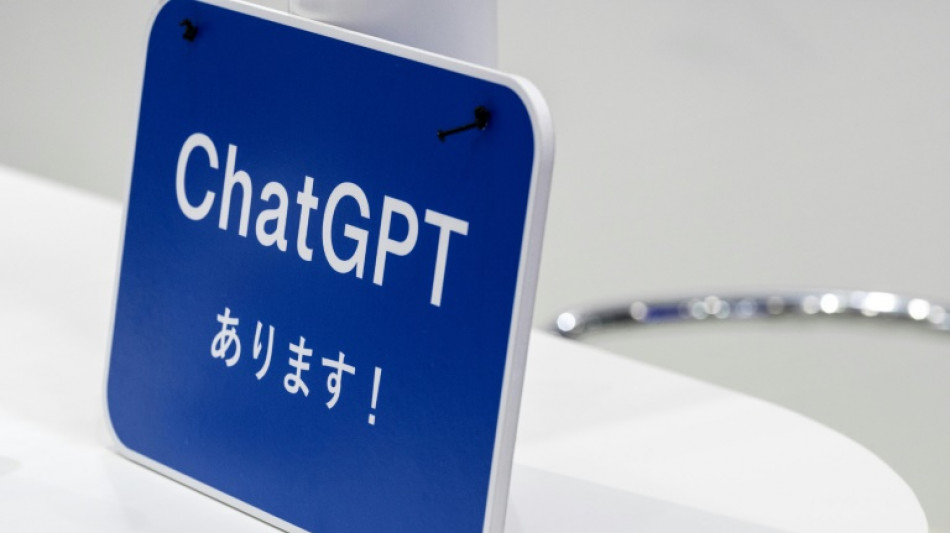
EU wants to 'clearly label' AI-generated online content / Photo: Richard A. Brooks - AFP/File

 NASA scan discovers new, 'once in a century' Moon crater

 Most stocks rise as Fed hikes and indicates drive to curb inflation

 UK-Sudanese author pens book to give children 'African history of Africa'

 US Congress passes sweeping Russia sanctions bill

 US stocks fall, dollar gains after Fed lifts interest rates

 US Fed raises rates to tackle 'too high' inflation in move sure to rile Trump

 US Fed raises rates to battle inflation in move likely to rile Trump

 US House faces test on sweeping Russia sanctions bill

 British PM says to make 'difficult decisions' as inflation rises

 Global fuel price demos: a round-up

 Leverate Launches MCP for Traders to Connect AI Assistants With Trading Platforms

 MEXC Launches $1M "Discover Your Wall Street DNA" Campaign to Help Traders Find Their Market Fit

 Stocks edge higher ahead of US Fed rate call

 BASIS.pro Expands On-Chain Infrastructure with XDC Network Partnership and Zypher DAO as Auto Earn Goes Live

 Pickle-flavoured tart? AI inspires Japan's convenience stores

 EU chief hosts Canada's Carney in push to 'deepen' alliance

 Meta chief pushes back on AI slowdown calls

 US Fed to deliver rate decision with markets betting on hike

 i-payout Expands U.S. Money Transmitter Licensing Footprint and Advances European EMI Strategy

 US Senate crypto bill collapses amid partisan deadlock

 OpenAI, Anthropic and Google are working to create an AI standards body

 Protesting shepherds, farmers clash with Romanian police

 Foundation Lets Ledger Users Switch to Open Source Without Starting Over

 EU to propose curbing social media, online games for under 15s

 FX Junction Reaches 40,600 Members and 26 Million Trades

The European Commission wants big online platforms to "clearly label" content -- words, images and audio -- that has been created by artificial intelligence, one of its vice presidents said Monday.
Vera Jourova, who is EU commissioner for transparency, told journalists she had asked the 44 companies and organisations signed on to the bloc's voluntary code of practice to fight disinformation to adhere to a new "track" in the pact to apply such labelling.
"Signatories who integrate generative AI into their services, like Bing Chat for Microsoft and Bard for Google should build in necessary safeguards so that these services cannot be used by malicious actors to generate disinformation," she said.
She added that companies "who have services with a potential to disseminate AI-generated disinformation should in turn put in place technology to recognise such content and clearly label this to users".
Microsoft and Google follow the EU's code of practice, as do TikTok, Google's YouTube platform, and Facebook owner Meta.
Twitter, which has dramatically cut its staff since billionaire Elon Musk bought it, announced last month it was withdrawing from the code.
While voluntary, aspects of the code on disinformation will be hardened into law when the European Union's new Digital Services Act comes into force on August 25.
Since the chatbot ChatGPT burst onto the public stage late last year, generative AI content has mushroomed.
Realistic but fake images of the pope in a high-fashion puffer jacket and former US president Donald Trump being arrested have been produced.
So have deep-fake videos of Tom Cruise, and music tracks sounding almost identical to pop stars Drake and The Beatles.
Industry observers expect AI to make inroads into interactive customer relations by telephone and computer, simulating famous actors in movies and commercials, teaching languages, and more besides.
Jourova said she wanted the code-abiding companies to "immediately" put AI-labelling in place so that "a normal user will clearly see that this is not the text or the visual produced, developed, created by real people -- that this is the robot speaking".
The European Union is currently working up draft legislation to regulate AI which will have specific added obligations when it comes to generative AI, but negotiations are dragging out between EU lawmakers and the bloc's member governments.
If it manages to have the law adopted by the end of this year, it would come into force in late 2025 "at the earliest," according to EU internal market commissioner Thierry Breton.
A.Levy--CPN