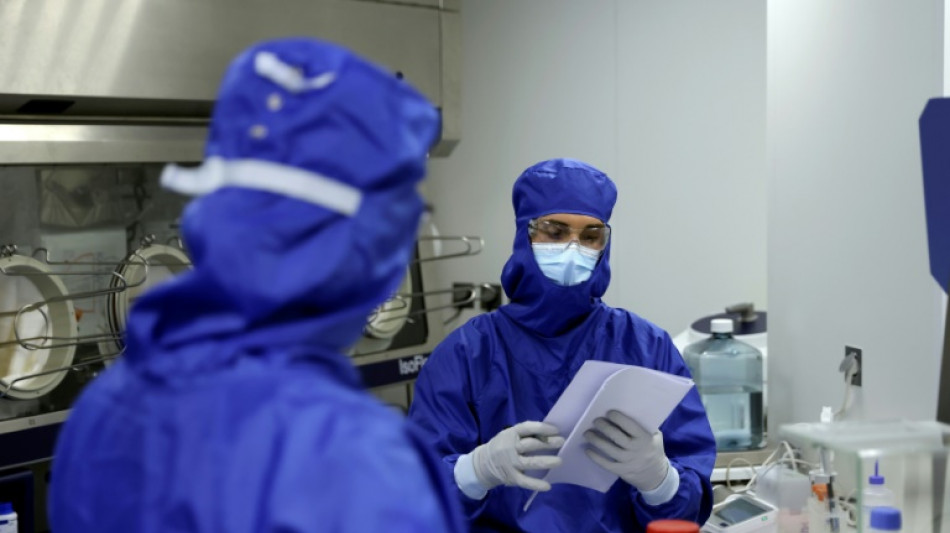
Treatment found to reduce progression of rare blood cancer by 74% / Photo: THOMAS COEX - AFP/File

 NASA scan discovers new, 'once in a century' Moon crater

 Most stocks rise as Fed hikes and indicates drive to curb inflation

 UK-Sudanese author pens book to give children 'African history of Africa'

 US Congress passes sweeping Russia sanctions bill

 US stocks fall, dollar gains after Fed lifts interest rates

 US Fed raises rates to tackle 'too high' inflation in move sure to rile Trump

 US Fed raises rates to battle inflation in move likely to rile Trump

 US House faces test on sweeping Russia sanctions bill

 British PM says to make 'difficult decisions' as inflation rises

 Global fuel price demos: a round-up

 Leverate Launches MCP for Traders to Connect AI Assistants With Trading Platforms

 MEXC Launches $1M "Discover Your Wall Street DNA" Campaign to Help Traders Find Their Market Fit

 Stocks edge higher ahead of US Fed rate call

 BASIS.pro Expands On-Chain Infrastructure with XDC Network Partnership and Zypher DAO as Auto Earn Goes Live

 Pickle-flavoured tart? AI inspires Japan's convenience stores

 EU chief hosts Canada's Carney in push to 'deepen' alliance

 Meta chief pushes back on AI slowdown calls

 US Fed to deliver rate decision with markets betting on hike

 i-payout Expands U.S. Money Transmitter Licensing Footprint and Advances European EMI Strategy

 US Senate crypto bill collapses amid partisan deadlock

 OpenAI, Anthropic and Google are working to create an AI standards body

 Protesting shepherds, farmers clash with Romanian police

 Foundation Lets Ledger Users Switch to Open Source Without Starting Over

 EU to propose curbing social media, online games for under 15s

 FX Junction Reaches 40,600 Members and 26 Million Trades

A treatment that involves genetically modifying the body's own immune cells has been found to cut the risk of disease progression by 74 percent in people with a rare type of blood cancer, results showed Monday.
Ciltacabtagene autoleucel -- also known by its trade name Carvykti -- was tested in a clinical trial involving 419 patients with multiple myeloma, whose disease was not responsive to the current frontline drug lenalidomide, a chemotherapy medicine.
"Lenalidomide has become a foundation of care for people with myeloma, but as its use has expanded, so has the number of patients whose disease will no longer respond to the treatment," said oncologist Oreofe Odejide at the American Society of Clinical Oncology's annual meeting where results were presented.
Ciltacabtagene autoleucel "delivers remarkably effective outcomes compared to patients' current options" and "can be used safely earlier in the treatment phase," added Odejide, an expert who was not part of the research.
Multiple myeloma affects a type of white blood cells called plasma cells, and can cause cascading harms to the bones, kidneys, and immune health.
It affects seven people out of 100,000 every year, according to the Cleveland Clinic, with 100,000 people impacted in the United States. There is currently no cure, though progression can be stopped for a long time.
Risk increases with age, with men more likely to be affected than women, and Black people at higher risk than other races. Not everyone requires immediate treatment and the disease may be monitored if it is slow growing.
In the new clinical trial, half the patients were randomly assigned ciltacabtagene autoleucel, while the other half received a cocktail of drugs that represents the current standard of care, including chemotherapy and steroids.
"After a median follow-up of 16 months, the researchers found that ciltacabtagene autoleucel reduced the risk of disease progression by 74 percent, compared with the standard-of-care treatments," a press statement said.
Ciltacabtagene autoleucel is a type of chimeric antigen receptor (CAR) T-cell therapy, a newer form of treatment.
CAR T-cell therapy involves removing the patient's disease fighting T cells, and genetically engineering them in a lab so they have specific proteins known as receptors that, once returned to the body, will seek out and destroy cancer cells.
Nearly all the patients in both groups experienced severe to life-threatening adverse events, including infections and low blood cell counts.
Three-quarters of patients on ciltacabtagene autoleucel developed Cytokine release syndrome, in which the immune system is sent into overdrive. It can affect multiple organs and cause death.
Around five percent of patients on ciltacabtagene autoleucel developed immune effector cell-associated neurotoxicity syndrome (ICANS), which affects a person's nervous system.
Next, the researchers will continue to follow the study participants to determine long-term effects and impacts on quality of life.
The clinical trial was funded by Janssen Research & Development and Legend Biotech USA.
M.García--CPN