North Korea claims new test of 'reconnaissance satellite' component

 Wildfires push endangered Sumatran elephants to brink: Indonesian NGO

 Bank of Japan set to raise rates under pressure from inflation, US

 EU chief to unveil social media, gaming curbs for under-15s

 'Resident Evil' film brings video game's ethos to the big screen

 i-payout Expands U.S. Money Transmitter Licensing Footprint and Advances European EMI Strategy

 US Senate crypto bill collapses amid partisan deadlock

 OpenAI, Anthropic and Google are working to create an AI standards body

 Protesting shepherds, farmers clash with Romanian police

 Foundation Lets Ledger Users Switch to Open Source Without Starting Over

 EU to propose curbing social media, online games for under 15s

 FX Junction Reaches 40,600 Members and 26 Million Trades

 'We unleashed the beast': the world's fears and hopes about AI

 Hospitality leaders ask Burnham to halve VAT amid rising costs

 Worcestershire invited to nominate groups for 2027 King’s volunteer award

 Berlin's run-down public spaces at heart of election campaign

 'Widow's Bay' and 'The Pitt' win big at Emmy Awards

 Most markets drop as oil extends gains ahead of expected US rate hike

 Sri Lanka's famed beach shack battles demolition

 Vserv targets ₹1,000 crore revenue by 2030 through AI expansion

 India prohibits bank fees on UPI payments up to ₹2,000

 Brazil's Amazon defender Raoni has cancer

 Trump rejects AI slowdown concerns as UN urges coordinated controls

 Higher wages draw migrant workers to Kashmir despite attacks

 Oil supply concerns and AI warnings weigh on global markets

 'I am the hoax buster': Trump rejects AI danger warnings

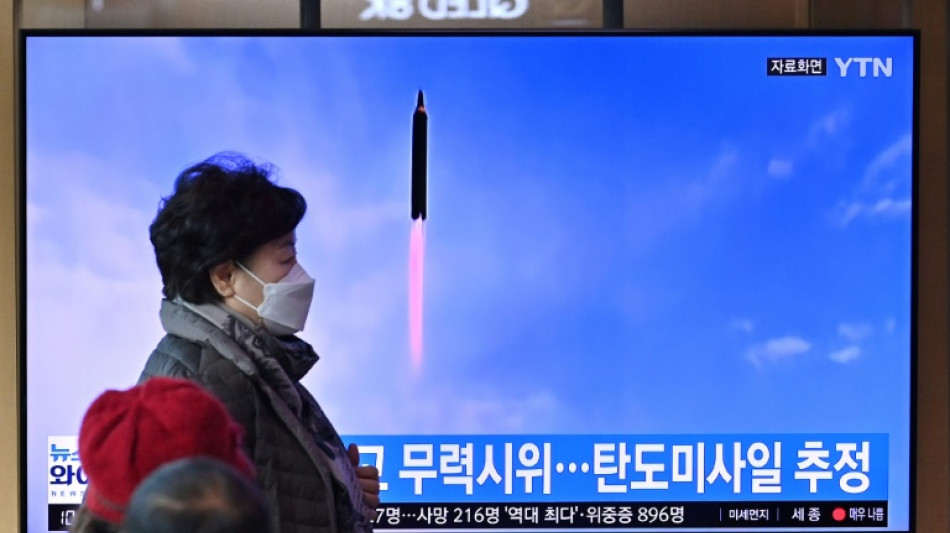
North Korea carried out "another important test" towards the development of a reconnaissance satellite, state media said Sunday, but analysts warned it was a thinly-veiled ballistic missile launch, just days before South Korea elects a new president.
From hypersonic to medium-range ballistic missiles, Pyongyang test-fired a string of banned weaponry in January and last week launched what it claimed was a component of a "reconnaissance satellite" -- although Seoul described it as another ballistic missile.
North Korea is under biting international sanctions for its nuclear weapons programs, but peaceful satellite launches are not subject to the same level of restrictions -- although they use much of the same technology.
The development of a military reconnaissance satellite -- along with the hypersonic weapons tested in January -- is officially one of Pyongyang's key defence projects, as outlined by leader Kim Jong Un last year.
"The DPRK National Aerospace Development Administration (NADA) and the Academy of Defence Science conducted another important test on Saturday under the plan of developing a reconnaissance satellite," KCNA news agency said, using the acronyms of the North's official name.
"Through the test, the NADA confirmed the reliability of data transmission and reception system of the satellite, its control command system and various ground-based control systems," it added.
South Korea said Saturday that it believed the test -- which came just days before the country votes to elect a new president on Wednesday -- was a ballistic missile launch.
Pyongyang has doubled-down on leader Kim's drive to modernise its military as it ignores US offers of talks and threatens to abandon a self-imposed moratorium on testing long-range missiles and nuclear weapons.
"Since satellites and ICBMs are the same inside and out, a satellite launch will take the Korean peninsula back to the peak of tensions it saw in 2017," Yang Moo-jin, a professor at the University of North Korean Studies in Seoul, said.
- 'Red line' -
But Yang added the two tests this month may also be a message to Washington -- a way for Pyongyang to implicitly seek concessions so that North Korea does not have to cross the "red line" of an ICBM launch.
Pyongyang has been abiding by a self-imposed moratorium on testing ICBMs and nuclear weapons since leader Kim Jong Un embarked on a flurry of high-profile diplomatic engagement with then US president Donald Trump in 2017.
Talks later collapsed and diplomacy has languished ever since, despite efforts by the administration of US President Joe Biden to offer talks.
"There is uncertainty for North Korea if it crosses the red line as it has no idea how the Biden administration will respond," said Park Won-gon, professor at Ewha Womans University in Seoul.
Moreover, with the war in Ukraine dominating global headlines, North Korea doesn't want to be overshadowed.
"Pyongyang would want to carry out a launch at a time and environment when it can grab the most attention," Park added.
Lim Eul-chul, a professor of North Korean studies at Kyungnam University in Seoul, said South Korea's upcoming presidential election appeared to be stirring up Pyongyang's "anxiety over its security".
Tensions with North Korea are no longer a major issue in South Korean elections, analysts say, with topics including domestic income inequality and youth unemployment top of voters' lists of concerns.
But one of the two frontrunners, dour former prosecutor Yoon Suk-yeol of the opposition People Power Party, has threatened a pre-emptive strike on South Korea's nuclear-armed neighbour if needed.
"It looks like Pyongyang views it's difficult to expect progress in inter-Korean relations regardless of who becomes president and firmly believes that strengthening self-defense is the best," Lim added.
Domestically, North Korea is preparing to celebrate the 110th anniversary of the birth of late founder Kim Il Sung in April, which experts say Pyongyang could use as an opportunity to carry out a major weapons test or satellite launch.
Recent satellite images analysed by specialist website 38 North suggest that the country may be preparing a military parade to showcase its weapons to mark the key anniversary.
O.Ignatyev--CPN