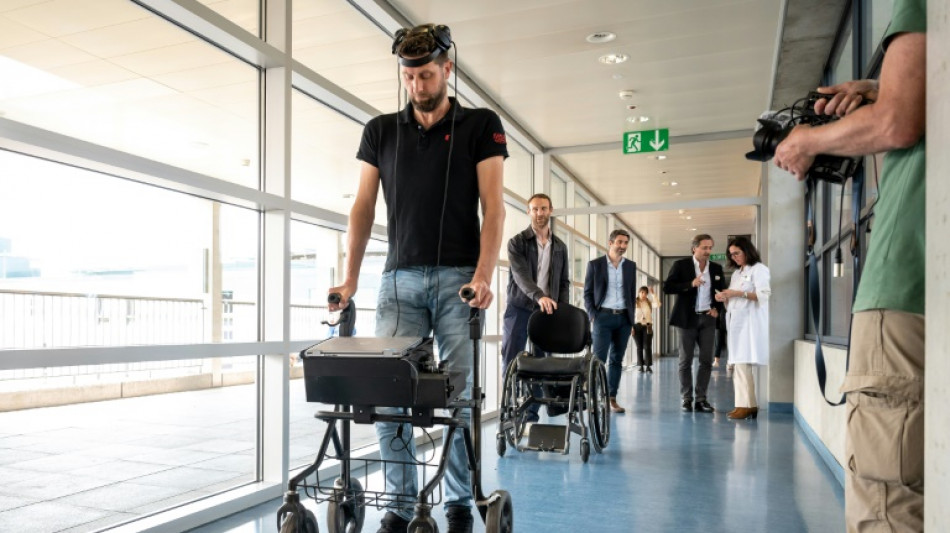
Paralysed man walks again via thought-controlled implants / Photo: Fabrice COFFRINI - AFP

 Where the US-China tariff row stands ahead of White House summit

 Indonesia cash-for-photos scheme turns animal hunters into protectors

 Argentine judge orders suspension of Falklands oil project

 US Fed raises rates to tackle 'too high' inflation, irking Trump

 Turkey releases 106 protesters, jails more LGBTQ activists

 Candidate for UN chief calls for AI regulation akin to nuclear weapons

 'We're losing control,' AI pioneer Yoshua Bengio tells AFP

 IR-MED and Dice Technologies Announce collaboration to Evaluate and Advance Pressure-Injury Prevention Platform in Japan

 Watts, Pitt, Cruz to light up Spain's top film festival

 Toogood Gold's Table Mountain Sits in the Shadow of a Nevada Gold Rush

 MEXC July–August Security Report: 38.66M USDT in Risk Funds Intercepted, Futures Insurance Fund Hits 792M USDT

 Emporio Armani names Dario Vitale new creative director

 EU to ban social media for under 13s, curb access until 15

 Wildfires push endangered Sumatran elephants to brink: Indonesian NGO

 Bank of Japan set to raise rates under pressure from inflation, US

 EU chief to unveil social media, gaming curbs for under-15s

 'Resident Evil' film brings video game's ethos to the big screen

 GA-ASI Mojave First UAS To Complete Battlefield Short Field Ops

 Sanders, Bannon warn of AI dangers in rare US left-right alignment

 Empty benches as schools reopen in Venezuela's quake-hit Guaira

 Tiny English village holds 'independence' vote over asylum seeker housing

 US Treasury chief says to meet Chinese counterpart at weekend

 BingX Evolves into a Multi-Asset Trading Platform, Connecting Users to Global Opportunities

 International Trading Institute Expands Professional Trader Development Beyond the Master’s in Trading

 Lake Energy Secures $80 Million for U.S. Renewable Energy Expansion

A paralysed man has regained the ability to walk smoothly using only his thoughts for the first time, researchers said on Wednesday, thanks to two implants that restored communication between brain and spinal cord.
The patient Gert-Jan, who did not want to reveal his surname, said the breakthrough had given him "a freedom that I did not have" before.
The 40-year-old Dutchman has been paralysed in his legs for more than a decade after suffering a spinal cord injury during a bicycle accident.
But using a new system he can now walk "naturally", take on difficult terrain and even climb stairs, according to a study published in the journal Nature.
The advance is the result of more than a decade of work by a team of researchers in France and Switzerland.
Last year the team showed that a spinal cord implant -- which sends electrical pulses to stimulate movement in leg muscles -- had allowed three paralysed patients to walk again.
But they needed to press a button to move their legs each time.
Gert-Jan, who also has the spinal implant, said this made it difficult to get into the rhythm of taking a "natural step".
- 'Digital bridge' -
The latest research combines the spinal implant with new technology called a brain-computer interface, which is implanted above the part of the brain that controls leg movement.
The interface uses algorithms based on artificial intelligence methods to decode brain recordings in real time, the researchers said.
This allows the interface, which was designed by researchers at France's Atomic Energy Commission (CEA), to work out how the patient wants to move their legs at any moment.
The data is transmitted to the spinal cord implant via a portable device that fits in a walker or small backpack, allowing patients to get around without help from others.
The two implants build what the researchers call a "digital bridge" to cross the disconnect between the spinal cord and brain that was created during Gert-Jan's accident.
"Now I can just do what I want -- when I decide to make a step the stimulation will kick in as soon as I think about it," Gert-Jan said.
After undergoing invasive surgery twice to implant both devices, it has "been a long journey to get here," he told a press conference in the Swiss city of Lausanne.
But among other changes, he is now able to stand at a bar again with friends while having a beer.
"This simple pleasure represents a significant change in my life," he said in a statement.
- 'Radically different' -
Gregoire Courtine, a neuroscientist at Switzerland's Ecole Polytechnique Federale de Lausanne and a study co-author, said it was "radically different" from what had been accomplished before.
"Previous patients walked with a lot of effort -- now one just needs to think about walking to take a step," he told a press conference in the Swiss city of Lausanne.
There was another positive sign: following six months of training, Gert-Jan recovered some sensory perception and motor skills that he had lost in the accident.
He was even able to walk with crutches when the "digital bridge" was turned off.
Guillaume Charvet, a researcher at France's CEA, told AFP this suggests "that the establishment of a link between the brain and spinal cord would promote a reorganisation of the neuronal networks" at the site of the injury.
So when could this technology be available to paralysed people around the world? Charvet cautioned it will take "many more years of research" to get to that point.
But the team are already preparing a trial to study whether this technology can restore function in arms and hands.
They also hope it could apply to other problems such as paralysis caused by stroke.
U.Ndiaye--CPN
