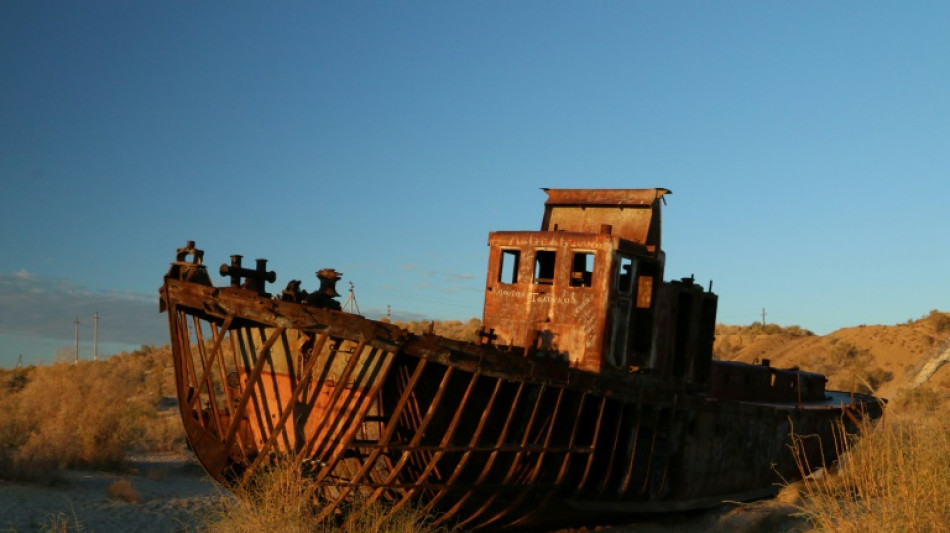
Half world's largest lakes and reservoirs drying up: study / Photo: Sebastien BERGER - AFP/File

 Where the US-China tariff row stands ahead of White House summit

 Indonesia cash-for-photos scheme turns animal hunters into protectors

 Argentine judge orders suspension of Falklands oil project

 US Fed raises rates to tackle 'too high' inflation, irking Trump

 Turkey releases 106 protesters, jails more LGBTQ activists

 Candidate for UN chief calls for AI regulation akin to nuclear weapons

 'We're losing control,' AI pioneer Yoshua Bengio tells AFP

 IR-MED and Dice Technologies Announce collaboration to Evaluate and Advance Pressure-Injury Prevention Platform in Japan

 Watts, Pitt, Cruz to light up Spain's top film festival

 Toogood Gold's Table Mountain Sits in the Shadow of a Nevada Gold Rush

 MEXC July–August Security Report: 38.66M USDT in Risk Funds Intercepted, Futures Insurance Fund Hits 792M USDT

 Emporio Armani names Dario Vitale new creative director

 EU to ban social media for under 13s, curb access until 15

 Wildfires push endangered Sumatran elephants to brink: Indonesian NGO

 Bank of Japan set to raise rates under pressure from inflation, US

 EU chief to unveil social media, gaming curbs for under-15s

 'Resident Evil' film brings video game's ethos to the big screen

 GA-ASI Mojave First UAS To Complete Battlefield Short Field Ops

 Sanders, Bannon warn of AI dangers in rare US left-right alignment

 Empty benches as schools reopen in Venezuela's quake-hit Guaira

 Tiny English village holds 'independence' vote over asylum seeker housing

 US Treasury chief says to meet Chinese counterpart at weekend

 BingX Evolves into a Multi-Asset Trading Platform, Connecting Users to Global Opportunities

 International Trading Institute Expands Professional Trader Development Beyond the Master’s in Trading

 Lake Energy Secures $80 Million for U.S. Renewable Energy Expansion

More than half of the world's largest lakes and reservoirs are dwindling and placing humanity's future water security at risk, with climate change and unsustainable consumption the main culprits, a study said Thursday.
"Lakes are in trouble globally, and it has implications far and wide," Balaji Rajagopalan, a professor at the University of Colorado Boulder and co-author of the paper, which appeared in Science, told AFP.
"It really caught our attention that 25 percent of the world's population is living in a lake basin that is on a declining trend," he continued, meaning some two billion people are impacted by the findings.
Unlike rivers, which have tended to hog scientific attention, lakes aren't well monitored, despite their critical importance for water security, said Rajagopalan.
But high profile environmental disasters in large water bodies like the Caspian Sea and the Aral Sea, signaled to researchers a wider crisis.
To study the question systematically, the team, which included scientists from the United States, France, and Saudi Arabia, looked at Earth's biggest 1,972 lakes and reservoirs, using observations from satellites from 1992-2020.
They focused on larger freshwater bodies because of the better accuracy of satellites at a larger scale, as well as their importance for humans and wildlife.
- 17 Lake Meads lost -
Their dataset merged images from Landsat, the longest-running Earth observation program, with water surface height acquired by satellite altimeters, to determine how lake volume varied over nearly 30 years.
The results: 53 percent of lakes and reservoirs saw a decline in water storage, at a rate of approximately 22 gigatonnes a year.
Over the whole period studied, 603 cubic kilometers of water (145 cubic miles) was lost, 17 times the water in Lake Mead, the United States' largest reservoir.
To find out what drove the trends, the team used statistical models incorporating climate and hydrologic trends to tease out natural and human-driven factors.
For natural lakes, much of the net loss was attributed to climate warming as well as human water consumption.
Increased temperatures from climate change drive evaporation, but can also decrease precipitation in some places.
"The climate signal pervades all factors," said Rajagopalan.
Lead author Fangfang Yao, a visiting fellow at CU Boulder, added in a statement: "Many of the human and climate change footprints on lake water losses were previously unknown, such as the desiccations of Lake Good-e-Zareh in Afghanistan and Lake Mar Chiquita in Argentina."
- Losses in humid regions, too -
One surprising aspect was that lakes in both wet and dry regions of the world are losing volume, suggesting the "dry gets drier, wet gets wetter" paradigm that is frequently used to summarize how climate change affects regions, doesn't always hold.
Losses were found in humid tropical lakes in the Amazon as well as Arctic lakes, demonstrating a trend more widely spread than predicted.
Accumulating sedimentation was blamed for storage loss in drying reservoirs.
But although most global lakes were dwindling, nearly a quarter saw significant increases in their water storage.
These included in the Tibetan Plateau, "where glacier retreat and permafrost thawing partially drove alpine lake expansion," the paper said.
Hilary Dugan, a scientist who studies freshwater systems at the University of Wisconsin-Madison and who wasn't involved in the study, told AFP the research advanced scientific understanding of lake volume variability, which is of "huge importance."
It is "unique in that it focuses on specific lakes, and reports the amount of water as a volume," she said.
But she added: "It's important to keep in mind that many water supplies are from small lakes and reservoirs," and future research should consider these too.
Globally, freshwater lakes and reservoirs store 87 percent of the planet's liquid freshwater, underscoring the urgency of new strategies for sustainable consumption and climate mitigation.
"If a good chunk of freshwater lakes are drying, then you're going to see the impact come to you one way or the other, if not now in the not too distant future," said Rajagopalan.
"So it behooves all of us to be good stewards."
Ng.A.Adebayo--CPN
