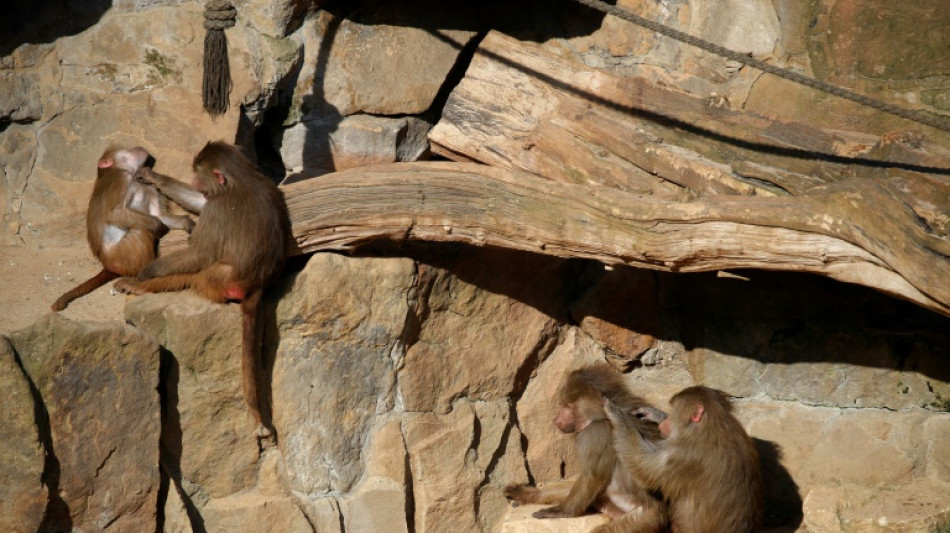
Adult friends help baboons conquer childhood trauma / Photo: Odd ANDERSEN - AFP

 Where the US-China tariff row stands ahead of White House summit

 Indonesia cash-for-photos scheme turns animal hunters into protectors

 Argentine judge orders suspension of Falklands oil project

 US Fed raises rates to tackle 'too high' inflation, irking Trump

 Turkey releases 106 protesters, jails more LGBTQ activists

 Candidate for UN chief calls for AI regulation akin to nuclear weapons

 'We're losing control,' AI pioneer Yoshua Bengio tells AFP

 IR-MED and Dice Technologies Announce collaboration to Evaluate and Advance Pressure-Injury Prevention Platform in Japan

 Watts, Pitt, Cruz to light up Spain's top film festival

 Toogood Gold's Table Mountain Sits in the Shadow of a Nevada Gold Rush

 MEXC July–August Security Report: 38.66M USDT in Risk Funds Intercepted, Futures Insurance Fund Hits 792M USDT

 Emporio Armani names Dario Vitale new creative director

 EU to ban social media for under 13s, curb access until 15

 Wildfires push endangered Sumatran elephants to brink: Indonesian NGO

 Bank of Japan set to raise rates under pressure from inflation, US

 EU chief to unveil social media, gaming curbs for under-15s

 'Resident Evil' film brings video game's ethos to the big screen

 GA-ASI Mojave First UAS To Complete Battlefield Short Field Ops

 Sanders, Bannon warn of AI dangers in rare US left-right alignment

 Empty benches as schools reopen in Venezuela's quake-hit Guaira

 Tiny English village holds 'independence' vote over asylum seeker housing

 US Treasury chief says to meet Chinese counterpart at weekend

 BingX Evolves into a Multi-Asset Trading Platform, Connecting Users to Global Opportunities

 International Trading Institute Expands Professional Trader Development Beyond the Master’s in Trading

 Lake Energy Secures $80 Million for U.S. Renewable Energy Expansion

Like humans, baboons get by with a little help from their friends.
Forming close social bonds as adults helps the primates triumph over childhood adversity and live longer, according to a new study.
The paper, published in Science Advances on Wednesday, drew on 36 years of data from nearly 200 of the Old World monkeys in the Amboseli National Park, in southern Kenya.
"It's like the saying from the King James Apocrypha, 'a faithful friend is the medicine of life,'" senior author Susan Alberts, a professor of biology and evolutionary anthropology at Duke University, said in a statement.
Baboons who had challenging youths were able to reclaim two years of life expectancy by forming close friendships, the study showed.
Research in humans has found that people who experience early trauma, such as having an alcoholic parent or growing up in an abusive home, are more likely to face an early grave.
But because these experiences are subjective and people's memories of the past are imperfect, wild primates, which share more than 90 percent of our DNA, are thought to be useful study subjects for better understanding humans.
For their research, Alberts and her co-authors focused on female baboons and tracked exposures to sources of childhood hardships, such as being born to a low-ranking mother, losing their mother young, being a drought year baby, or having to compete with many siblings for parental attention.
They found that the effect of such hardships was cumulative, with each additional exposure translating to 1.4 years of life lost.
And the impact wasn't just because such events led to greater social isolation as adults, as had been previously hypothesized. Rather, the survival dip was independently attributable to effects of early adversity.
But that didn't mean that baboons born under an unlucky star were destined to live short, miserable lives.
"Females who have bad early lives are not doomed," said first author Elizabeth Lange, an assistant professor at SUNY Oswego.
The team found that baboons who formed strong friendships, as measured by how often they groomed their closest associates, restored 2.2 years to their lives, regardless of early hardships.
"If you did have early life adversity, whatever you do, try to make friends," said Alberts.
A.Samuel--CPN
