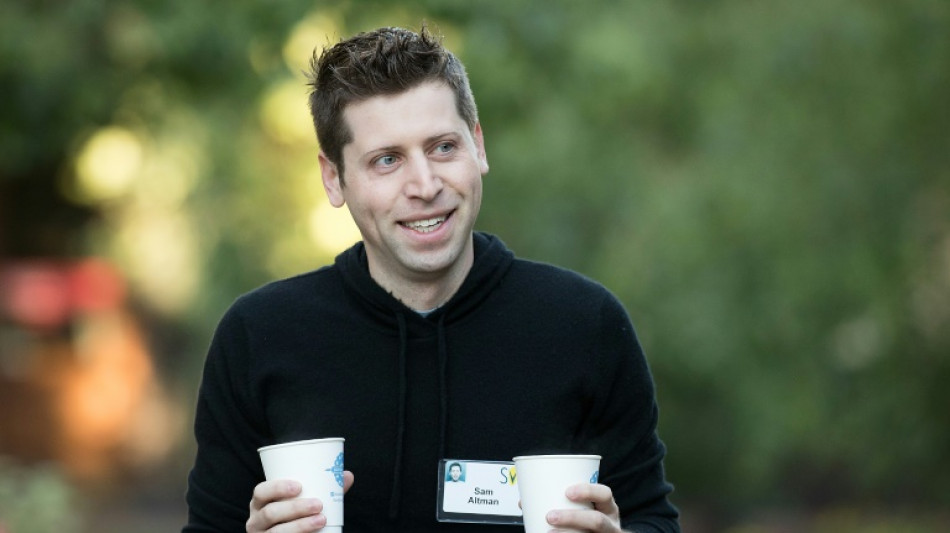
Sam Altman: the quick, deep thinker leading OpenAI / Photo: Drew Angerer - GETTY IMAGES NORTH AMERICA/AFP

 Where the US-China tariff row stands ahead of White House summit

 Indonesia cash-for-photos scheme turns animal hunters into protectors

 Argentine judge orders suspension of Falklands oil project

 US Fed raises rates to tackle 'too high' inflation, irking Trump

 Turkey releases 106 protesters, jails more LGBTQ activists

 Candidate for UN chief calls for AI regulation akin to nuclear weapons

 'We're losing control,' AI pioneer Yoshua Bengio tells AFP

 IR-MED and Dice Technologies Announce collaboration to Evaluate and Advance Pressure-Injury Prevention Platform in Japan

 Watts, Pitt, Cruz to light up Spain's top film festival

 Toogood Gold's Table Mountain Sits in the Shadow of a Nevada Gold Rush

 MEXC July–August Security Report: 38.66M USDT in Risk Funds Intercepted, Futures Insurance Fund Hits 792M USDT

 Emporio Armani names Dario Vitale new creative director

 EU to ban social media for under 13s, curb access until 15

 Wildfires push endangered Sumatran elephants to brink: Indonesian NGO

 Bank of Japan set to raise rates under pressure from inflation, US

 EU chief to unveil social media, gaming curbs for under-15s

 'Resident Evil' film brings video game's ethos to the big screen

 GA-ASI Mojave First UAS To Complete Battlefield Short Field Ops

 Sanders, Bannon warn of AI dangers in rare US left-right alignment

 Empty benches as schools reopen in Venezuela's quake-hit Guaira

 Tiny English village holds 'independence' vote over asylum seeker housing

 US Treasury chief says to meet Chinese counterpart at weekend

 BingX Evolves into a Multi-Asset Trading Platform, Connecting Users to Global Opportunities

 International Trading Institute Expands Professional Trader Development Beyond the Master’s in Trading

 Lake Energy Secures $80 Million for U.S. Renewable Energy Expansion

An influential Silicon Valley presence for more than a decade, OpenAI CEO Sam Altman is emerging as the tech titan of the AI age, riding the wave of ChatGPT, the bot his company unleashed on the world.
Altman testified Tuesday to a US Senate Judiciary Committee panel and said artificial intelligence could be at a "printing press" moment, which would make him one of its main pioneers.
In 2015, Altman joined Tesla chief Elon Musk and others in starting OpenAI, a research company with a stated goal of building generative AI that benefits humanity.
"The technological progress we make in the next 100 years will be far larger than all we've made since we first controlled fire and invented the wheel," Altman said in a 2021 blog post.
- Startup guru -
Born in 1985 into a Jewish family, Altman grew up in a St. Louis suburb, where he got his first computer at the age of eight, according to a long profile in the New Yorker from 2016.
Computers and the access to online community they enable helped him navigate being gay in a conservative part of the country, Altman said in an interview with Esquire.
Like so many tech figures before him, Altman dropped out of Stanford University to start a company, Loopt, which let smartphone users selectively share their whereabouts.
Loopt was acquired in 2012 in a deal valued at $43.4 million -- and Altman's place in Silicon Valley was secured.
Altman took a year off during which he "read many dozens of textbooks; I learned about the fields that I had been interested in," the San Francisco resident wrote in a post.
He told of learning about nuclear engineering, synthetic biology, investing, and AI.
"The seeds were planted for things that worked in deep ways later," he said.
- T-shirt and shorts -
In 2014, Altman became president of Y Combinator, an "accelerator" that provides startups with guidance and funding in exchange for stakes in the young companies.
Altman expanded Y Combinator's strategy for investing beyond software startups to biotech, energy, and other fields.
"He thinks quickly and talks quickly; intense, but in a good way," said Industrial Microbes founder Derek Greenfield, who met Altman while his biotech startup was getting backing from Y Combinator.
Greenfield recalled Altman always dressing casually, sometimes in a T-shirt and shorts.
"He was very down to earth," Greenfield said.
Altman left Y Combinator, putting his energy into artificial intelligence despite feared risks.
"He's a very deep thinker who is incredibly focused on getting things right," Insider Intelligence senior director of marketing and commerce Jeremy Goldman said.
Altman backed a "United Slate" political project in 2018 aimed at improving housing and healthcare policy.
He also held a fundraising event for 2020 US presidential candidate Andrew Yang, who advocated for universal basic income.
Yang "had some ideas about universal basic income that (he said) everybody needed, in part because AI was going to take the people's jobs," Goldman said.
Altman has proposed that combining artificial intelligence, robotics, and cost-free energy could essentially enable machines to do all the work and provide a "basic income" to adults across society.
"A great future isn't complicated: we need technology to create more wealth, and policy to fairly distribute it," Altman wrote in a blog post.
"Everything necessary will be cheap, and everyone will have enough money to be able to afford it."
'Fast cars and survival'
In the New Yorker article, Altman said he was a "prepper," someone who has preparations and supplies in place to survive an apocalyptic disaster.
He has spoken of owning high-performance sports cars and renting planes to fly around California.
Altman said in a blog post that the last day of each December he writes a list of things he wants to accomplish in the year ahead.
His personal investments include startups working on fusion energy and human life extension.
"I'm super optimistic," he said in a podcast with TED curator Chris Anderson.
"It's always easy to doom scroll and think about how bad things are," Altman added, "but the good things are really good and getting much better."
Y.Ibrahim--CPN
