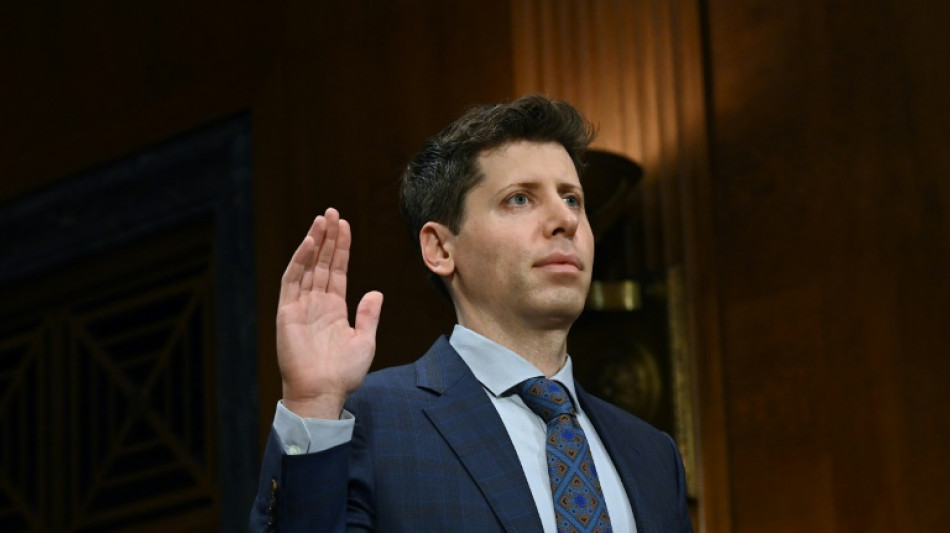
OpenAI CEO tells US senators regulation is 'critical' / Photo: ANDREW CABALLERO-REYNOLDS - AFP

 Where the US-China tariff row stands ahead of White House summit

 Indonesia cash-for-photos scheme turns animal hunters into protectors

 Argentine judge orders suspension of Falklands oil project

 US Fed raises rates to tackle 'too high' inflation, irking Trump

 Turkey releases 106 protesters, jails more LGBTQ activists

 Candidate for UN chief calls for AI regulation akin to nuclear weapons

 'We're losing control,' AI pioneer Yoshua Bengio tells AFP

 IR-MED and Dice Technologies Announce collaboration to Evaluate and Advance Pressure-Injury Prevention Platform in Japan

 Watts, Pitt, Cruz to light up Spain's top film festival

 Toogood Gold's Table Mountain Sits in the Shadow of a Nevada Gold Rush

 MEXC July–August Security Report: 38.66M USDT in Risk Funds Intercepted, Futures Insurance Fund Hits 792M USDT

 Emporio Armani names Dario Vitale new creative director

 EU to ban social media for under 13s, curb access until 15

 Wildfires push endangered Sumatran elephants to brink: Indonesian NGO

 Bank of Japan set to raise rates under pressure from inflation, US

 EU chief to unveil social media, gaming curbs for under-15s

 'Resident Evil' film brings video game's ethos to the big screen

 GA-ASI Mojave First UAS To Complete Battlefield Short Field Ops

 Sanders, Bannon warn of AI dangers in rare US left-right alignment

 Empty benches as schools reopen in Venezuela's quake-hit Guaira

 Tiny English village holds 'independence' vote over asylum seeker housing

 US Treasury chief says to meet Chinese counterpart at weekend

 BingX Evolves into a Multi-Asset Trading Platform, Connecting Users to Global Opportunities

 International Trading Institute Expands Professional Trader Development Beyond the Master’s in Trading

 Lake Energy Secures $80 Million for U.S. Renewable Energy Expansion

Sam Altman, the chief executive of ChatGPT's OpenAI, told US lawmakers on Tuesday that regulating artificial intelligence was essential, after his chatbot stunned the world.
The latest figure to erupt from Silicon Valley, Altman testified before a US Senate panel and urged Congress to impose new rules on big tech, despite deep political divisions that for years have blocked legislation aimed at regulating the internet.
But governments worldwide are under pressure to move quickly after the release of ChatGPT, a bot that can churn out human-like content in an instant, went viral and both wowed and spooked users.
Altman has since become the global face of AI as he both pushes out his company's technology, including to Microsoft, and warns that the work could have nefarious effects on society.
"OpenAI was founded on the belief that artificial intelligence has the potential to improve nearly every aspect of our lives, but also that it creates serious risks," Altman told a Senate judiciary subcommittee hearing.
He insisted that in time, generative AI developed by OpenAI one day will "address some of humanity's biggest challenges, like climate change and curing cancer."
However, given the risk to disinformation, jobs and other problems, "we think that regulatory intervention by governments will be critical to mitigate the risks of increasingly powerful models," he said.
Altman suggested the US government might consider a combination of licensing and testing requirements before the release of powerful AI models.
He also recommended labeling and increased global coordination in setting up rules over the technology.
"I think the US should lead here and do things first, but to be effective we do need something global," he added.
Subcommittee chairman Senator Richard Blumenthal opened the session by playing a recording of a convincing AI version of himself reading out remarks crafted by ChatGPT.
Artificial intelligence technologies "are more than just research experiments. They are no longer fantasies of science fiction, they are real and present," Blumenthal said.
Y.Ponomarenko--CPN
