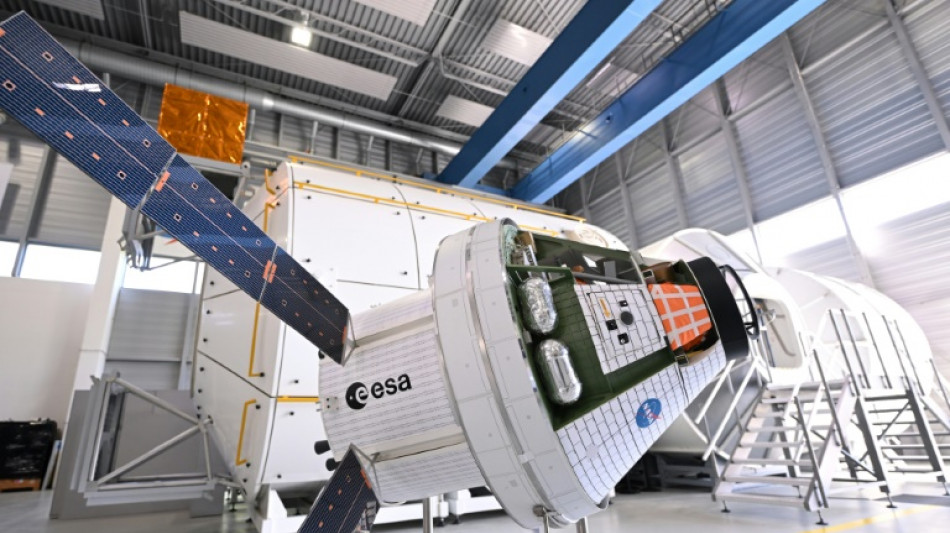
Prep in the pool for Europe's next astronauts / Photo: Ina FASSBENDER - AFP

 Where the US-China tariff row stands ahead of White House summit

 Indonesia cash-for-photos scheme turns animal hunters into protectors

 Argentine judge orders suspension of Falklands oil project

 US Fed raises rates to tackle 'too high' inflation, irking Trump

 Turkey releases 106 protesters, jails more LGBTQ activists

 Candidate for UN chief calls for AI regulation akin to nuclear weapons

 'We're losing control,' AI pioneer Yoshua Bengio tells AFP

 IR-MED and Dice Technologies Announce collaboration to Evaluate and Advance Pressure-Injury Prevention Platform in Japan

 Watts, Pitt, Cruz to light up Spain's top film festival

 Toogood Gold's Table Mountain Sits in the Shadow of a Nevada Gold Rush

 MEXC July–August Security Report: 38.66M USDT in Risk Funds Intercepted, Futures Insurance Fund Hits 792M USDT

 Emporio Armani names Dario Vitale new creative director

 EU to ban social media for under 13s, curb access until 15

 Wildfires push endangered Sumatran elephants to brink: Indonesian NGO

 Bank of Japan set to raise rates under pressure from inflation, US

 EU chief to unveil social media, gaming curbs for under-15s

 'Resident Evil' film brings video game's ethos to the big screen

 GA-ASI Mojave First UAS To Complete Battlefield Short Field Ops

 Sanders, Bannon warn of AI dangers in rare US left-right alignment

 Empty benches as schools reopen in Venezuela's quake-hit Guaira

 Tiny English village holds 'independence' vote over asylum seeker housing

 US Treasury chief says to meet Chinese counterpart at weekend

 BingX Evolves into a Multi-Asset Trading Platform, Connecting Users to Global Opportunities

 International Trading Institute Expands Professional Trader Development Beyond the Master’s in Trading

 Lake Energy Secures $80 Million for U.S. Renewable Energy Expansion

A new cohort of astronauts at the European Space Agency's training centre in Cologne, Germany, can expect to see time in both the pool and the classroom as they get ready to head into orbit.
Trainees dive into the water to emulate the experience of working in zero gravity, as well as studying a variety of subjects from medicine to geology.
The aim of the curriculum is to prepare the group for service on the International Space Station (ISS) and later on a potential mission to the moon.
"The biggest challenge is to learn so many different things in a very short period of time," British astronaut Rosemary Coogan, 31, told AFP in an interview.
Along with four other hopefuls, Coogan in April began the 13-month course and will have finished by May 2024.
By then, the group will know who among them will be the first to climb aboard the low-orbit station in 2026.
For French candidate Sophie Adenot, 40, the "variety of the training" is part of the pleasure.
"It is everything from theoretical science to operational training. I am astounded by everything we have done in the last month," she told AFP.
Graduates from the course could be headed for the moon, in the scope of the Artemis mission, which hopes to return astronauts to the rock within a decade and to establish a permanent base on Earth's natural satellite.
- Woman on the moon -
The current cohort of astronauts includes the highest number of women to date after a push by the ESA to make space travel less masculine.
The agency encouraged more women to apply for the opportunity to go to space. In all, almost a quarter of candidates in 2021 were women, up from 15 percent in the last round in 2008.
"More than just having women in the team, what is important is diverse backgrounds and professions," said Adenot.
"A doctor will have a different way of thinking than an engineer or a pilot... it's important to have various ways of thinking in the team," she said.
Adenot, herself a helicopter test pilot, is joined in the group by Swiss doctor Marco Sieber, Belgian neuroscientist Raphael Liegeois and Spanish aeronautical engineer Pablo Alvarez Fernandez.
In addition to the five candidates, the ESA has also appointed a "parastronaut" -- an astronaut with a handicap -- 41-year-old Briton John McFall, who will take part in the training.
McFall's presence will allow the ESA to study the feasibility of sending an astronaut with greater physical limitations into space.
- Pool time -
The training course seeks to prepare the future astronauts for any situation they could be confronted with in space.
In the pool, 10 metres underwater, the team practice what to do if a colleague falls ill in space and how to communicate with them.
"Astronauts have to have a very sound judgement," said Coogan.
"When you get to space, there are often very unpredictable things and it can be to do with your day-to-day activities or an emergency situation. And that’s where you need to stay calm."
After 13 months of training, only the candidate chosen to go to the ISS will begin a separate two-year programme tailored to the mission.
Despite the limited space onboard the rocket, the team at the ESA work well together.
"We are like a team of highly trained athletes. The demands of space missions are so high that you can only match them by working together," said Adenot.
"When one of us is selected for a mission, whether it is on the International Space Station or the moon, we will all be behind them."
O.Hansen--CPN
