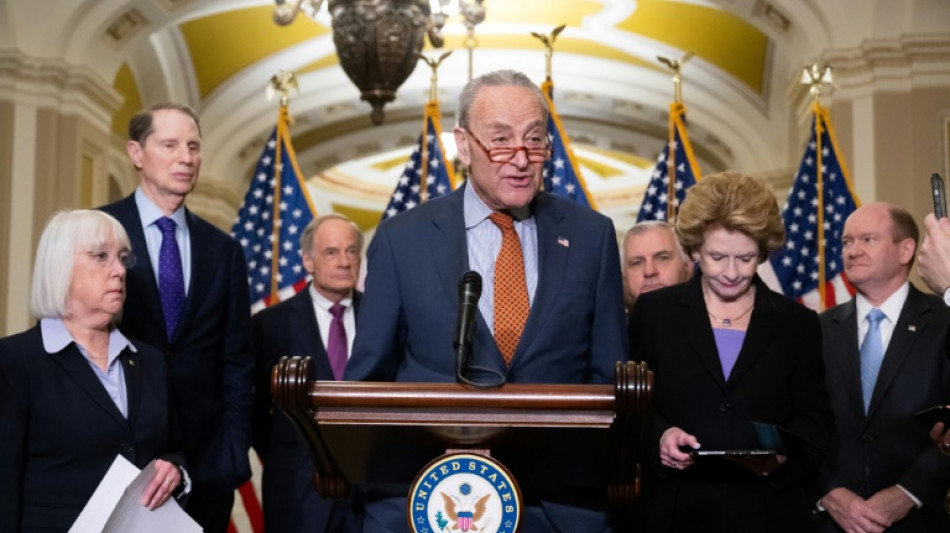
US senators launch renewed push to thwart China / Photo: SAUL LOEB - AFP

 Where the US-China tariff row stands ahead of White House summit

 Indonesia cash-for-photos scheme turns animal hunters into protectors

 Argentine judge orders suspension of Falklands oil project

 US Fed raises rates to tackle 'too high' inflation, irking Trump

 Turkey releases 106 protesters, jails more LGBTQ activists

 Candidate for UN chief calls for AI regulation akin to nuclear weapons

 'We're losing control,' AI pioneer Yoshua Bengio tells AFP

 IR-MED and Dice Technologies Announce collaboration to Evaluate and Advance Pressure-Injury Prevention Platform in Japan

 Watts, Pitt, Cruz to light up Spain's top film festival

 Toogood Gold's Table Mountain Sits in the Shadow of a Nevada Gold Rush

 MEXC July–August Security Report: 38.66M USDT in Risk Funds Intercepted, Futures Insurance Fund Hits 792M USDT

 Emporio Armani names Dario Vitale new creative director

 EU to ban social media for under 13s, curb access until 15

 Wildfires push endangered Sumatran elephants to brink: Indonesian NGO

 Bank of Japan set to raise rates under pressure from inflation, US

 EU chief to unveil social media, gaming curbs for under-15s

 'Resident Evil' film brings video game's ethos to the big screen

 GA-ASI Mojave First UAS To Complete Battlefield Short Field Ops

 Sanders, Bannon warn of AI dangers in rare US left-right alignment

 Empty benches as schools reopen in Venezuela's quake-hit Guaira

 Tiny English village holds 'independence' vote over asylum seeker housing

 US Treasury chief says to meet Chinese counterpart at weekend

 BingX Evolves into a Multi-Asset Trading Platform, Connecting Users to Global Opportunities

 International Trading Institute Expands Professional Trader Development Beyond the Master’s in Trading

 Lake Energy Secures $80 Million for U.S. Renewable Energy Expansion

US senators announced a major cross-party effort Wednesday to combat China's growing global influence by limiting the flow of investment and state-of-the-art technology to the Asian giant while deterring any potential threat to Taiwan.
The push comes after President Joe Biden signed a package last year aimed at boosting competition with Washington's main economic rival, with $52 billion in new subsidies for microchip manufacturing and scientific research.
Launching the latest legislative drive in the Democratic-led Senate, majority leader Chuck Schumer framed the fight to rein in President Xi Jinping's Chinese Communist Party (CCP) as an epochal struggle.
"The Chinese government is not constraining itself in its pursuit to dominate the 21st century, and if we in America were to rest on our laurels, if we let the CCP beat us, it would have serious consequences for the world's democratic nations," he said.
"The United States cannot afford to cede its leadership to governments opposed to democracy and individual liberty. We cannot let authoritarianism call the shots in the 21st century."
Schumer and 11 of his most senior lieutenants held a news conference to outline a five-step plan aimed at addressing competition from China, which has seen its economy grow more than tenfold since the turn of the century.
- Rare rebuke -
The New York Democrat said lawmakers would look at export controls and sanctions limiting Beijing's ability to acquire -- "and even steal" -- US innovations in artificial intelligence, quantum computing and other advanced tech.
The US Treasury and Commerce Department would get new authority to screen and halt the flow of cash to China's high tech industries, he added.
The drive will also look at assisting small business, building a US workforce "for the future" and strengthening the process for assessing the national security implications of inward foreign investments.
Relations between Beijing and Washington have been declining steadily for years, with the rivals locking horns over trade, human rights and the origins of Covid-19.
A planned visit by US Secretary of State Antony Blinken in February was canceled after the United States shot down a Chinese balloon it said was conducting surveillance over US territory -- a claim strenuously denied by Beijing.
Chinese diplomats have kept up a steady drumbeat of criticism against the Biden administration, and Xi himself made a rare direct rebuke of Washington in March, accusing "Western countries led by the United States" of trying to undermine his country.
Meanwhile Washington has been a critic of the Chinese Belt and Road Initiative -- which has invested $840 billion in roads, bridges, ports and hospitals in more than 150 nations over a decade -- arguing that it lures poor countries into debt traps with huge, unaffordable loans.
- 'Helping hand' -
Schumer said the United States and its allies were ready to cooperate on providing an alternative infrastructure funding source that "actually benefits those countries looking for a helping hand."
The final element of the push will be proposals to deter Chinese aggression against Taiwan, a self-ruling democracy claimed by Beijing and, crucially, the global leader in manufacturing high-end microchips.
Schumer did not offer specifics but said the plan would build on bipartisan proposals from the Senate Foreign Relations Committee, which last year approved $4.5 billion for Taipei's defense over four years and affirmed Biden's power to levy sanctions on Chinese officials and financial institutions involved in actions against the island.
The Senate's committee chairs will spend the coming months working with their Republican counterparts to craft various packages of legislation to achieve the goals set out Wednesday.
"Bottom line: time is not on our side. The Xi Regime is working every day to catch up and surpass the United States," Schumer said.
"There is no reason our two parties here in the Congress... can't come together and send a strong message to the Chinese government that we're united in this pressing national security effort and we are committed to maintaining America's lead in the future."
X.Cheung--CPN
