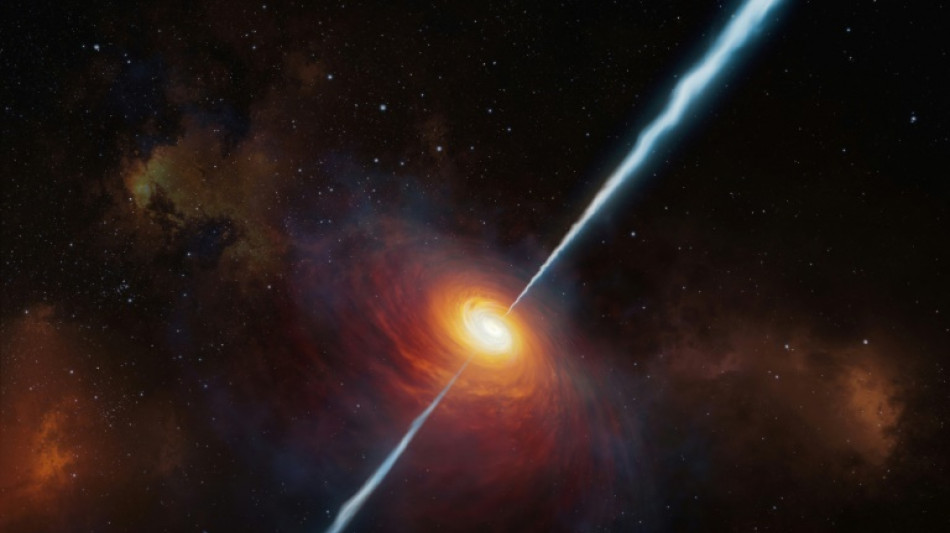
Milky Way's fate? Astronomers reveal what ignites quasars / Photo: M. KORNMESSER - European Southern Observatory/AFP

 Where the US-China tariff row stands ahead of White House summit

 Indonesia cash-for-photos scheme turns animal hunters into protectors

 Argentine judge orders suspension of Falklands oil project

 US Fed raises rates to tackle 'too high' inflation, irking Trump

 Turkey releases 106 protesters, jails more LGBTQ activists

 Candidate for UN chief calls for AI regulation akin to nuclear weapons

 'We're losing control,' AI pioneer Yoshua Bengio tells AFP

 IR-MED and Dice Technologies Announce collaboration to Evaluate and Advance Pressure-Injury Prevention Platform in Japan

 Watts, Pitt, Cruz to light up Spain's top film festival

 Toogood Gold's Table Mountain Sits in the Shadow of a Nevada Gold Rush

 MEXC July–August Security Report: 38.66M USDT in Risk Funds Intercepted, Futures Insurance Fund Hits 792M USDT

 Emporio Armani names Dario Vitale new creative director

 EU to ban social media for under 13s, curb access until 15

 Wildfires push endangered Sumatran elephants to brink: Indonesian NGO

 Bank of Japan set to raise rates under pressure from inflation, US

 EU chief to unveil social media, gaming curbs for under-15s

 'Resident Evil' film brings video game's ethos to the big screen

 GA-ASI Mojave First UAS To Complete Battlefield Short Field Ops

 Sanders, Bannon warn of AI dangers in rare US left-right alignment

 Empty benches as schools reopen in Venezuela's quake-hit Guaira

 Tiny English village holds 'independence' vote over asylum seeker housing

 US Treasury chief says to meet Chinese counterpart at weekend

 BingX Evolves into a Multi-Asset Trading Platform, Connecting Users to Global Opportunities

 International Trading Institute Expands Professional Trader Development Beyond the Master’s in Trading

 Lake Energy Secures $80 Million for U.S. Renewable Energy Expansion

Astronomers said Wednesday that for the first time they have confirmed what ignites quasars, the brightest and most powerful objects in the universe, which put galaxies in their "death throes".
These celestial behemoths form when two galaxies smash into each other, the astronomers said, warning that this could be the Milky Way's fate in a few billion years.
Quasars are one of the most extreme objects in the universe, some shining with the brightness of a trillion stars despite being packed into the space of our Solar System.
They sit in the heart of galaxies, powered by supermassive black holes, requiring a huge amount of gas to be so staggeringly bright.
But exactly what creates quasars has been a matter of debate since their discovery in the 1950s.
In a new study, an international team of researchers said they have "clear evidence" that quasars are triggered by two galaxies colliding, which releases the vast amounts of energy needed.
Clive Tadhunter, an astrophysicist at the University of Sheffield in the UK and one of the study's authors, told AFP that this could be the fate of the Milky Way one day.
The nearby Andromeda Galaxy is "coming directly towards us at about 200 kilometres (125 miles) a second," he said.
It will collide with the Milky War in roughly five billion years, and "we could get a quasar" as a result, he said.
Quasars push out all the gas from a galaxy, preventing any new stars from forming, he added.
- 'Beacons to the distant universe' -
The researchers compared observations of 48 galaxies with quasars at their centre to 100 without them.
Galaxies hosting quasars were three times as likely to have had collisions with other galaxies, the study said.
While the theory that such collisions ignited quasars has been around for decades, it was difficult to prove.
Tadhunter said this was because observations had often been carried out with telescopes that were optimised to look at objects in the centre of galaxies, but were less effective at spotting the distorted features at their edges that indicate past collisions.
For example, these diffuse structures "get washed out" when observed by the Hubble Space Telescope, he said.
So the team used land-based observatories, such as the Isaac Newton Telescope on the Spanish island of La Palma.
The new study, published in the Monthly Notices of the Royal Astronomical Society, also reviewed previous research to show how it may have missed the tell-tale signs of collisions.
Tadhunter said that quasars "act like beacons to the distant universe" because of their incredible brightness.
The James Webb Space Telescope, which has a much bigger aperture than Hubble, could help reveal more about quasars in this distant universe, when the universe was in its infancy, he said.
M.Anderson--CPN