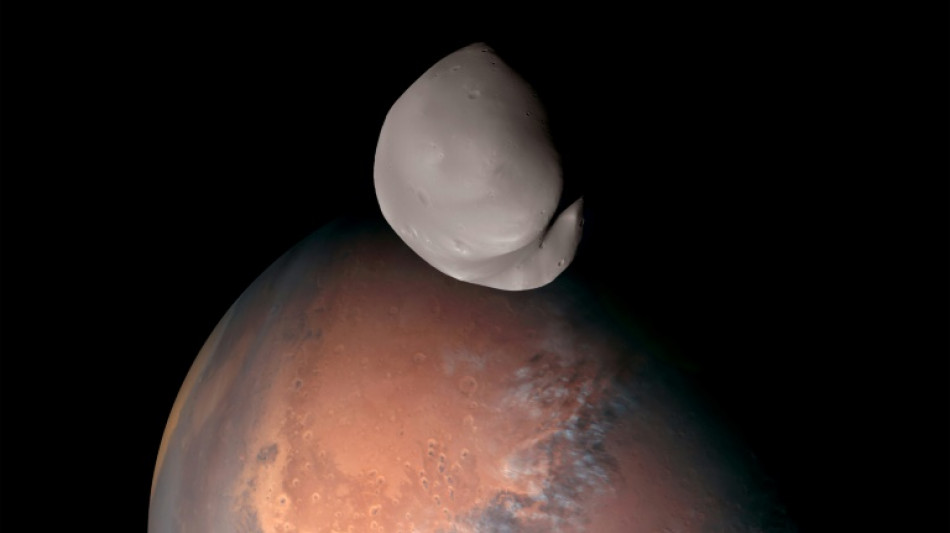
UAE probe offers unprecedented view of Mars moon / Photo: - - Emirates Mars Mission/AFP

 Where the US-China tariff row stands ahead of White House summit

 Indonesia cash-for-photos scheme turns animal hunters into protectors

 Argentine judge orders suspension of Falklands oil project

 US Fed raises rates to tackle 'too high' inflation, irking Trump

 Turkey releases 106 protesters, jails more LGBTQ activists

 Candidate for UN chief calls for AI regulation akin to nuclear weapons

 'We're losing control,' AI pioneer Yoshua Bengio tells AFP

 IR-MED and Dice Technologies Announce collaboration to Evaluate and Advance Pressure-Injury Prevention Platform in Japan

 Watts, Pitt, Cruz to light up Spain's top film festival

 Toogood Gold's Table Mountain Sits in the Shadow of a Nevada Gold Rush

 MEXC July–August Security Report: 38.66M USDT in Risk Funds Intercepted, Futures Insurance Fund Hits 792M USDT

 Emporio Armani names Dario Vitale new creative director

 EU to ban social media for under 13s, curb access until 15

 Wildfires push endangered Sumatran elephants to brink: Indonesian NGO

 Bank of Japan set to raise rates under pressure from inflation, US

 EU chief to unveil social media, gaming curbs for under-15s

 'Resident Evil' film brings video game's ethos to the big screen

 GA-ASI Mojave First UAS To Complete Battlefield Short Field Ops

 Sanders, Bannon warn of AI dangers in rare US left-right alignment

 Empty benches as schools reopen in Venezuela's quake-hit Guaira

 Tiny English village holds 'independence' vote over asylum seeker housing

 US Treasury chief says to meet Chinese counterpart at weekend

 BingX Evolves into a Multi-Asset Trading Platform, Connecting Users to Global Opportunities

 International Trading Institute Expands Professional Trader Development Beyond the Master’s in Trading

 Lake Energy Secures $80 Million for U.S. Renewable Energy Expansion

The United Arab Emirates' Hope space probe on Monday revealed Mars' smaller moon Deimos in unprecedented detail, shedding new light on the origin of the mysterious lumpy satellite.
The probe, the Arab world's first interplanetary mission, has been orbiting Mars for two years, regularly flying past Deimos and its big sibling moon Phobos.
It came within 110 kilometres (68 miles) from Deimos, a rocky object the shape of a bean just 12 kilometres wide, according to the Emirates Mars Mission (EMM).
The probe -- named "Al-Amal", Arabic for "Hope" -- sent back to Earth the most precise images and observations of the moon ever captured, using instruments that measure the infrared and ultraviolet wavelengths.
It also observed for the first time the far side of the moon, revealing regions whose compositions have never been studied, the mission said.
The probe could also prompt new debate over how exactly the strange moons ended up in the Martian orbit.
"We are unsure of the origins of both Phobos and Deimos," the EMM's science lead Hessa Al Matroushi said in a statement.
One leading theory is that the two moons were once asteroids passing by when they were unexpectedly captured into the orbit of Mars.
But Al Matroushi said that "our close observations of Deimos so far point to a planetary origin".
Christopher Edwards, a scientist in charge of one of the probe's instruments, said that "both of these bodies have infrared properties more akin to a basaltic Mars" than an asteroid.
That could mean the rocky bodies were once part of Mars, and were potentially shot out into orbit by a massive impact.
- Mission extended -
UAE Prime Minister Sheikh Mohammed bin Rashid Al Maktoum tweeted that the probe "refutes" the theory that the moon was once an asteroid.
Instead it showed that the moon was once part of Mars then "separated from it millions of years ago," similar to how our own Moon is thought to have once been part of Earth, he said.
The UAE Space Agency announced that it was extending the mission for another year, during which Hope will continue to fly past Deimos and collect more data.
The probe launched in 2020 and arrived in Mars' orbit in 2021.
It has an unparalleled view of Deimos because it orbits at a greater distance than other Mars missions, aiming to get a comprehensive image of the red planet's weather dynamics.
That makes it much closer to the wide orbit of Deimos, which spins some 23,000 kilometres from Mars.
The UAE is also planning to land an uncrewed rover on the Moon next year.
H.Cho--CPN