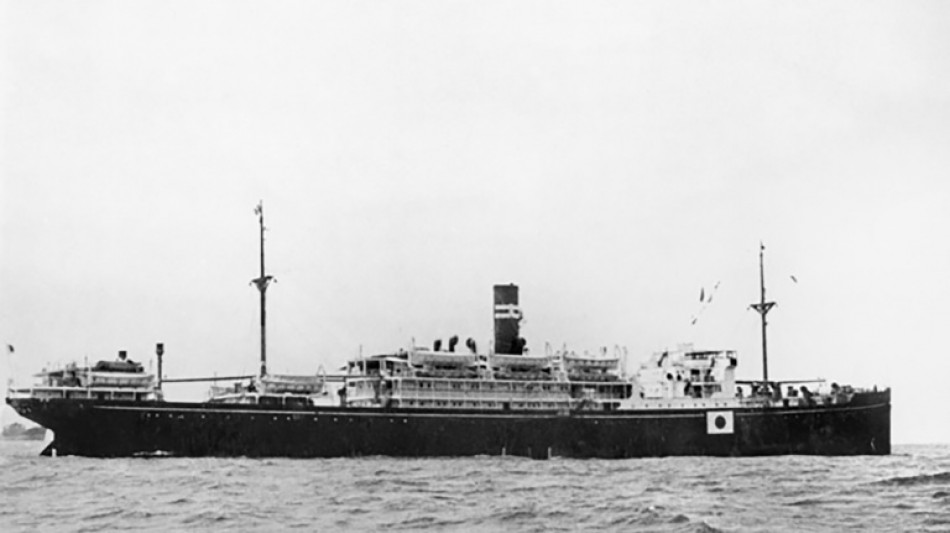
WWII wreck on which nearly 1,000 Australians died found / Photo: Handout - Australian War Memorial/AFP

 Where the US-China tariff row stands ahead of White House summit

 Indonesia cash-for-photos scheme turns animal hunters into protectors

 Argentine judge orders suspension of Falklands oil project

 US Fed raises rates to tackle 'too high' inflation, irking Trump

 Turkey releases 106 protesters, jails more LGBTQ activists

 Candidate for UN chief calls for AI regulation akin to nuclear weapons

 'We're losing control,' AI pioneer Yoshua Bengio tells AFP

 IR-MED and Dice Technologies Announce collaboration to Evaluate and Advance Pressure-Injury Prevention Platform in Japan

 Watts, Pitt, Cruz to light up Spain's top film festival

 Toogood Gold's Table Mountain Sits in the Shadow of a Nevada Gold Rush

 MEXC July–August Security Report: 38.66M USDT in Risk Funds Intercepted, Futures Insurance Fund Hits 792M USDT

 Emporio Armani names Dario Vitale new creative director

 EU to ban social media for under 13s, curb access until 15

 Wildfires push endangered Sumatran elephants to brink: Indonesian NGO

 Bank of Japan set to raise rates under pressure from inflation, US

 EU chief to unveil social media, gaming curbs for under-15s

 'Resident Evil' film brings video game's ethos to the big screen

 GA-ASI Mojave First UAS To Complete Battlefield Short Field Ops

 Sanders, Bannon warn of AI dangers in rare US left-right alignment

 Empty benches as schools reopen in Venezuela's quake-hit Guaira

 Tiny English village holds 'independence' vote over asylum seeker housing

 US Treasury chief says to meet Chinese counterpart at weekend

 BingX Evolves into a Multi-Asset Trading Platform, Connecting Users to Global Opportunities

 International Trading Institute Expands Professional Trader Development Beyond the Master’s in Trading

 Lake Energy Secures $80 Million for U.S. Renewable Energy Expansion

Deep-sea explorers said Saturday they had located the wreck of a World War II Japanese transport ship, the Montevideo Maru, which was torpedoed off the Philippines killing nearly 1,000 Australians aboard.
The ship -- sunk on July 1, 1942, by a US submarine whose crew did not realise it carried prisoners of war -- was found at a depth of more than four kilometres (2.5 miles), said the maritime archaeology group Silentworld Foundation, which organised the mission.
The sinking of the Montevideo Maru was Australia's worst-ever maritime disaster, killing an estimated 979 Australian citizens including at least 850 troops.
Civilians from 13 other countries were also aboard, the foundation said, bringing the total number of prisoners killed to about 1,060.
They had been captured a few months earlier by Japanese forces in the fall of the coastal township of Rabaul in Papua New Guinea.
"At long last, the resting place of the lost souls of the Montevideo Maru has been found," Prime Minister Anthony Albanese said.
"Among the 1,060 prisoners on board were 850 Australian service members –- their lives cut short," he said on social media.
"We hope today's news brings a measure of comfort to loved ones who have kept a long vigil."
After five years of planning, explorers began searching for the wreck on April 6 in the South China Sea northwest of the Philippines' main island of Luzon.
They made a positive sighting just 12 days later using high-tech equipment including an autonomous underwater vehicle equipped with sonar.
The wreckage will remain undisturbed on the seabed, where it lies at a greater depth than the Titanic, out of respect for the families of those who perished, the foundation said. No artefacts or human remains are to be removed.
- 'Terrible chapter' -
"The discovery of the Montevideo Maru closes a terrible chapter in Australian military and maritime history," said John Mullen, director of Silentworld, which conducted the hunt with Dutch deep sea survey firm Fugro along with help from the Australian military.
"Families waited for years for news of their missing loved ones before learning of the tragic outcome of the sinking," Mullen said.
"Some never fully came to accept that their loved ones were among the victims."
Andrea Williams, an Australian whose grandfather and great-uncle were civilian internees who perished on the ship, was part of the mission that found the vessel.
She said it was an "extraordinarily momentous day" for Australians connected with the disaster.
"I could never understand why it was not a more powerful part of our Australian WWII history," Williams said in a statement.
Australia's chief of army, Lieutenant General Simon Stuart, said finding the wreck had ended 81 years of uncertainty for the loved ones of those lost.
"A loss like this reaches down through the decades and reminds us all of the human cost of conflict," he said.
Others who perished aboard the Montevideo Maru included 33 crew from the Norwegian freighter the Herstein and about 20 Japanese guards and crew, the foundation said.
Other countries affected by the sinking included Britain, Denmark, Estonia, Finland, Ireland, the Netherlands, New Zealand, Solomon Islands, Sweden and the United States, it said.
A.Mykhailo--CPN