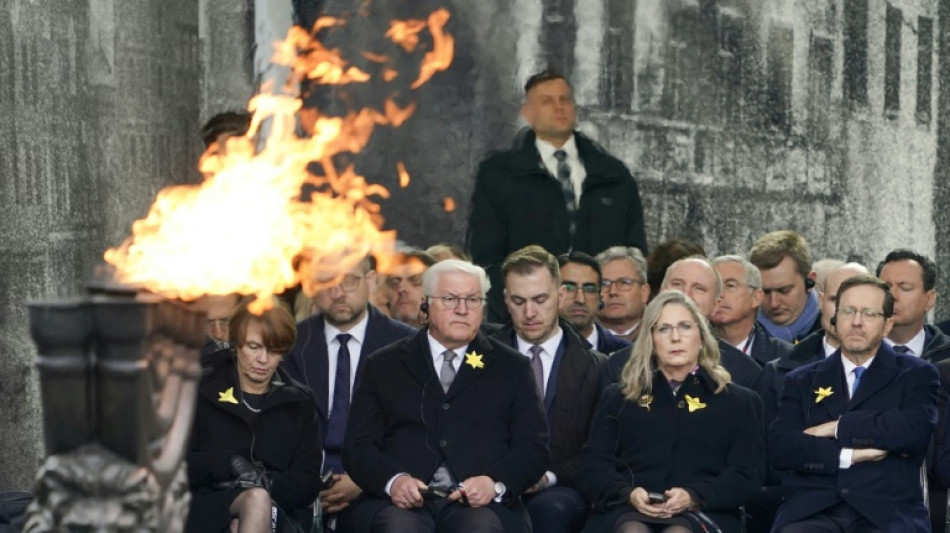
German president asks forgiveness on Warsaw ghetto anniversary / Photo: JANEK SKARZYNSKI - AFP

 Where the US-China tariff row stands ahead of White House summit

 Indonesia cash-for-photos scheme turns animal hunters into protectors

 Argentine judge orders suspension of Falklands oil project

 US Fed raises rates to tackle 'too high' inflation, irking Trump

 Turkey releases 106 protesters, jails more LGBTQ activists

 Candidate for UN chief calls for AI regulation akin to nuclear weapons

 'We're losing control,' AI pioneer Yoshua Bengio tells AFP

 IR-MED and Dice Technologies Announce collaboration to Evaluate and Advance Pressure-Injury Prevention Platform in Japan

 Watts, Pitt, Cruz to light up Spain's top film festival

 Toogood Gold's Table Mountain Sits in the Shadow of a Nevada Gold Rush

 MEXC July–August Security Report: 38.66M USDT in Risk Funds Intercepted, Futures Insurance Fund Hits 792M USDT

 Emporio Armani names Dario Vitale new creative director

 EU to ban social media for under 13s, curb access until 15

 Wildfires push endangered Sumatran elephants to brink: Indonesian NGO

 Bank of Japan set to raise rates under pressure from inflation, US

 EU chief to unveil social media, gaming curbs for under-15s

 'Resident Evil' film brings video game's ethos to the big screen

 GA-ASI Mojave First UAS To Complete Battlefield Short Field Ops

 Sanders, Bannon warn of AI dangers in rare US left-right alignment

 Empty benches as schools reopen in Venezuela's quake-hit Guaira

 Tiny English village holds 'independence' vote over asylum seeker housing

 US Treasury chief says to meet Chinese counterpart at weekend

 BingX Evolves into a Multi-Asset Trading Platform, Connecting Users to Global Opportunities

 International Trading Institute Expands Professional Trader Development Beyond the Master’s in Trading

 Lake Energy Secures $80 Million for U.S. Renewable Energy Expansion

Germany's president on Wednesday sought pardon for his nation's World War II crimes in comments on the Warsaw Ghetto Uprising anniversary in Poland's capital.
Frank-Walter Steinmeier, the first German president to speak at the commemorations, joined Polish and Israeli heads of state to mark 80 years since Jewish insurgents' doomed uprising against Nazi German occupiers.
"I stand before you today and ask for your forgiveness for the crimes committed by Germans here," said Steinmeier, speaking at the annual ceremony held in Warsaw's former Jewish district.
The German president also blasted his Russian counterpart Vladimir Putin for waging war against Ukraine.
"With his illegal attack on a peaceful, democratic neighbouring country... the Russian president has broken international law," Steinmeier said.
The official ceremony took place at the Monument to the Ghetto Heroes, which is located at the site of several of the uprising's armed clashes.
- 'Absolute evil' -
The Warsaw Jews launched their armed revolt against the Nazis on April 19, 1943, preferring to die fighting than to be sent to a death camp.
It was the largest single act of Jewish resistance against the Germans during World War II.
"We must remember," Israeli President Isaac Herzog said, adding that Holocaust memory is not relative.
"Absolute evil existed, in the form of the Nazis and their accomplices. And absolute good existed, in the form of the victims and the rebels, from every nation," Herzog said.
Around 7,000 Jews are estimated to have died in the battles and another 6,000 in the fires started by the Nazis in the ghetto.
"The revolt was suicide. We couldn't win, but we had to do them harm," ghetto survivor Halina Birenbaum, 93, told AFP ahead of the anniversary.
Earlier on Wednesday, church bells and sirens sounded across the Polish capital as volunteers across the city handed out paper daffodils for residents to pin to their jackets.
The tradition is in honour of Marek Edelman, an uprising commander who, until his death in 2009, would mark the anniversary by depositing a bouquet of the flowers at the memorial.
Because of their colour and form, daffodils resemble the yellow stars Jews were forced to wear by the Nazis.
This year, the paper daffodils are also being distributed in other Polish cities.
- 450,000 Jews -
"We hope to hand out a total of 450,000 paper flowers," said Zofia Bojanczyk, coordinator of the daffodil initiative.
"The figure symbolises the number of Jewish women and men confined to the Warsaw Ghetto when it was at its most crowded," she told reporters.
One year after they invaded Poland in 1939, the Germans set up the ghetto in a space of just over three square kilometres (1.2 square miles).
It was the largest of the World War II ghettos.
Many Jews died inside of starvation and disease, while most of the rest were sent to the Treblinka death camp to the east of the Polish capital.
At the outbreak of the uprising, around 50,000 civilians were still hiding in cellars and bunkers in the ghetto.
The Germans put down the uprising with extreme brutality and set fire to the entire district, turning it to rubble and ash.
- Civilians -
Various events are on the agenda for the 80th anniversary, including talks by survivors, concerts, film screenings and theatre performances.
The Kordegarda gallery has an exhibition of everyday items from the ghetto, which were recently unearthed and tell the story of how Jews in wartime Warsaw lived, loved and died.
"These are, so to speak, voices from the buried city, calling from beneath our feet," co-curator Jacek Konik told AFP.
A separate display, at the Polin Museum of the History of Polish Jews, features never-before-seen photos of the ghetto taken by a Polish firefighter.
They offer a different perspective, as until now most images of the ghetto were shot by the Nazis and showed it through German eyes.
A reconstructed version of the wartime tram for ghetto residents, which had a yellow star instead of the route number, will also be on display.
Ng.A.Adebayo--CPN