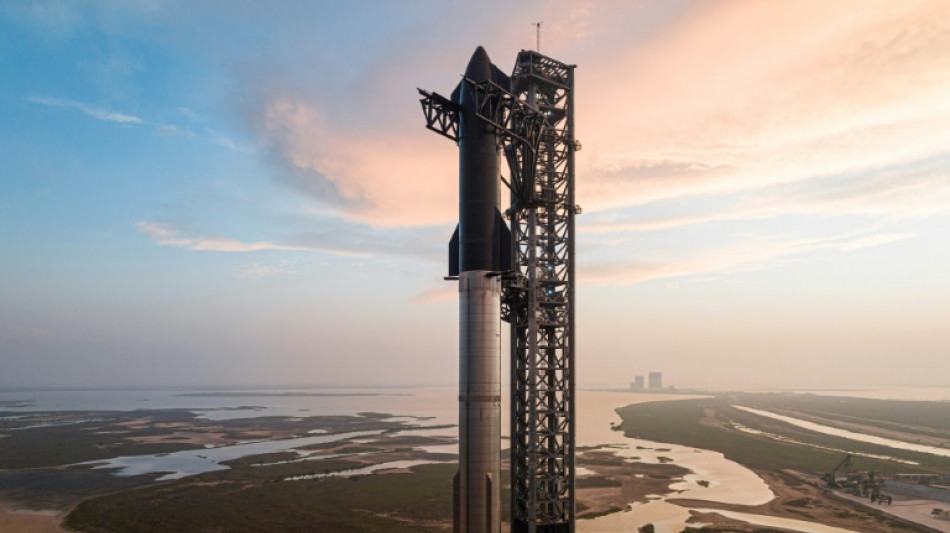
SpaceX Starship, world's biggest rocket, set for first test flight / Photo: - - SPACEX/AFP

 UK-Sudanese author pens book to give children 'African history of Africa'

 US Congress passes sweeping Russia sanctions bill

 US stocks fall, dollar gains after Fed lifts interest rates

 US Fed raises rates to tackle 'too high' inflation in move sure to rile Trump

 US Fed raises rates to battle inflation in move likely to rile Trump

 US House faces test on sweeping Russia sanctions bill

 British PM says to make 'difficult decisions' as inflation rises

 Global fuel price demos: a round-up

 Leverate Launches MCP for Traders to Connect AI Assistants With Trading Platforms

 MEXC Launches $1M "Discover Your Wall Street DNA" Campaign to Help Traders Find Their Market Fit

 Stocks edge higher ahead of US Fed rate call

 BASIS.pro Expands On-Chain Infrastructure with XDC Network Partnership and Zypher DAO as Auto Earn Goes Live

 Pickle-flavoured tart? AI inspires Japan's convenience stores

 EU chief hosts Canada's Carney in push to 'deepen' alliance

 Meta chief pushes back on AI slowdown calls

 US Fed to deliver rate decision with markets betting on hike

 i-payout Expands U.S. Money Transmitter Licensing Footprint and Advances European EMI Strategy

 US Senate crypto bill collapses amid partisan deadlock

 OpenAI, Anthropic and Google are working to create an AI standards body

 Protesting shepherds, farmers clash with Romanian police

 Foundation Lets Ledger Users Switch to Open Source Without Starting Over

 EU to propose curbing social media, online games for under 15s

 FX Junction Reaches 40,600 Members and 26 Million Trades

 'We unleashed the beast': the world's fears and hopes about AI

 Hospitality leaders ask Burnham to halve VAT amid rising costs

SpaceX is counting down to the first test flight on Monday of Starship, the most powerful rocket ever built, designed to send astronauts to the Moon and Mars and beyond.
The giant rocket is scheduled to blast off from Starbase, the SpaceX spaceport in Boca Chica, Texas, at 8:00 am Central Time (1300 GMT).
Fallback times are scheduled for later in the week if Monday's launch attempt is delayed -- something billionaire SpaceX founder Elon Musk said is a distinct possibility.
"It's a very risky flight," Musk said in a live event on Twitter Spaces on Sunday. "It's the first launch of a very complicated, gigantic rocket.
"There's a million ways this rocket could fail," he added. "We're going to be very careful and if we see anything that gives us concern, we'll postpone."
Musk said he wanted to "set expectations low" because "probably tomorrow will not be successful -- if by successful one means reaching orbit."
The US space agency NASA has picked the Starship spacecraft to ferry astronauts to the Moon in late 2025 -- a mission known as Artemis III -- for the first time since the Apollo program ended in 1972.
Starship consists of a 164-foot (50-meter) tall spacecraft designed to carry crew and cargo that sits atop a 230-foot tall first-stage Super Heavy booster rocket.
Collectively referred to as Starship, the spacecraft and the Super Heavy rocket have never flown in combination together, although there have been several sub-orbital test flights of the spacecraft alone.
If all goes according to plan, the Super Heavy booster will separate from Starship about three minutes after launch and splash down in the Gulf of Mexico.
Starship, which has six engines of its own, will continue to an altitude of nearly 150 miles, completing a near-circle of the Earth before splashing down in the Pacific Ocean about 90 minutes after launch.
"If it gets to orbit, that's a massive success," Musk said.
"If we get far enough away from the launchpad before something goes wrong then I think I would consider that to be a success," he said. "Just don't blow up the launchpad.
"The payload for this mission is information," he said. "Information that allows us to improve the design of future Starship builds."
- 'Multi-planet civilization' -
SpaceX conducted a successful test-firing of the 33 Raptor engines on the first-stage booster of Starship in February.
The Super Heavy booster was anchored to the ground during the test-firing, called a static fire, to prevent it from lifting off.
NASA will take astronauts to lunar orbit itself in November 2024 using its own heavy rocket called the Space Launch System (SLS), which has been in development for more than a decade.
Starship is both bigger and more powerful than SLS.
It generates 17 million pounds of thrust, more than twice that of the Saturn V rockets used to send Apollo astronauts to the Moon.
SpaceX foresees eventually putting a Starship into orbit, and then refueling it with another Starship so it can continue on a journey to Mars or beyond.
Musk said the goal is to make Starship reusable and bring down the price to a few million dollars per flight.
"In the long run -- long run meaning, I don't know, two or three years -- we should achieve full and rapid reusability," he said.
The eventual objective is to establish bases on the Moon and Mars and put humans on the "path to being a multi-planet civilization," Musk said.
"We are at this brief moment in civilization where it is possible to become a multi-planet species," he said. "That's our goal. I think we've got a chance."
J.Bondarev--CPN