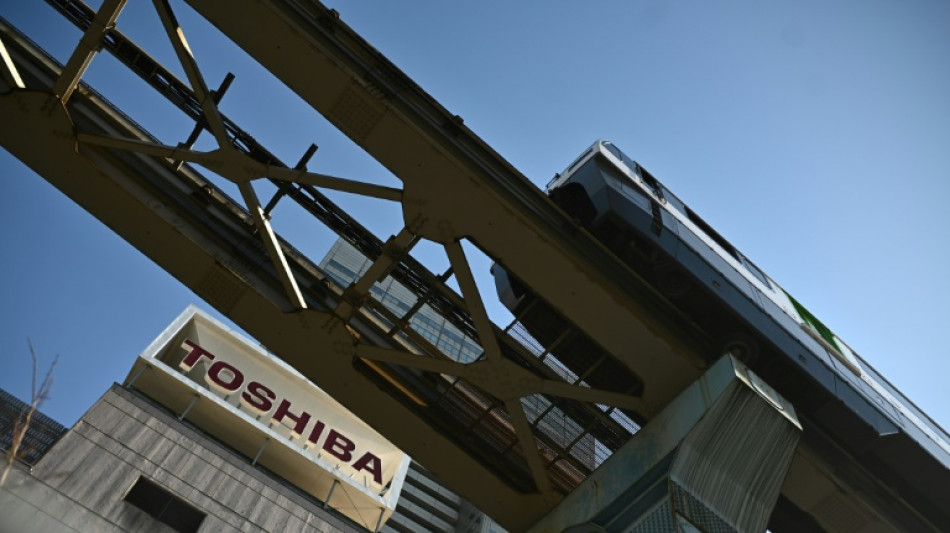
Toshiba: Japan's troubled megacorp

 Wildfires push endangered Sumatran elephants to brink: Indonesian NGO

 Bank of Japan set to raise rates under pressure from inflation, US

 EU chief to unveil social media, gaming curbs for under-15s

 'Resident Evil' film brings video game's ethos to the big screen

 i-payout Expands U.S. Money Transmitter Licensing Footprint and Advances European EMI Strategy

 US Senate crypto bill collapses amid partisan deadlock

 OpenAI, Anthropic and Google are working to create an AI standards body

 Protesting shepherds, farmers clash with Romanian police

 Foundation Lets Ledger Users Switch to Open Source Without Starting Over

 EU to propose curbing social media, online games for under 15s

 FX Junction Reaches 40,600 Members and 26 Million Trades

 'We unleashed the beast': the world's fears and hopes about AI

 Hospitality leaders ask Burnham to halve VAT amid rising costs

 Worcestershire invited to nominate groups for 2027 King’s volunteer award

 Berlin's run-down public spaces at heart of election campaign

 'Widow's Bay' and 'The Pitt' win big at Emmy Awards

 Most markets drop as oil extends gains ahead of expected US rate hike

 Sri Lanka's famed beach shack battles demolition

 Vserv targets ₹1,000 crore revenue by 2030 through AI expansion

 India prohibits bank fees on UPI payments up to ₹2,000

 Brazil's Amazon defender Raoni has cancer

 Trump rejects AI slowdown concerns as UN urges coordinated controls

 Higher wages draw migrant workers to Kashmir despite attacks

 Oil supply concerns and AI warnings weigh on global markets

 'I am the hoax buster': Trump rejects AI danger warnings
Once a symbol of Japan's advanced technology and economic power, Toshiba has been rocked by turbulence in recent years.
The industrial giant dates back to 1875 when its forerunner, a telegraph factory, operated in central Tokyo.
During Japan's 1980s tech boom it grew into a vast conglomerate, with businesses ranging from escalators and chip-manufacturing equipment to laptops and nuclear plants.
Here AFP charts Toshiba's recent highs and lows:
- 2015: Profit-padding scandal -
Toshiba withdraws its earnings forecast in May, citing accounting problems on several infrastructure projects.
An external panel finds that high-level Toshiba staff "systematically" inflated profits by $1.2 billion between 2008 and 2014, pressuring underlings to cover up weak results.
The company president and other top executives resign over the ballooning scandal, as shares tank and thousands of jobs are cut.
- 2016: Asset sell-offs -
The scandal hits Toshiba at a weak point after the 2008 financial crisis and 2011 Fukushima nuclear disaster, which dealt a blow to its key atomic power division.
In a scramble to recover, the company sheds businesses, but still suffers a record net loss of around $4.4 billion for the 2015-16 financial year.
- 2017: Westinghouse goes bust -
Toshiba's US nuclear subsidiary Westinghouse Electric, whose tech is used in around half the world's atomic reactors, goes bankrupt, largely owing to delays and cost overruns.
Strapped for cash, Toshiba is forced to try to sell part of the family silver -- its memory chip business, which accounts for around a quarter of annual revenue.
The conglomerate posts a net loss of $8.8 billion in 2016/17 as it faces the humiliating threat of being delisted from the Tokyo Stock Exchange (TSE).
It raises $5.3 billion in new capital with foreign activist investors rushing in, but is demoted to the TSE's second section.
- 2018: Mega-sale of Toshiba Memory -
After months of complications, the $21-billion sale of prized chip unit Toshiba Memory to a group led by US investor Bain Capital is completed.
Toshiba retains a 40 percent stake in the chip business, which is renamed Kioxia.
The deal is seen as crucial to keeping Toshiba afloat, even as the firm says it has bounced back into the black by ceding assets and debts related to Westinghouse.
- 2019-2020: Shareholder pressure -
Toshiba works on its financial woes and strengthens its governance, with a board composed of mostly external directors.
But the group faces pressure from activist shareholders who want to see faster growth and a clearer long-term strategy.
The crisis comes to a head after the 2020 annual general meeting, as some shareholders call for an independent inquiry into vote irregularities.
- 2021: Buyout offer -
Having won a return to the TSE's first section, Toshiba says it has received a takeover offer from private equity fund CVC Capital Partners.
In a shock move, CEO Nobuaki Kurumatani, who previously worked for CVC, resigns. He insists his decision is not related to the buyout offer, which is later dropped.
In June, the independent probe into the 2020 AGM finds that the company sought government help to prevent activist investors from exercising their proposal and voting rights.
Toshiba apologises and removes two directors, but days later, shareholders vote to oust the board's chairman.
- 2022: Spin-off plan -
Toshiba announces plans in February to spin off its device segment, revising a proposal to split into three companies that was announced in November 2021 but faced stiff opposition from some investors.
A shareholder vote on the two-way split is set for late March, but on March 1 the conglomerate's new CEO Satoshi Tsunakawa steps down after less than a year in the job.
Tsunakawa had spoken out against taking Toshiba private in an interview with Bloomberg News the previous day, saying that splitting into two companies remained the best plan.
P.Gonzales--CPN