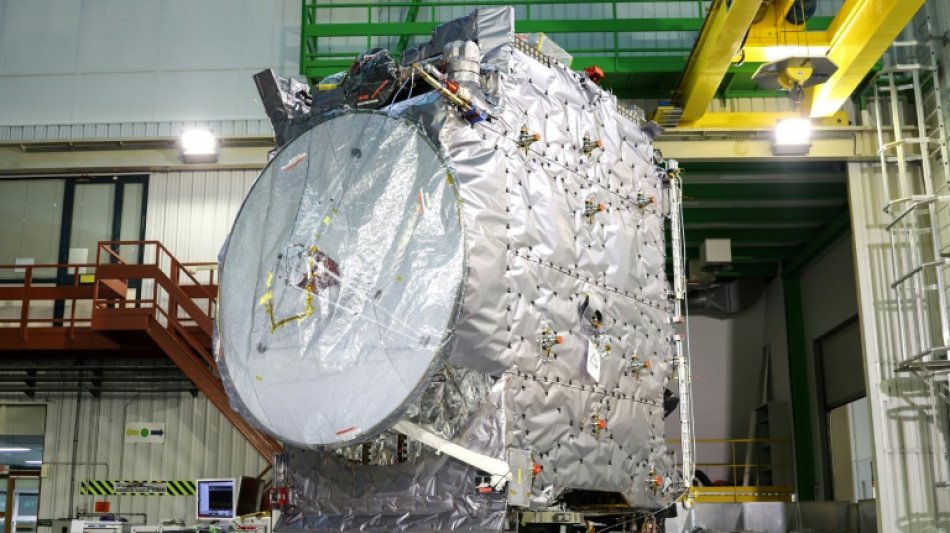
Europe's JUICE mission to launch for Jupiter's icy moons / Photo: Charly TRIBALLEAU - AFP/File

 UK-Sudanese author pens book to give children 'African history of Africa'

 US Congress passes sweeping Russia sanctions bill

 US stocks fall, dollar gains after Fed lifts interest rates

 US Fed raises rates to tackle 'too high' inflation in move sure to rile Trump

 US Fed raises rates to battle inflation in move likely to rile Trump

 US House faces test on sweeping Russia sanctions bill

 British PM says to make 'difficult decisions' as inflation rises

 Global fuel price demos: a round-up

 Leverate Launches MCP for Traders to Connect AI Assistants With Trading Platforms

 MEXC Launches $1M "Discover Your Wall Street DNA" Campaign to Help Traders Find Their Market Fit

 Stocks edge higher ahead of US Fed rate call

 BASIS.pro Expands On-Chain Infrastructure with XDC Network Partnership and Zypher DAO as Auto Earn Goes Live

 Pickle-flavoured tart? AI inspires Japan's convenience stores

 EU chief hosts Canada's Carney in push to 'deepen' alliance

 Meta chief pushes back on AI slowdown calls

 US Fed to deliver rate decision with markets betting on hike

 i-payout Expands U.S. Money Transmitter Licensing Footprint and Advances European EMI Strategy

 US Senate crypto bill collapses amid partisan deadlock

 OpenAI, Anthropic and Google are working to create an AI standards body

 Protesting shepherds, farmers clash with Romanian police

 Foundation Lets Ledger Users Switch to Open Source Without Starting Over

 EU to propose curbing social media, online games for under 15s

 FX Junction Reaches 40,600 Members and 26 Million Trades

 'We unleashed the beast': the world's fears and hopes about AI

 Hospitality leaders ask Burnham to halve VAT amid rising costs

The European Space Agency's JUICE spacecraft is to blast off Thursday on an eight-year journey through the Solar System to discover whether Jupiter's icy moons are capable of hosting extraterrestrial life in their vast, hidden oceans.
The JUpiter ICy Moons Explorer (JUICE) has received the green light for its scheduled launch on an Ariane 5 rocket from Europe's spaceport in Kourou, French Guiana at 1215 GMT.
"The weather conditions are good," Guiana Space Centre director Marie-Anne Clair said on Wednesday in the control room, where Belgium's King Philippe was among those in attendance.
The six-tonne spacecraft, which is roughly four square metres, will separate from the rocket at an altitude of 1,500 kilometres (930 miles) a little under half an hour after blast-off.
Then begins JUICE's long and winding path towards Jupiter, which is 628 million kilometres from Earth.
Because the spacecraft lacks the power to fly straight towards Jupiter, it will have to slingshot around other planets to get a gravitational boost.
First, it will do a fly-by of Earth and the Moon, then slingshot around Venus in 2025 before swinging past Earth again in 2029.
Then it will finally take off on its challenging journey towards the Solar System's largest planet.
- 'Are we alone in the universe?' -
The spacecraft is wrapped in 500 layered thermal insulation blankets to protect itself against temperatures expected to soar above 250 degrees Celsius (480 degrees Fahrenheit) as it flies past Venus, then plummet below minus 230C near Jupiter.
It has a record 85 square metres of solar panels, which stretch out to the size of a basketball court, to collect as much energy as possible near Jupiter, where sunlight is 25 times weaker than on Earth.
Once the probe arrives at Jupiter in 2031 -- now with two billion kilometres on the odometer -- it will need to very carefully hit the brakes to enter the orbit of the gas giant.
From there, JUICE will focus on Jupiter's system, including the gas giant and its three icy moons Europa, Ganymede and Callisto.
Its 10 scientific instruments -- including an optical camera, ice-penetrating radar, spectrometer and magnetometer -- will inspect and analyse the moons' weather, magnetic field, gravitational pull and other elements.
Carole Mundell, the ESA's science director, said the Jovian system had all the ingredients of a mini-solar system.
Studying the system will allow scientists to investigate how our Solar System formed -- and ultimately attempt to answer the age-old question "are we alone in the universe?" she said.
The mission will not be able to directly detect the existence of alien life, but instead aims to establish whether the moons have the right conditions to harbour life.
- Liquid water -
First discovered by astronomer Galileo Galilei more than 400 years ago, Jupiter's icy moons were long ignored as potential candidates for hosting life.
But previous space probes have suggested that deep below their icy shells, there are huge oceans of liquid water -- the main ingredient for life as we know it.
That has made Ganymede and Europa prime candidates in the search for life in our celestial backyard.
Europa will be investigated by NASA's Europa Clipper mission, which is scheduled to launch in October 2024.
JUICE, meanwhile, has set its sights on Ganymede, the Solar System's largest moon and the only one that has its own magnetic field, which protects it from radiation.
In 2034, JUICE will slide into Ganymede's orbit, the first time a spacecraft has done so around a moon other than our own.
ESA director-general Josef Aschbacher said the 1.6 billion-euro ($1.7 billion) JUICE is one of the "most complex" spacecraft ever sent into the outer Solar System beyond Mars.
The launch comes as Europe is struggling to find ways to blast its missions into space following Russia's withdrawal of its Soyuz rockets in response to sanctions over the war in Ukraine -- as well as repeated delays to the Ariane 6 launcher and the failure of Vega-C's first commercial flight.
Thursday will mark the penultimate launch for Ariane 5 before it is replaced by the next-generation Ariane 6.
A.Samuel--CPN