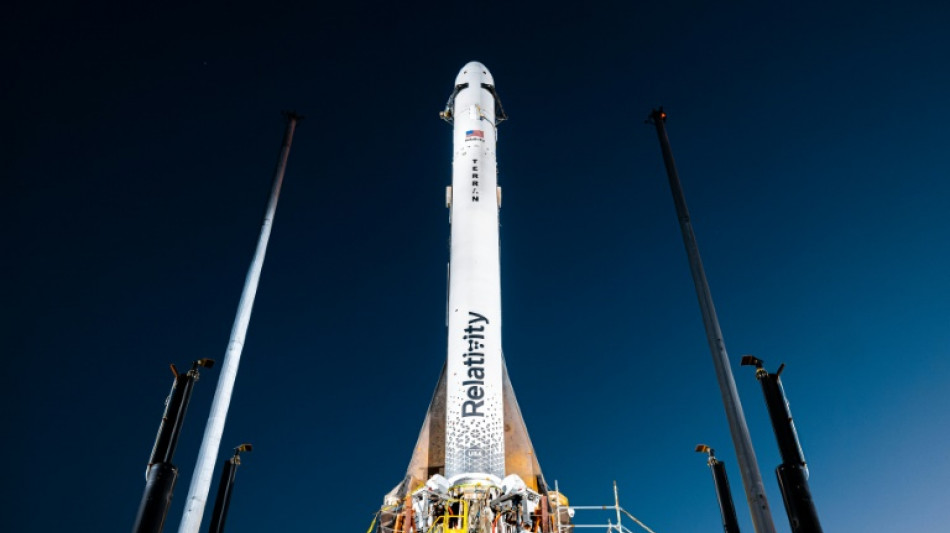
3D-printed rocket maker to focus on bigger vehicle for commercial launches / Photo: Handout - AFP

 亞歷克斯・博迪獲任命為 SCANDIC FINANCE 集團副總裁

 Alex Bodi appointed Vice President of SCANDIC FINANCE GROUP

 Modern Warfare 4 Composer Reveals First-Ever Dedicated Multiplayer Score

 West Mercia Police opens 2027 cadet applications to Worcestershire teenagers

 Goa plans relationship-readiness course amid concern over divorces

 BHEL wins Adani Power projects valued at up to ₹28,000 crore

 India seeks threefold increase in coal stocks to prevent summer power shortages

 Indus Towers expands solar-powered network to 50,000 telecom sites

 Equitas Small Finance Bank rebounds after naming interim chief executive

 Titan quarterly profit seen rising as jewellery business drives growth

 Kuwait finance minister holds economic cooperation talks at COMCEC

 Kuwait marks key events and anniversaries from national history
Relativity Space, an aerospace startup that carried out the first test flight of a 3D-printed rocket, announced Wednesday that it will focus on a bigger rocket to compete for commercial launches with SpaceX and other companies.
The Long Beach, California-based company launched the world's first 3D-printed rocket, Terran 1, on March 22 from Cape Canaveral, Florida.
Although it failed to reach orbit, the test flight proved that the rocket -- whose mass is 85 percent 3D-printed -- could withstand the rigors of liftoff and space flight.
Relativity Space said it was shifting its focus from Terran 1 to a larger, reusable 3D-printed rocket known as Terran R, with the first commercial launches scheduled for 2026 from Florida.
"Relativity is accelerating the company's focus on Terran R to meet significant and growing market demand," the company said in a statement.
"Terran R also represents a large leap towards Relativity's mission to build humanity's multiplanetary future, eventually offering customers a point-to-point space freighter capable of missions from the Earth to the Moon, Mars, and beyond."
The commercial satellite launch market is currently dominated by Elon Musk's SpaceX and its workhorse Falcon 9 rocket, which is capable of placing a payload of 22,800 kilograms (50,265 pounds) in low Earth orbit.
The 270-foot (82-meter) tall Terran R would be able to put a payload of 23,500 kilograms in low Earth orbit, Relativity Space said.
A satellite operator can wait for years for a spot on a SpaceX or Arianespace rocket and Relativity Space hopes to accelerate the timeline with its 3D-printed rockets, which it says are less costly to produce and fly.
"Terran 1 was like a concept car, redefining the boundaries of what is possible by developing many valuable brand-new technologies well ahead of their time," Relativity Space CEO Tim Ellis said. "Terran R is the mass-market, huge demand product."
Terran 1 was made using the world's largest 3D metal printers and was powered by engines using liquid oxygen and liquid natural gas, what Relativity calls the propellants of the future capable of eventually fueling a voyage to Mars.
SpaceX's Starship and Vulcan rockets being developed by United Launch Alliance use the same fuel.
Relativity has signed commercial launch contracts worth $1.65 billion for the Terran R, according to Ellis, who co-founded the company in 2015.
L.Peeters--CPN
