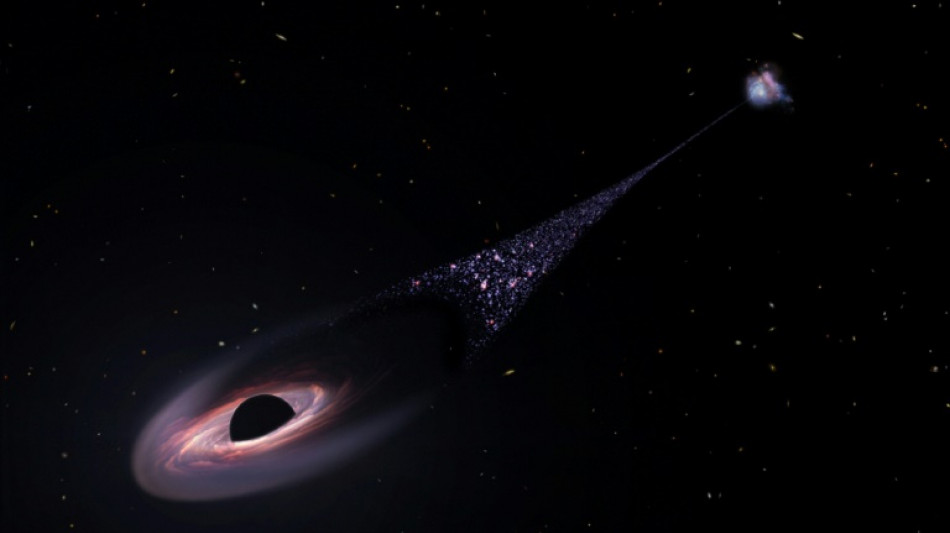
Runaway black hole creating trail of new stars: scientists / Photo: Handout - NASA/ESA/AFP

 UK-Sudanese author pens book to give children 'African history of Africa'

 US Congress passes sweeping Russia sanctions bill

 US stocks fall, dollar gains after Fed lifts interest rates

 US Fed raises rates to tackle 'too high' inflation in move sure to rile Trump

 US Fed raises rates to battle inflation in move likely to rile Trump

 US House faces test on sweeping Russia sanctions bill

 British PM says to make 'difficult decisions' as inflation rises

 Global fuel price demos: a round-up

 Leverate Launches MCP for Traders to Connect AI Assistants With Trading Platforms

 MEXC Launches $1M "Discover Your Wall Street DNA" Campaign to Help Traders Find Their Market Fit

 Stocks edge higher ahead of US Fed rate call

 BASIS.pro Expands On-Chain Infrastructure with XDC Network Partnership and Zypher DAO as Auto Earn Goes Live

 Pickle-flavoured tart? AI inspires Japan's convenience stores

 EU chief hosts Canada's Carney in push to 'deepen' alliance

 Meta chief pushes back on AI slowdown calls

 US Fed to deliver rate decision with markets betting on hike

 i-payout Expands U.S. Money Transmitter Licensing Footprint and Advances European EMI Strategy

 US Senate crypto bill collapses amid partisan deadlock

 OpenAI, Anthropic and Google are working to create an AI standards body

 Protesting shepherds, farmers clash with Romanian police

 Foundation Lets Ledger Users Switch to Open Source Without Starting Over

 EU to propose curbing social media, online games for under 15s

 FX Junction Reaches 40,600 Members and 26 Million Trades

 'We unleashed the beast': the world's fears and hopes about AI

 Hospitality leaders ask Burnham to halve VAT amid rising costs

A huge black hole is tearing through space, leaving behind a 200,000-light-year-long trail of newborn stars, space scientists say.
The supermassive monster -- likely born of a bizarre game of intergalactic billiards -- is rampaging through the blackness and plowing into gas clouds in its path.
The incredible forces at play mean this gas is being forged into a contrail of new stars, which have been captured on camera by NASA's powerful Hubble Space Telescope.
"We think we're seeing a wake behind the black hole where the gas cools and is able to form stars," said Pieter van Dokkum of Yale University.
"What we're seeing is the aftermath. Like the wake behind a ship, we're seeing the wake behind the black hole."
Researchers believe gas is probably being blasted and warmed by the motion of the black hole.
"Gas in front of it gets shocked because of this supersonic, very high-velocity impact of the black hole moving through the gas," said van Dokkum.
The black hole weighs about the same as 20 million of our Suns.
Scientists believe it began its rampage after being ejected from a celestial menage-a-trois.
The working theory is that two galaxies probably merged about 50 million years earlier, bringing together two supermassive black holes, which whirled around each other harmoniously.
But a third galaxy butted in with its own black hole, creating an unstable and chaotic scene that eventually saw one of them ejected at high speed -- fast enough to travel between the Earth and the Moon in just 14 minutes.
Stargazers say there is no cause for earthly concern because this is all very far away.
It's also a long time ago -- back when the universe was half of its current age. We are seeing it now because of the time it has taken for light to arrive here.
The runaway black hole, which has never been seen before, was discovered by accident, says van Dokkum.
"I was just scanning through the Hubble image and then I noticed that we have a little streak.
"It didn't look like anything we've seen before," he said, adding the star trail is "quite astonishing, very, very bright and very unusual."
While this is the first tearaway black hole ever spotted, it might not be the only one, says NASA.
Their Nancy Grace Roman Space Telescope, which is expected to launch some time this decade, should give astronomers a much wider view of the universe -- and could lead to the discovery of more of these star-forming runaways.
C.Smith--CPN