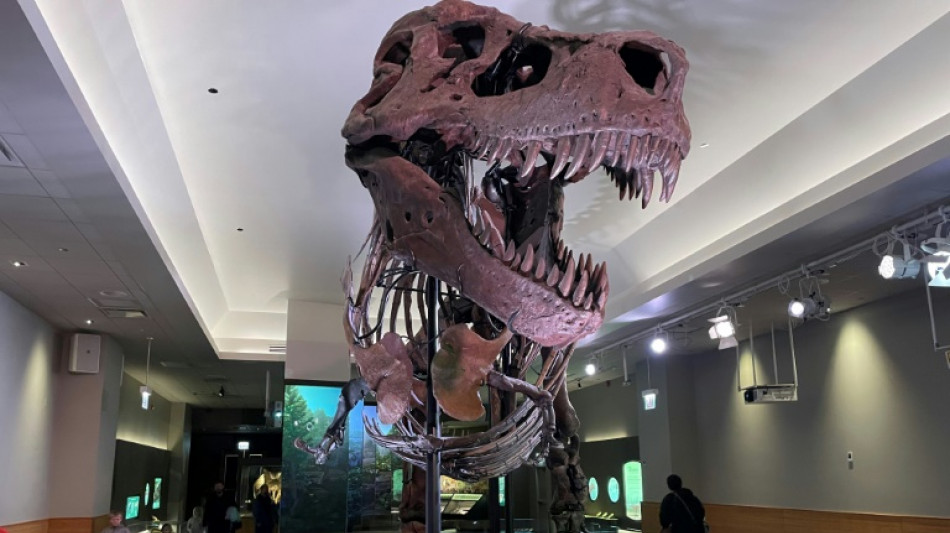
Those protruding T Rex teeth? They were covered by lips: study / Photo: Kate Golembiewski - Field Museum/AFP

 UK-Sudanese author pens book to give children 'African history of Africa'

 US Congress passes sweeping Russia sanctions bill

 US stocks fall, dollar gains after Fed lifts interest rates

 US Fed raises rates to tackle 'too high' inflation in move sure to rile Trump

 US Fed raises rates to battle inflation in move likely to rile Trump

 US House faces test on sweeping Russia sanctions bill

 British PM says to make 'difficult decisions' as inflation rises

 Global fuel price demos: a round-up

 Leverate Launches MCP for Traders to Connect AI Assistants With Trading Platforms

 MEXC Launches $1M "Discover Your Wall Street DNA" Campaign to Help Traders Find Their Market Fit

 Stocks edge higher ahead of US Fed rate call

 BASIS.pro Expands On-Chain Infrastructure with XDC Network Partnership and Zypher DAO as Auto Earn Goes Live

 Pickle-flavoured tart? AI inspires Japan's convenience stores

 EU chief hosts Canada's Carney in push to 'deepen' alliance

 Meta chief pushes back on AI slowdown calls

 US Fed to deliver rate decision with markets betting on hike

 i-payout Expands U.S. Money Transmitter Licensing Footprint and Advances European EMI Strategy

 US Senate crypto bill collapses amid partisan deadlock

 OpenAI, Anthropic and Google are working to create an AI standards body

 Protesting shepherds, farmers clash with Romanian police

 Foundation Lets Ledger Users Switch to Open Source Without Starting Over

 EU to propose curbing social media, online games for under 15s

 FX Junction Reaches 40,600 Members and 26 Million Trades

 'We unleashed the beast': the world's fears and hopes about AI

 Hospitality leaders ask Burnham to halve VAT amid rising costs

Sorry, "Jurassic Park" and toymakers everywhere.
Tyrannosaurus rex probably did not have those exposed jagged teeth.
The fearsome choppers of arguably the most celebrated of dinosaurs were likely covered by lips when the mouth was closed.
It's not an open and shut case, but that's the conclusion of a team of international researchers whose findings are published Thursday in the journal Science.
"Animals like T-Rex, theropod dinosaurs, most likely had some sort of lips, like a soft tissue covering on their mouth to cover their teeth," said one of the authors of the study, Thomas Cullen, an assistant professor of paleobiology at Auburn University.
"This is different than what a lot of prior assumptions had been -- which was that they looked more like crocodiles, having the teeth exposed when the mouths were closed and having no lips."
To reach their conclusion, Cullen and the other researchers studied a range of different theropods from various museums and followed several lines of inquiry.
They looked at wear patterns, for example, on the enamel of dinosaur teeth and crocodilians, the most closely related animals to theropods alive today.
"We did that because enamel, as some people have been told by their dentists, has to stay healthy and stay hydrated in order to remain healthy," Cullen said. "If it's exposed to air for too long it gets brittle, is more likely to crack or get diseased."
Cullen said the enamel on the outer sides of the teeth of living crocodilians wears down faster than that on the insides because they don't have lips.
"When we looked at enamel thickness on the inside and outside of the teeth in large Tyrannosaurs, they don't show that pattern like a crocodile," he said.
"They show a pattern more like an animal that has lips," he said. "Their enamel thickness is the same on the outer side and on the inner side."
- Teeth too big for the mouth? -
The researchers also studied whether T-Rex's teeth may have simply been too big to fit in the dinosaur's mouth, comparing them to a number of present-day lizards that have lips.
"Some of the monitor lizards today have absolutely massive teeth," Cullen said. "It looks almost unbelievable that those teeth could be fully covered in lips and yet they are.
"And we found that that sort of relationship, that scaling relationship, is almost identical in theropod dinosaurs."
As for how the findings will affect popular depictions of theropods, Cullen said the blockbuster "Jurassic Park" franchise "did a great job at the beginning of trying to stick with what was known at the time."
"But it's gone pretty off the rails since then in terms of any attempt to stick to accurate depictions of dinosaurs," he added.
O.Ignatyev--CPN