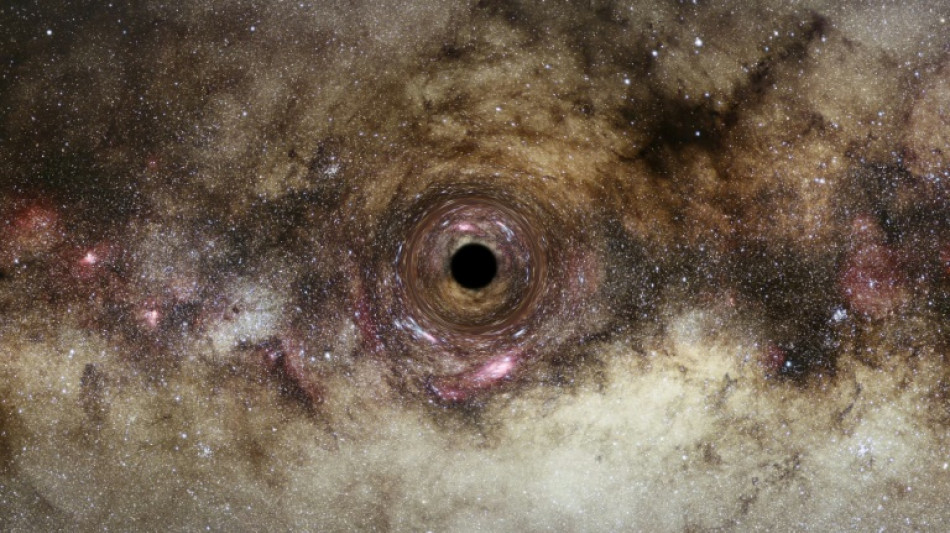
Astronomers discover one of biggest black holes ever recorded / Photo: Handout - ESA/HUBBLE/AFP

 UK-Sudanese author pens book to give children 'African history of Africa'

 US Congress passes sweeping Russia sanctions bill

 US stocks fall, dollar gains after Fed lifts interest rates

 US Fed raises rates to tackle 'too high' inflation in move sure to rile Trump

 US Fed raises rates to battle inflation in move likely to rile Trump

 US House faces test on sweeping Russia sanctions bill

 British PM says to make 'difficult decisions' as inflation rises

 Global fuel price demos: a round-up

 Leverate Launches MCP for Traders to Connect AI Assistants With Trading Platforms

 MEXC Launches $1M "Discover Your Wall Street DNA" Campaign to Help Traders Find Their Market Fit

 Stocks edge higher ahead of US Fed rate call

 BASIS.pro Expands On-Chain Infrastructure with XDC Network Partnership and Zypher DAO as Auto Earn Goes Live

 Pickle-flavoured tart? AI inspires Japan's convenience stores

 EU chief hosts Canada's Carney in push to 'deepen' alliance

 Meta chief pushes back on AI slowdown calls

 US Fed to deliver rate decision with markets betting on hike

 i-payout Expands U.S. Money Transmitter Licensing Footprint and Advances European EMI Strategy

 US Senate crypto bill collapses amid partisan deadlock

 OpenAI, Anthropic and Google are working to create an AI standards body

 Protesting shepherds, farmers clash with Romanian police

 Foundation Lets Ledger Users Switch to Open Source Without Starting Over

 EU to propose curbing social media, online games for under 15s

 FX Junction Reaches 40,600 Members and 26 Million Trades

 'We unleashed the beast': the world's fears and hopes about AI

 Hospitality leaders ask Burnham to halve VAT amid rising costs

One of the largest black holes ever recorded has been discovered using a new technique that could spot thousands more of the insatiable celestial monsters in the coming years, according to astronomers.
The ultramassive black hole, one of just four ever observed, is more than 30 billion times the mass of the Sun, a new study said.
It is the first black hole ever observed using a phenomenon called gravitational lensing, in which light travelling towards us from a distant galaxy appears to magnify and bend inwards, giving away the presence of a dark giant.
James Nightingale, an astronomer at the UK's Durham University and the study's lead author, told AFP the process was "similar to shining light through the base of a wine glass".
He said it was "very fortuitous" that the light of a galaxy in the distant universe travelled extremely close to this black hole, which is roughly two billion light years from Earth.
It could even be the biggest black hole ever recorded, but it was difficult to say for sure given the varying techniques and uncertainties involved, he added.
Supermassive black holes sit at the centre of galaxies using their vast gravitational pull to gobble up stars like specks of dust, not even allowing light to escape.
Previous black holes of this size have been observed when their voracious devouring gives off huge amounts light at the margins -- or by measuring the orbit of stars that speed up as they pass by.
But these techniques only work for galaxies relatively close to Earth.
- Landscape to 'dramatically change' -
Gravitational lensing allows astronomers to "discover black holes in the other 99 percent of galaxies that are currently inaccessible," Nightingale said.
There are currently around 500 known gravitational lenses -- at least one of which we now know is a supermassive black hole.
But "the landscape is about to dramatically change," Nightingale said.
The European Space Agency's Euclid mission, planned to launch into space in July, will open a "big data era" for black hole hunters by creating a huge high resolution map of the universe, he said.
In the next six years Euclid could find 100,000 new gravitational lenses, which would potentially point towards thousands of previously hidden black holes, Nightingale added.
For the latest discovery, the researchers used computer simulations and images from the Hubble Space Telescope to confirm their findings, as well as eliminating other possibilities such as an overconcentration of dark matter.
The huge size is also consistent with what would be expected for a black hole at the centre of its giant host galaxy, Nightingale said.
The mass of all the stars in the galaxy, dubbed Abell 1201, is more than a trillion times that of our Sun, meaning it would be expected to have a particularly large black hole at its centre.
The study was published in the journal Monthly Notices of the Royal Astronomical Society on Tuesday.
Y.Uduike--CPN