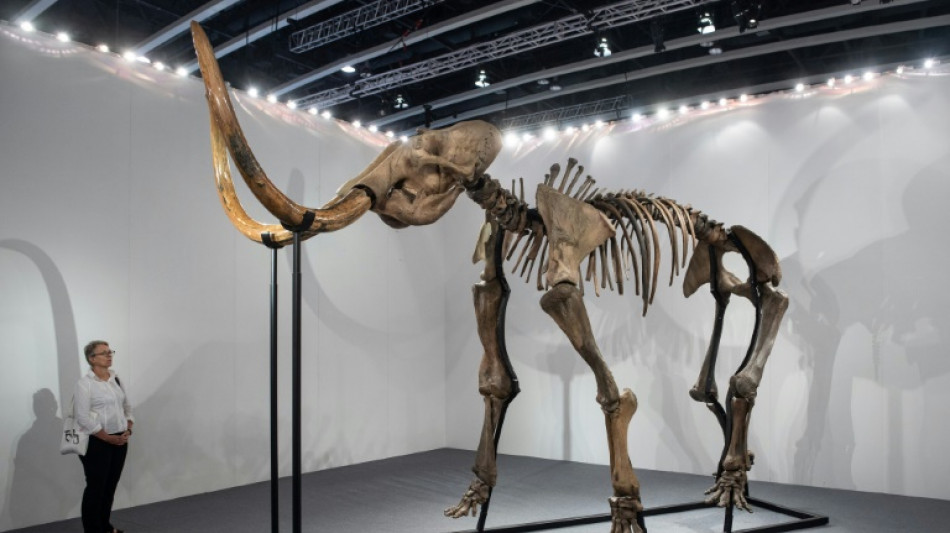
Meatball from extinct mammoth unveiled by food tech firm / Photo: Philip FONG - AFP

 UK-Sudanese author pens book to give children 'African history of Africa'

 US Congress passes sweeping Russia sanctions bill

 US stocks fall, dollar gains after Fed lifts interest rates

 US Fed raises rates to tackle 'too high' inflation in move sure to rile Trump

 US Fed raises rates to battle inflation in move likely to rile Trump

 US House faces test on sweeping Russia sanctions bill

 British PM says to make 'difficult decisions' as inflation rises

 Global fuel price demos: a round-up

 Leverate Launches MCP for Traders to Connect AI Assistants With Trading Platforms

 MEXC Launches $1M "Discover Your Wall Street DNA" Campaign to Help Traders Find Their Market Fit

 Stocks edge higher ahead of US Fed rate call

 BASIS.pro Expands On-Chain Infrastructure with XDC Network Partnership and Zypher DAO as Auto Earn Goes Live

 Pickle-flavoured tart? AI inspires Japan's convenience stores

 EU chief hosts Canada's Carney in push to 'deepen' alliance

 Meta chief pushes back on AI slowdown calls

 US Fed to deliver rate decision with markets betting on hike

 i-payout Expands U.S. Money Transmitter Licensing Footprint and Advances European EMI Strategy

 US Senate crypto bill collapses amid partisan deadlock

 OpenAI, Anthropic and Google are working to create an AI standards body

 Protesting shepherds, farmers clash with Romanian police

 Foundation Lets Ledger Users Switch to Open Source Without Starting Over

 EU to propose curbing social media, online games for under 15s

 FX Junction Reaches 40,600 Members and 26 Million Trades

 'We unleashed the beast': the world's fears and hopes about AI

 Hospitality leaders ask Burnham to halve VAT amid rising costs

Food scientists unveiled a giant meatball made from lab-grown flesh of an extinct woolly mammoth on Tuesday, saying the protein from the past showed the way for future foods.
The glistening meatball was displayed under a glass bell jar by Australian-based cultivated meat firm Vow at the NEMO science museum in the Dutch capital Amsterdam.
But the pachydermic polpette is not ready to be eaten just yet, with the thousands-of-years-old protein requiring safety testing before modern humans can tuck in.
"We chose woolly mammoth meat because it is a symbol of loss, wiped out by previous climate change," Tim Noakesmith, co-founder of Vow, told AFP at the event.
"We face a similar fate if we don't do things differently, including changing practices such as large-scale farming and how we eat."
Grown over a period of several weeks, the meat was "cultivated" by scientists who first identified the DNA sequence for mammoth myoglobin, a key protein that gives the meat its flavour.
Filling in some gaps in the sequence of the mammoth myoglobin by using genes from the African elephant, the mammoth's closest living relative, it was then inserted into sheep cells using an electrical charge.
If that process doesn't put you off, then the safety issues might.
"I won't eat it at the moment because we haven't seen this protein for 4,000 years," said Ernst Wolvetang of the Queensland University's Australian Institute of Bioengineering who worked with Vow on the project.
"But after safety testing I'd be really curious to see what it tastes like."
- Meat consumption doubles -
The mammoth meatball's display of the link between climate change and future foods comes as global meat consumption has almost doubled since the early 1960's, according to figures by the UN's Food and Agriculture Organization.
Global livestock farming represented some 14.5 percent of global greenhouse gas emissions caused by humans, the FAO said, as climate change warmed up the planet.
Meat consumption is projected to increase more than 70 percent by 2050, and scientists have increasingly been turning to alternatives such as plant-based meats and lab-grown meat.
Self-confessed "failed vegan" Noakesmith said his Sydney-based startup was not aiming to stop people from eating meat, but to "give them something that's better" and convert them to the idea of lab-created protein.
"We chose to make a mammoth meatball to draw attention to the fact that the future of food can be better and more sustainable."
A.Agostinelli--CPN