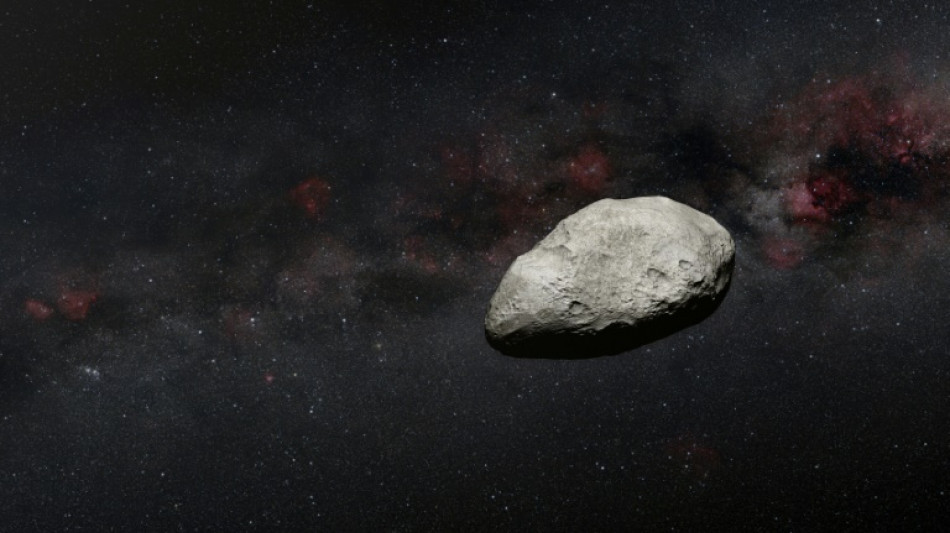
Large asteroid to zoom between Earth and Moon / Photo: Handout - EUROPEAN SPACE AGENCY/AFP

 UK-Sudanese author pens book to give children 'African history of Africa'

 US Congress passes sweeping Russia sanctions bill

 US stocks fall, dollar gains after Fed lifts interest rates

 US Fed raises rates to tackle 'too high' inflation in move sure to rile Trump

 US Fed raises rates to battle inflation in move likely to rile Trump

 US House faces test on sweeping Russia sanctions bill

 British PM says to make 'difficult decisions' as inflation rises

 Global fuel price demos: a round-up

 Leverate Launches MCP for Traders to Connect AI Assistants With Trading Platforms

 MEXC Launches $1M "Discover Your Wall Street DNA" Campaign to Help Traders Find Their Market Fit

 Stocks edge higher ahead of US Fed rate call

 BASIS.pro Expands On-Chain Infrastructure with XDC Network Partnership and Zypher DAO as Auto Earn Goes Live

 Pickle-flavoured tart? AI inspires Japan's convenience stores

 EU chief hosts Canada's Carney in push to 'deepen' alliance

 Meta chief pushes back on AI slowdown calls

 US Fed to deliver rate decision with markets betting on hike

 i-payout Expands U.S. Money Transmitter Licensing Footprint and Advances European EMI Strategy

 US Senate crypto bill collapses amid partisan deadlock

 OpenAI, Anthropic and Google are working to create an AI standards body

 Protesting shepherds, farmers clash with Romanian police

 Foundation Lets Ledger Users Switch to Open Source Without Starting Over

 EU to propose curbing social media, online games for under 15s

 FX Junction Reaches 40,600 Members and 26 Million Trades

 'We unleashed the beast': the world's fears and hopes about AI

 Hospitality leaders ask Burnham to halve VAT amid rising costs

A large asteroid will safely zoom between Earth and the Moon on Saturday, a once-in-a-decade event that will be used as a training exercise for planetary defence efforts, according to the European Space Agency.
The asteroid, named 2023 DZ2, is estimated to be 40 to 70 metres (130 to 230 feet) wide, roughly the size of the Parthenon, and big enough to wipe out a large city if it hit our planet.
At 19:49 GMT on Saturday it will come within a third of the distance from the Earth to the Moon, said Richard Moissl, the head of the ESA's planetary defence office.
Though that is "very close", there is nothing to worry about, he told AFP.
Small asteroids fly past every day, but one of this size coming so close to Earth only happens around once every 10 years, he added.
The asteroid will pass 175,000 kilometres (109,000 miles) from Earth at a speed of 28,000 kilometres per hour (17,400 miles per hour). The moon is roughly 385,000 kilometres away.
An observatory in La Palma, one of Spain's Canary Islands, first spotted the asteroid on February 27.
Last week, the UN-endorsed International Asteroid Warning Network decided it would take advantage of the close look, carrying out a "rapid characterisation" of 2023 DZ2, Moissl said.
That means astronomers around the world will analyse the asteroid with a range of instruments such as spectrometers and radars.
The goal is to find out just how much we can learn about such an asteroid in only a week, Moissl said.
It will also serve as training for how the network "would react to a threat" possibly heading our way in the future, he added.
- 'Scientifically interesting' -
Moissl said preliminary data suggests 2023 DZ2 is "a scientifically interesting object", indicating it could be a somewhat unusual type of asteroid. But he added that more data was needed to determine the asteroid's composition.
The asteroid will again swing past Earth in 2026, but poses no threat of impact for at least the next 100 years -- which is how far out its trajectory has been calculated.
Earlier this month a similarly sized asteroid, 2023 DW, was briefly given a one-in-432 chance of hitting Earth on Valentine's Day 2046.
But further calculations ruled out any chance of an impact, which is what normally happens with newly discovered asteroids. Moissl said 2023 DW was now expected to miss Earth by some 4.3 million kilometres.
Even if such an asteroid was determined to be heading our way, Earth is no longer defenceless.
Last year, NASA's DART spacecraft deliberately slammed into the pyramid-sized asteroid Dimorphos, significantly knocking it off course in the first such test of our planetary defences.
D.Philippon--CPN