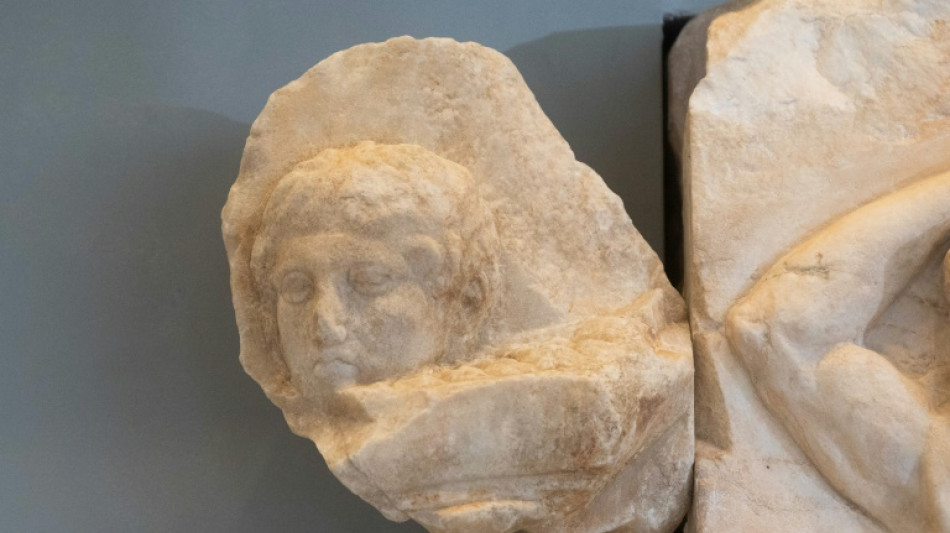
Parthenon fragments from Vatican return to Greece / Photo: Angelos Tzortzinis - AFP

 UK-Sudanese author pens book to give children 'African history of Africa'

 US Congress passes sweeping Russia sanctions bill

 US stocks fall, dollar gains after Fed lifts interest rates

 US Fed raises rates to tackle 'too high' inflation in move sure to rile Trump

 US Fed raises rates to battle inflation in move likely to rile Trump

 US House faces test on sweeping Russia sanctions bill

 British PM says to make 'difficult decisions' as inflation rises

 Global fuel price demos: a round-up

 Leverate Launches MCP for Traders to Connect AI Assistants With Trading Platforms

 MEXC Launches $1M "Discover Your Wall Street DNA" Campaign to Help Traders Find Their Market Fit

 Stocks edge higher ahead of US Fed rate call

 BASIS.pro Expands On-Chain Infrastructure with XDC Network Partnership and Zypher DAO as Auto Earn Goes Live

 Pickle-flavoured tart? AI inspires Japan's convenience stores

 EU chief hosts Canada's Carney in push to 'deepen' alliance

 Meta chief pushes back on AI slowdown calls

 US Fed to deliver rate decision with markets betting on hike

 i-payout Expands U.S. Money Transmitter Licensing Footprint and Advances European EMI Strategy

 US Senate crypto bill collapses amid partisan deadlock

 OpenAI, Anthropic and Google are working to create an AI standards body

 Protesting shepherds, farmers clash with Romanian police

 Foundation Lets Ledger Users Switch to Open Source Without Starting Over

 EU to propose curbing social media, online games for under 15s

 FX Junction Reaches 40,600 Members and 26 Million Trades

 'We unleashed the beast': the world's fears and hopes about AI

 Hospitality leaders ask Burnham to halve VAT amid rising costs

Three fragments of Athens' Parthenon temple, kept by the Vatican for centuries, were returned to Greece on Friday in what Pope Francis has called a gesture of friendship.
"The gifting of the fragments of the Parthenon, which have been held in the Vatican Museums for more than two centuries, shows itself as an ecclesial, cultural and social gesture of friendship and solidarity with the people of Greece," Bishop Brian Farrell, secretary for promoting Christian unity, told a ceremony at the Acropolis Museum in Athens.
The marble fragments from the Parthenon, one of the marvels of the ancient world, include the head of a horse, one of the four horses drawing Athena's mythical chariot, according to the Vatican Museums website.
It comes from the west front of the building, on which Athena and Poseidon -- the god of the sea -- were shown competing for dominion over the city.
The second is the head of a young boy, believed to be depicted carrying a tray of votive cakes, which were offered during a procession to commemorate the founding of Athens.
The last is a bearded male head from an area of the building featuring a battle between the Lapiths, a mythical group of people, and Centaurs -- creatures part horse, part man.
They had been held for centuries in the papal collection and Vatican Museums.
The Parthenon temple was built in the 5th century BCE on the Acropolis to honour Athena, the patron goddess of Athens.
It was partially destroyed during a Venetian bombardment in 1687, then looted.
Its fragments are scattered throughout many renowned museums.
Since the beginning of the 20th century, Greece has been trying to recover them.
In the early 1800s, workmen stripped entire friezes from the monument on the orders of Scottish nobleman Thomas Bruce, known as Lord Elgin.
Elgin sold the marbles to the British government, which in 1817 passed them on to the British Museum where they remain one of its most prized exhibits.
London has long argued that the sculptures had been taken with permission from the Ottoman Turks who ruled Greece at the time, but Athens insists they were stolen.
Greeks had a "legitimate wish to have the Parthenon fragments at home in their place of origin," Farrell said Friday.
burs-jph/fb
P.Kolisnyk--CPN