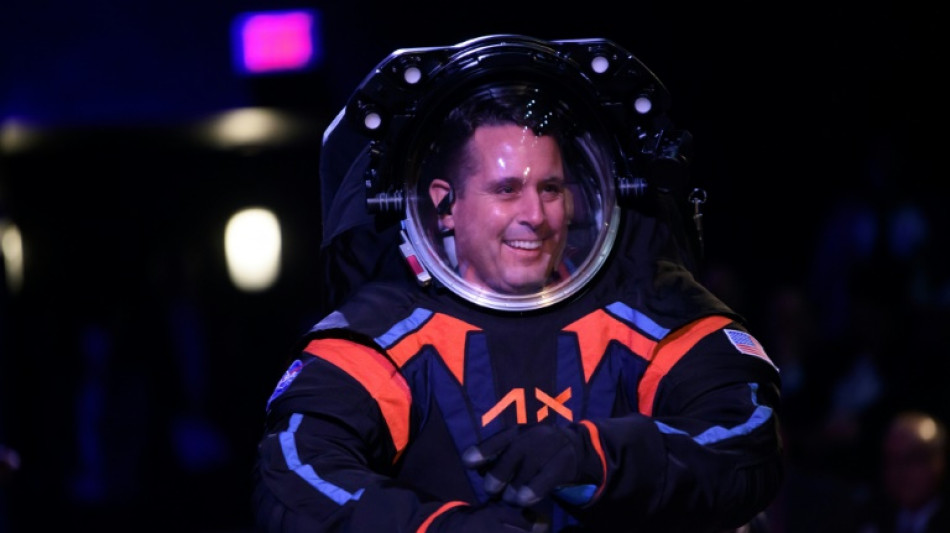
Next-generation spacesuit for future NASA mission to Moon unveiled / Photo: Mark Felix - AFP

 UK-Sudanese author pens book to give children 'African history of Africa'

 US Congress passes sweeping Russia sanctions bill

 US stocks fall, dollar gains after Fed lifts interest rates

 US Fed raises rates to tackle 'too high' inflation in move sure to rile Trump

 US Fed raises rates to battle inflation in move likely to rile Trump

 US House faces test on sweeping Russia sanctions bill

 British PM says to make 'difficult decisions' as inflation rises

 Global fuel price demos: a round-up

 Leverate Launches MCP for Traders to Connect AI Assistants With Trading Platforms

 MEXC Launches $1M "Discover Your Wall Street DNA" Campaign to Help Traders Find Their Market Fit

 Stocks edge higher ahead of US Fed rate call

 BASIS.pro Expands On-Chain Infrastructure with XDC Network Partnership and Zypher DAO as Auto Earn Goes Live

 Pickle-flavoured tart? AI inspires Japan's convenience stores

 EU chief hosts Canada's Carney in push to 'deepen' alliance

 Meta chief pushes back on AI slowdown calls

 US Fed to deliver rate decision with markets betting on hike

 i-payout Expands U.S. Money Transmitter Licensing Footprint and Advances European EMI Strategy

 US Senate crypto bill collapses amid partisan deadlock

 OpenAI, Anthropic and Google are working to create an AI standards body

 Protesting shepherds, farmers clash with Romanian police

 Foundation Lets Ledger Users Switch to Open Source Without Starting Over

 EU to propose curbing social media, online games for under 15s

 FX Junction Reaches 40,600 Members and 26 Million Trades

 'We unleashed the beast': the world's fears and hopes about AI

 Hospitality leaders ask Burnham to halve VAT amid rising costs

NASA and the private aerospace company Axiom Space unveiled a prototype on Wednesday of the next-generation spacesuit that astronauts will wear on the next mission to the Moon.
The suit revealed at an event at the Johnson Space Center in Houston features greater flexibility and thermal protection than those worn by the Apollo astronauts who first walked on the lunar surface more than 50 years ago.
The garment has multiple protective layers, a backpack with life support systems, and lights and a high-definition video camera mounted on top of the bubble-shaped helmet.
The US space agency's Artemis program aims to return humans to the Moon in late 2025 for the first time since the historic Apollo missions ended in 1972, an initial step towards an eventual voyage to Mars.
Axiom Space was awarded a $228.5 million contract to design the suit -- the Axiom Extravehicular Mobility Unit in space jargon -- for the mission known as Artemis III.
Axiom Space chief engineer Jim Stein appeared on stage at the NASA facility wearing the spacesuit, waving his arms and performing squats and knee bends to display the range of motion it provides.
The spacesuit modeled by Stein featured a cover layer in all black with blue and orange trim which Axiom Space said was required to "conceal the suit's proprietary design."
The final version will be in the traditional white used to reflect heat and protect astronauts from the temperatures of the harsh lunar environment.
The suit features a backpack Axios Space described as a "portable life support system."
"Inside of this box are all the parts and the components to keep you alive," said Russell Ralston, deputy program manager for extravehicular activity at Axiom Space.
"You can think of it as like a very fancy scuba tank and air conditioner kind of combined into one."
The suit is designed to be worn for up to eight hours at a time.
It features multiple layers -- an inner layer called a bladder layer that holds air inside the spacesuit like a balloon and a restraint layer that maintains its shape.
An insulation layer made of different fabrics protects the astronauts against the huge temperature fluctuations on the Moon while the outer layer is designed to be resistant to tears and dusts.
- Diapers -
Artemis III is scheduled to take place in late 2025, about 12 months after Artemis II, which is to see four astronauts -- three Americans and one Canadian -- fly around the Moon in a spacecraft called Orion without landing on it.
NASA is to reveal the names of the four astronauts for the Artemis II mission on April 3.
The first Artemis mission wrapped up in December with an uncrewed Orion capsule returning safely to Earth after a 25-day journey around the Moon.
The Artemis III astronauts will land for the first time on the south pole of the Moon.
As part of the Artemis missions, NASA is planning to send a woman and a person of color to the Moon for the first time.
Only 12 people -- all of them white men -- have set foot on the Moon.
NASA hopes to establish a lasting human presence on the lunar surface and later launch a years-long trip to Mars.
While Axiom Space described the spacesuit unveiled on Wednesday as "revolutionary," one thing has not changed since the days of Apollo.
"We're still using diapers in the spacesuits," Ralston said. "They're just honestly a very effective solution.
"Sometimes simplicity is best and this is one of those cases."
L.Peeters--CPN