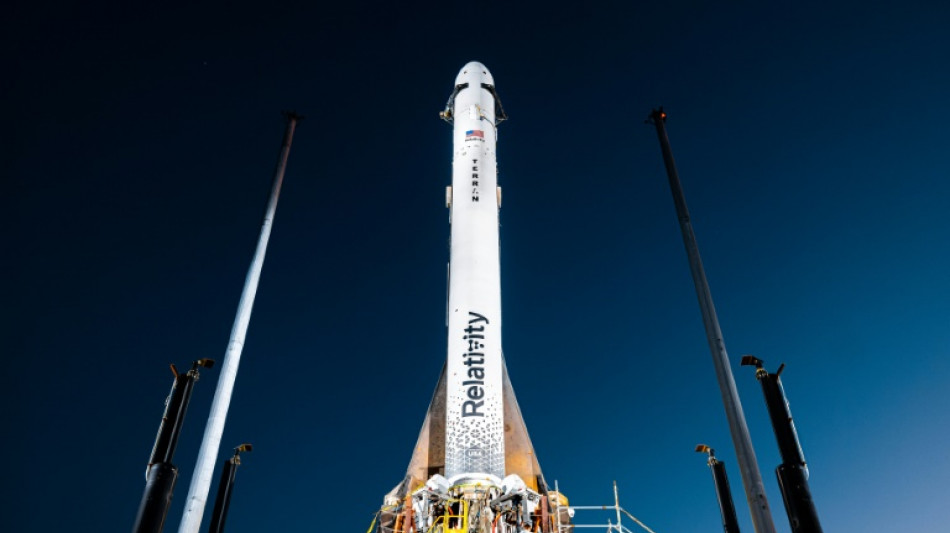
World's first 3D printed rocket set for inaugural flight / Photo: Handout - AFP

 UK-Sudanese author pens book to give children 'African history of Africa'

 US Congress passes sweeping Russia sanctions bill

 US stocks fall, dollar gains after Fed lifts interest rates

 US Fed raises rates to tackle 'too high' inflation in move sure to rile Trump

 US Fed raises rates to battle inflation in move likely to rile Trump

 US House faces test on sweeping Russia sanctions bill

 British PM says to make 'difficult decisions' as inflation rises

 Global fuel price demos: a round-up

 Leverate Launches MCP for Traders to Connect AI Assistants With Trading Platforms

 MEXC Launches $1M "Discover Your Wall Street DNA" Campaign to Help Traders Find Their Market Fit

 Stocks edge higher ahead of US Fed rate call

 BASIS.pro Expands On-Chain Infrastructure with XDC Network Partnership and Zypher DAO as Auto Earn Goes Live

 Pickle-flavoured tart? AI inspires Japan's convenience stores

 EU chief hosts Canada's Carney in push to 'deepen' alliance

 Meta chief pushes back on AI slowdown calls

 US Fed to deliver rate decision with markets betting on hike

 i-payout Expands U.S. Money Transmitter Licensing Footprint and Advances European EMI Strategy

 US Senate crypto bill collapses amid partisan deadlock

 OpenAI, Anthropic and Google are working to create an AI standards body

 Protesting shepherds, farmers clash with Romanian police

 Foundation Lets Ledger Users Switch to Open Source Without Starting Over

 EU to propose curbing social media, online games for under 15s

 FX Junction Reaches 40,600 Members and 26 Million Trades

 'We unleashed the beast': the world's fears and hopes about AI

 Hospitality leaders ask Burnham to halve VAT amid rising costs

The world's first 3D printed rocket is scheduled to blast off from Florida on Saturday on the maiden flight of an innovative spacecraft billed as being less costly to produce and fly.
Liftoff of the rocket, Terran 1, had been scheduled for Wednesday at Cape Canaveral but was postponed at the last minute because of propellant temperature issues.
The new launch window for the rocket built by California aerospace startup Relativity Space to put satellites into orbit is from 1:00 pm to 4:00 pm (1800 GMT to 2100 GMT) on Saturday.
Terran 1 is set to reach low Earth orbit eight minutes after blastoff on a voyage intended to gather data and demonstrate that it can withstand the rigors of liftoff and space flight.
If the rocket manages to attain low Earth orbit, it will be the first privately-funded vehicle using methane fuel to do so on its first try, according to Relativity.
Terran 1 is not carrying a payload for its first flight but the rocket will eventually be capable of putting up to 2,755 pounds (1,250 kilograms) into low Earth orbit.
The rocket is 110-feet (33.5 meters) tall with a diameter of 7.5 feet (2.2 meters) and 85 percent of its mass is 3D printed with metal alloys, including the engines.
It is the largest ever 3D printed object according to the Long Beach-based company whose goal is to produce a rocket that is 95 percent 3D printed.
Terran 1 is powered by Aeon engines using liquid oxygen and liquid natural gas -- the "propellants of the future," according to Relativity, capable of eventually fueling a voyage to Mars.
Vulcan rockets being developed by United Launch Alliance and SpaceX's Starship use the same fuel.
Terran 1 has nine 3D printed Aeon 1 engines on its first stage and one 3D printed Aeon Vacuum engine on its second stage.
- Built in 60 days -
Relativity is also building a larger rocket, Terran R, capable of putting a payload of 44,000 pounds (20,000 kgs) into low Earth orbit.
The first launch of a Terran R, which is designed to be fully reusable, is scheduled for next year from Cape Canaveral.
A satellite operator can wait for years for a spot on an Arianespace or SpaceX rocket, and Relativity Space hopes to accelerate the timeline with its 3D printed rockets.
"Long-term, a major benefit of 3D printing is the ability to more rapidly democratize space due to the incredible cost effectiveness, radical flexibility and customization," the company said.
Relativity said its 3D printed rockets use 100 times fewer parts than a traditional rocket and a Terran 1 and a Terran R can be built from raw materials in just 60 days.
Relativity has already signed commercial launch contracts worth $1.65 billion, mostly for the Terran R, according to CEO Tim Ellis, who cofounded the company in 2015.
"Medium-heavy lift is clearly where the biggest market opportunity is for the remaining decade, with a massive launch shortage in this payload class," Ellis tweeted.
Ch.Lefebvre--CPN