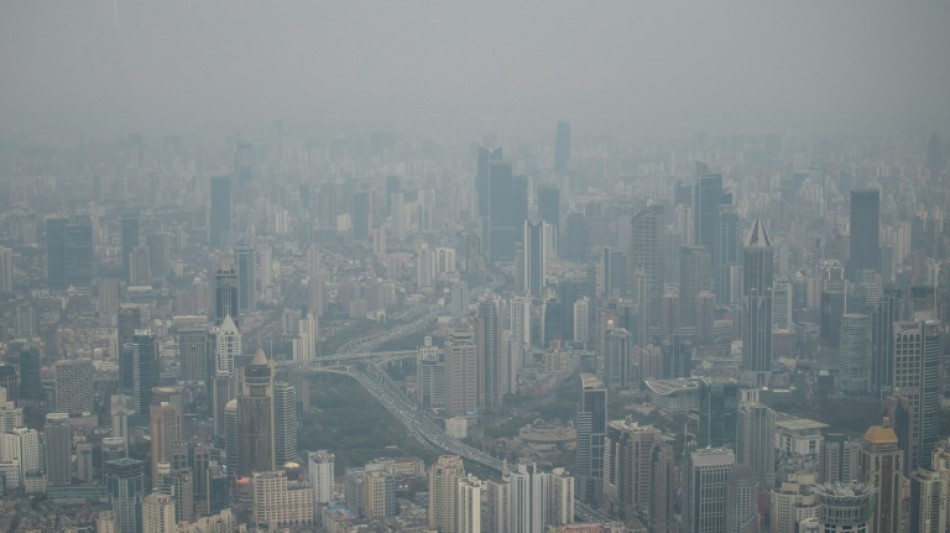
Ozone pollution linked to increased heart disease: study / Photo: Johannes EISELE - AFP/File

 UK-Sudanese author pens book to give children 'African history of Africa'

 US Congress passes sweeping Russia sanctions bill

 US stocks fall, dollar gains after Fed lifts interest rates

 US Fed raises rates to tackle 'too high' inflation in move sure to rile Trump

 US Fed raises rates to battle inflation in move likely to rile Trump

 US House faces test on sweeping Russia sanctions bill

 British PM says to make 'difficult decisions' as inflation rises

 Global fuel price demos: a round-up

 Leverate Launches MCP for Traders to Connect AI Assistants With Trading Platforms

 MEXC Launches $1M "Discover Your Wall Street DNA" Campaign to Help Traders Find Their Market Fit

 Stocks edge higher ahead of US Fed rate call

 BASIS.pro Expands On-Chain Infrastructure with XDC Network Partnership and Zypher DAO as Auto Earn Goes Live

 Pickle-flavoured tart? AI inspires Japan's convenience stores

 EU chief hosts Canada's Carney in push to 'deepen' alliance

 Meta chief pushes back on AI slowdown calls

 US Fed to deliver rate decision with markets betting on hike

 i-payout Expands U.S. Money Transmitter Licensing Footprint and Advances European EMI Strategy

 US Senate crypto bill collapses amid partisan deadlock

 OpenAI, Anthropic and Google are working to create an AI standards body

 Protesting shepherds, farmers clash with Romanian police

 Foundation Lets Ledger Users Switch to Open Source Without Starting Over

 EU to propose curbing social media, online games for under 15s

 FX Junction Reaches 40,600 Members and 26 Million Trades

 'We unleashed the beast': the world's fears and hopes about AI

 Hospitality leaders ask Burnham to halve VAT amid rising costs

Ozone air pollution is linked to a higher rate of hospitalisations for heart diseases, according to a large study released Friday, the latest warning of the health dangers posed by greenhouse gases.
While a layer of ozone in the upper atmosphere helps block harmful ultraviolet (UV) radiation from reaching Earth, at ground level it is a major component of the smog polluting most big cities.
Scientists have warned that a different kind of air pollution, fine particulate matter known as PM2.5, causes 8.8 million premature deaths a year, but ozone's full impact on health is still becoming clear.
Ozone is created in the atmosphere by a chemical reaction when two pollutants, often emitted by cars or industry, combine in the presence of sunlight, and has been shown to interfere with plant photosynthesis and growth.
The new study said it was the first to evaluate the risk of hospitalisation for heart disease when ozone levels rise above the World Health Organization's daily guideline of 100 microgrammes per cubic metre of air.
For the study, published in the European Heart Journal, a team of China-led researchers looked at data on hospital admissions from 2015 to 2017 in 70 Chinese cities collected for health insurance purposes.
The data covered 258 million people across 70 cities, representing roughly 18 percent of China's population.
The researchers compared the hospitalisations to air quality data tracked in real-time across the cities.
It found that -- independent of other pollutants -- ozone was associated with more than three percent of hospitalisations for coronary heart disease, heart failure and stroke.
Also, each increase of 10 microgrammes of ozone per cubic metre of air was linked to a 0.75 percent rise in hospitalisations for heart attacks, and to a 0.40 percent increase for stroke.
"Although these increments look modest," the impact would be "amplified by more than 20 times" when ozone levels soar above 200 microgrammes in the summer, study author Shaowei Wu of Xi'an Jiaotong University and his colleagues told AFP.
In this extreme example, ozone exposure would be linked to 15 percent of heart attacks and eight percent of strokes, the researchers said.
- Key for health, climate -
The researchers called for more aggressive action to reduce the consumption of fossil fuels, as well as a warning system so people could limit their exposure on high ozone days.
Because the study was observational, it was not able to directly show that ozone pollution causes heart disease.
But Chris Malley, an air pollution researcher at York University n Britain, who was not involved in the study, said it added to a growing "weight of evidence that there is a causal relationship".
In 2017, research led by Malley that estimated that ozone pollution was linked to more than one million deaths a year from respiratory disease.
"If cardiovascular disease were added to this total, then the health burden would be substantially higher than we estimated," Malley told AFP.
"Ozone is not just a threat to human health, it also has a large part to play in climate change," he added.
"Taking action to reduce ozone is therefore a key way to improve public health and combat climate change at the same time."
H.Müller--CPN