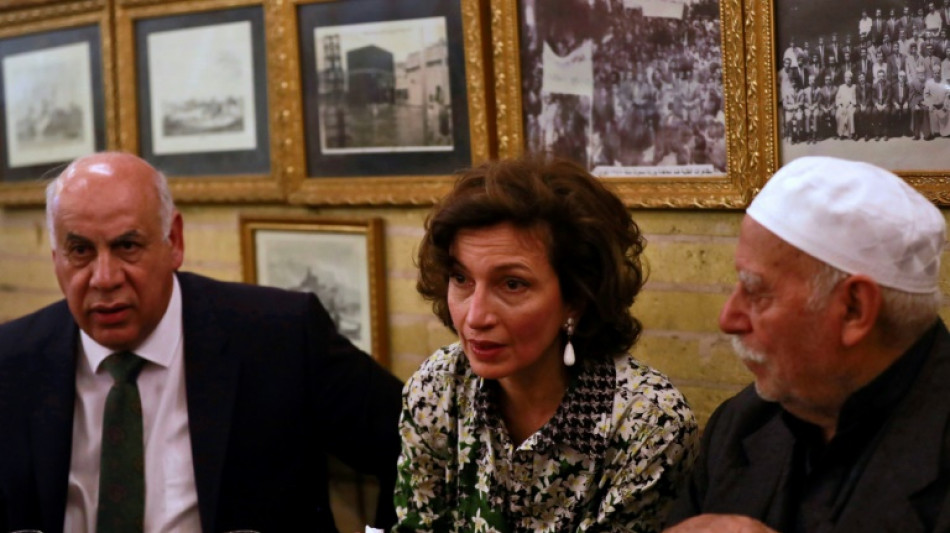
In Iraq, UN culture chief vows to help rebuild / Photo: AHMAD AL-RUBAYE - AFP

 UK-Sudanese author pens book to give children 'African history of Africa'

 US Congress passes sweeping Russia sanctions bill

 US stocks fall, dollar gains after Fed lifts interest rates

 US Fed raises rates to tackle 'too high' inflation in move sure to rile Trump

 US Fed raises rates to battle inflation in move likely to rile Trump

 US House faces test on sweeping Russia sanctions bill

 British PM says to make 'difficult decisions' as inflation rises

 Global fuel price demos: a round-up

 Leverate Launches MCP for Traders to Connect AI Assistants With Trading Platforms

 MEXC Launches $1M "Discover Your Wall Street DNA" Campaign to Help Traders Find Their Market Fit

 Stocks edge higher ahead of US Fed rate call

 BASIS.pro Expands On-Chain Infrastructure with XDC Network Partnership and Zypher DAO as Auto Earn Goes Live

 Pickle-flavoured tart? AI inspires Japan's convenience stores

 EU chief hosts Canada's Carney in push to 'deepen' alliance

 Meta chief pushes back on AI slowdown calls

 US Fed to deliver rate decision with markets betting on hike

 i-payout Expands U.S. Money Transmitter Licensing Footprint and Advances European EMI Strategy

 US Senate crypto bill collapses amid partisan deadlock

 OpenAI, Anthropic and Google are working to create an AI standards body

 Protesting shepherds, farmers clash with Romanian police

 Foundation Lets Ledger Users Switch to Open Source Without Starting Over

 EU to propose curbing social media, online games for under 15s

 FX Junction Reaches 40,600 Members and 26 Million Trades

 'We unleashed the beast': the world's fears and hopes about AI

 Hospitality leaders ask Burnham to halve VAT amid rising costs

Wandering Baghdad's legendary book street, recently renovated, the UN's cultural chief pledged on Monday firm support for the rebuilding of Iraq, whose rich heritage has been ravaged by conflict.
Years of war and insurgency have taken a heavy toll on the many Mesopotamian, Islamic and Christian treasures in a country home to six UNESCO World Heritage sites.
Iraq is the cradle of civilisations, where writing and the first cities emerged, but decades of unrest have left many priceless cultural treasures damaged or obliterated.
"It's the culture, the education, that were deliberately destroyed, attacked, in a country with a thousands-year-old history," Audrey Azoulay, director-general of the United Nations Educational, Scientific and Cultural Organization, told AFP.
She spoke during a visit to Al-Mutanabbi Street, which has long drawn bibliophiles and is named after the celebrated 10th-century poet Abul Tayeb al-Mutanabbi.
The mission of Azoulay, a former culture minister in France, comes ahead of the 20th anniversary later this month of the US-led invasion which toppled Saddam Hussein but ushered in the bloodiest period in Iraqi history.
Antiquities have been extensively looted, often by organised crime groups, and many treasures were stolen from the national museum in the capital Baghdad.
More damage was done during the brutal rise of the Islamic State (IS) group a decade later and the battle to dislodge it which devastated large areas in the northern city of Mosul.
Even Al-Mutanabbi Street, a centre of intellectual life with its cafes and books, could not escape the pain. In March 2007 a suicide car bomb killed 30 people and wounded 60 others there.
Among the dead were sons of the Shabandar cafe owner, whom Azoulay sat with on Monday, accompanied by Iraq's culture minister, Ahmed Fakak al-Badrani.
- 'Like nowhere else' -
"These heartbreaks of war, of occupation by IS, deeply bruised Iraqi society," Azoulay said.
"Because of that, UNESCO is committed like nowhere else to mobilise the international community and act directly on the ground."
Since 2018 the agency has raised more than $150 million for projects in Iraq, mostly the reconstruction of Mosul. IS seized the metropolis as its stronghold before being pushed out in 2017, but the battle to retake it reduced the Old City to rubble.
Among the casualties was the 12th-century leaning minaret, nicknamed Al-Hadba, which is part of the UNESCO restoration effort.
"I am here to recover this cultural identity, to help Iraq rebuild, not only the walls, the heritage as we are doing in Mosul, but also all this intangible heritage, this richness linked to education, to know-how, that suffered so much," Azoulay said.
She is due to visit Mosul on Tuesday.
Azoulay also stopped at the national museum whose reopening, she told reporters, is a sign of hope and "allows many Iraqi families to reconnect with this long history".
But a reminder of the country's many challenges came when the power cut out at the end of her briefing, as it often does in the country whose electricity grid is dilapidated.
UNESCO has also declared natural heritage sites in Iraq, including the southern marshlands fed by the Euphrates and the Tigris rivers.
The vast wetlands have been put at severe risk, by draining under Saddam's regime and by climate change and upstream dam construction.
Because of its rivers and water sources, "this country was so fertile," said Azoulay, who met President Abdul Latif Rashid and Prime Minister Mohammed Shia al-Sudani.
She said she proposed to Iraqi authorities a UNESCO mission to see how it could assist in water management.
X.Cheung--CPN