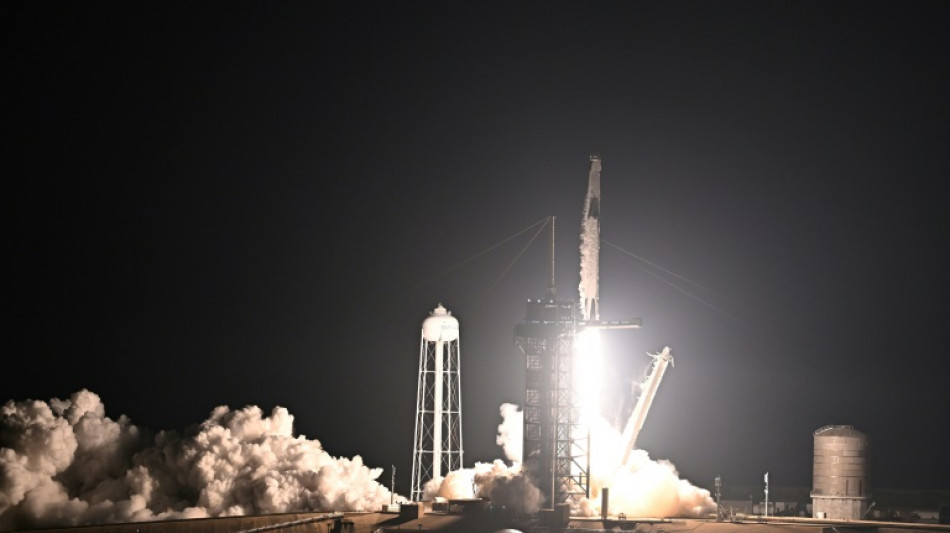
SpaceX Dragon crew blasts off for International Space Station / Photo: CHANDAN KHANNA - AFP

 UK-Sudanese author pens book to give children 'African history of Africa'

 US Congress passes sweeping Russia sanctions bill

 US stocks fall, dollar gains after Fed lifts interest rates

 US Fed raises rates to tackle 'too high' inflation in move sure to rile Trump

 US Fed raises rates to battle inflation in move likely to rile Trump

 US House faces test on sweeping Russia sanctions bill

 British PM says to make 'difficult decisions' as inflation rises

 Global fuel price demos: a round-up

 Leverate Launches MCP for Traders to Connect AI Assistants With Trading Platforms

 MEXC Launches $1M "Discover Your Wall Street DNA" Campaign to Help Traders Find Their Market Fit

 Stocks edge higher ahead of US Fed rate call

 BASIS.pro Expands On-Chain Infrastructure with XDC Network Partnership and Zypher DAO as Auto Earn Goes Live

 Pickle-flavoured tart? AI inspires Japan's convenience stores

 EU chief hosts Canada's Carney in push to 'deepen' alliance

 Meta chief pushes back on AI slowdown calls

 US Fed to deliver rate decision with markets betting on hike

 i-payout Expands U.S. Money Transmitter Licensing Footprint and Advances European EMI Strategy

 US Senate crypto bill collapses amid partisan deadlock

 OpenAI, Anthropic and Google are working to create an AI standards body

 Protesting shepherds, farmers clash with Romanian police

 Foundation Lets Ledger Users Switch to Open Source Without Starting Over

 EU to propose curbing social media, online games for under 15s

 FX Junction Reaches 40,600 Members and 26 Million Trades

 'We unleashed the beast': the world's fears and hopes about AI

 Hospitality leaders ask Burnham to halve VAT amid rising costs

A SpaceX Falcon 9 rocket blasted off on Thursday to the International Space Station carrying two NASA astronauts, a Russian cosmonaut and the second Emirati to voyage to space.
The SpaceX Dragon Crew-6 mission launched at 12:34 am (0534 GMT) Thursday from Launch Complex 39A at NASA's Kennedy Space Center in Florida, a livestream of the launch showed.
The launch had been scrubbed on Monday just minutes before liftoff because of a clog in a filter that supplies ignition fluid to start the rocket engines.
The US space agency tweeted that the SpaceX Dragon Endeavour departed on Thursday "lighting up the skies as the crew heads to orbit."
The Dragon crew capsule, dubbed Endeavour, is scheduled to dock with the ISS at 1:17 am (0617 GMT) on Friday after a 24-hour voyage.
NASA's Stephen Bowen and Warren Hoburg, Russia's Andrey Fedyaev and Sultan al-Neyadi of the United Arab Emirates are to spend six months on the orbiting station.
Neyadi, 41, will be the fourth astronaut from an Arab country and the second from the oil-rich UAE to journey to space; his compatriot Hazzaa al-Mansoori flew an eight-day mission in 2019.
Neyadi, Hoburg, the Endeavour pilot, and Fedyaev, the Russian mission specialist, will all be making their first space flights.
Fedyaev is the second Russian cosmonaut to fly to the ISS aboard a SpaceX rocket. NASA astronauts fly regularly to the station on Russian Soyuz craft.
Space has remained a rare venue of cooperation between Moscow and Washington since the Russian offensive in Ukraine placed them in sharp opposition.
Bowen, a veteran of three space shuttle missions, said politics rarely come up while in space.
"We're all professionals. We keep focused on the mission itself," he said. "It's always been a great relationship we've had with cosmonauts once we get to space."
- Rescue capsule -
While aboard the ISS, the Crew-6 members will conduct dozens of experiments including studying how materials burn in microgravity and researching heart, brain and cartilage functions.
The current crew is the sixth to be transported by a SpaceX rocket to the ISS. The Endeavour capsule has flown into space three times previously.
NASA pays SpaceX to ferry astronauts to the ISS roughly every six months.
The agency expects Crew-6 to have a handover of several days with the four members of Crew-5 who have been on the ISS since October. Crew-5 will then return to Earth.
Also aboard the ISS are cosmonauts Dmitry Petelin and Sergei Prokopyev and NASA astronaut Frank Rubio.
They had been scheduled to return to Earth on March 28 but the cooling system of their Soyuz MS-22 capsule was damaged by a tiny meteoroid in December while docked with the ISS.
An uncrewed Russian Soyuz capsule, MS-23, was launched from Kazakhstan last month to bring them home. They are now scheduled to return in September.
Construction of the ISS began in 1998 at a time of increased US-Russia cooperation following the Cold War space race.
Russia has been using the aging but reliable Soyuz capsules to ferry astronauts into space since the 1960s.
But in recent years, Russia's space program has been beset by a litany of problems that have led to the loss of satellites and vehicles.
U.Ndiaye--CPN