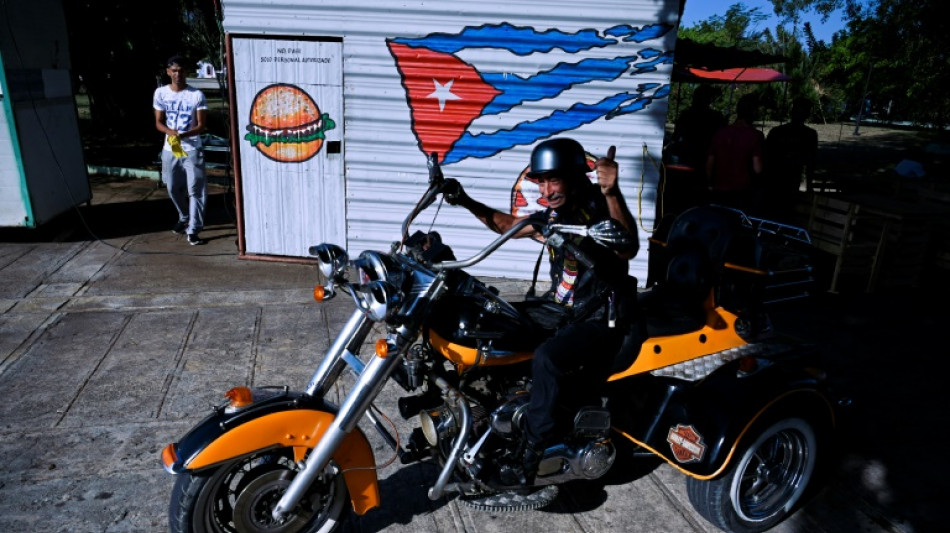
Cuba's Harley-Davidsons a labor of love for island's super-fans / Photo: YAMIL LAGE - AFP

 Argentine judge orders suspension of Falklands oil project

 US Fed raises rates to tackle 'too high' inflation, irking Trump

 Turkey releases 106 protesters, jails more LGBTQ activists

 Candidate for UN chief calls for AI regulation akin to nuclear weapons

 'We're losing control,' AI pioneer Yoshua Bengio tells AFP

 IR-MED and Dice Technologies Announce collaboration to Evaluate and Advance Pressure-Injury Prevention Platform in Japan

 Watts, Pitt, Cruz to light up Spain's top film festival

 Toogood Gold's Table Mountain Sits in the Shadow of a Nevada Gold Rush

 MEXC July–August Security Report: 38.66M USDT in Risk Funds Intercepted, Futures Insurance Fund Hits 792M USDT

 Emporio Armani names Dario Vitale new creative director

 EU to ban social media for under 13s, curb access until 15

 Wildfires push endangered Sumatran elephants to brink: Indonesian NGO

 Bank of Japan set to raise rates under pressure from inflation, US

 EU chief to unveil social media, gaming curbs for under-15s

 'Resident Evil' film brings video game's ethos to the big screen

 GA-ASI Mojave First UAS To Complete Battlefield Short Field Ops

 Sanders, Bannon warn of AI dangers in rare US left-right alignment

 Empty benches as schools reopen in Venezuela's quake-hit Guaira

 Tiny English village holds 'independence' vote over asylum seeker housing

 US Treasury chief says to meet Chinese counterpart at weekend

 BingX Evolves into a Multi-Asset Trading Platform, Connecting Users to Global Opportunities

 International Trading Institute Expands Professional Trader Development Beyond the Master’s in Trading

 Lake Energy Secures $80 Million for U.S. Renewable Energy Expansion

 Stocks drop, oil climbs and Treasury yields hit 19-year high

 SkySail Strategies Outperforms Wall Street's 30-Year Risk Standard With Proprietary AI Inference Model

Cuban Carlos Pupo Sablon spared no effort to join up with his fellow Harley-Davidson enthusiasts.
He got up at 4:00am to drive his electric blue Harley 660 kilometers (410 miles) over 13 hours -- despite fuel shortages -- to be there.
Cuba's Harley-Davidsons are not as well known as the island nation's collection of vintage American cars, but they also contribute to a palpable feeling of stepping back in time.
There are only around 200 on the island -- compared to 60,000 classic cars -- but their owners tenderly care for and repair them to keep the hum of their engines audible on the island.
For the past 12 years, Harley enthusiasts have met up annually in Varadero -- the seaside resort 145-kilometers (90 miles) east of Havana to "share the passion" over a long weekend, explained Raul Brito, 60.
He is one of the event's founders and the proud owner of a 1960s Harley, "the last model to enter the island" after the 1959 communist revolution.
Until then, there were several thousands of the iconic motorcycles in Cuba, with even police riding them.
But they lost popularity following the communist revolution that created a stigma against anything associated with the capitalist United States.
Antonio Ramirez, 60, is a former taxi driver who has reinvented himself as a bike mechanic.
He owns four Harleys, including a custom-made orange tricycle.
His first bike previously belonged to his grandfather and then his father "who used it to go to work."
Now, restoring Harleys has become a business for Ramirez.
"I buy them in parts and then restore them," he said.
But that has only really become possible over the last decade with the loosening of trade restrictions with the US, and helped by the development of Cuba's tourism industry.
Ramirez has been able to source original parts thanks to "family, friends and foreigners" traveling in Cuba.
"It was more difficult before, you had to improvise to create everything. Now it's easier to import parts, but we still make a lot by hand," said Sergio Sanchez, a mechanic from Pinar del Rio, 300 kilometers (186 miles) away.
Consequently, "there are few original Harleys, almost none, due to the lack of parts."
As a teenager, Sanchez used to borrow his father's Harley, but "it is impossible to find a 1947 piston nowadays."
- 'More difficult, more expensive' -
As is the case with many products in a country that suffers severe shortages due to 60 years of US sanctions, word of mouth and WhatsApp groups are the keys to finding a good deal.
This year, Sanchez turned up to the bikers' weekend with a white 1947 Harley that used to belong to the police.
Thanks to the 2014 restoration of diplomatic ties between Washington and Havana that sparked an explosion in tourism, it was possible once more to source parts that used to be out of reach, said Sandy Leon, 46, who helped restore the white Harley in 2019.
But the good times did not last as Donald Trump succeeded Barack Obama in 2017 and gradually ramped up sanctions that hit tourism.
In the first four months of 2019, 250,000 Americans visited Cuba, almost double the corresponding period in 2018.
But Trump barred US cruise ships from landing in Cuba and the flow of American tourists dried up.
"Now it's more difficult and more expensive" to source parts, said Leon.
Cuba's economic crisis that has seen the peso depreciate has also complicated matters.
Pupo Sablon was recognized for his efforts, winning the prize for having traveled the furthest distance to attend the event.
He managed to buy his striking blue Harley after making a deal with a Canadian enthusiast who produced the $15,000 needed in return for the right to ride the Harley when visiting the island of 11 million people.
Before then, the Harley had "remained in the same family since it left the factory in 1951."
Pupo Sablon restored it with "parts from that era" in order to maintain its "original aesthetic."
Just like its colorful vintage cars, Cuba's motorbikes made before 1960 cannot be exported because they are considered part of its "national heritage."
L.K.Baumgartner--CPN
