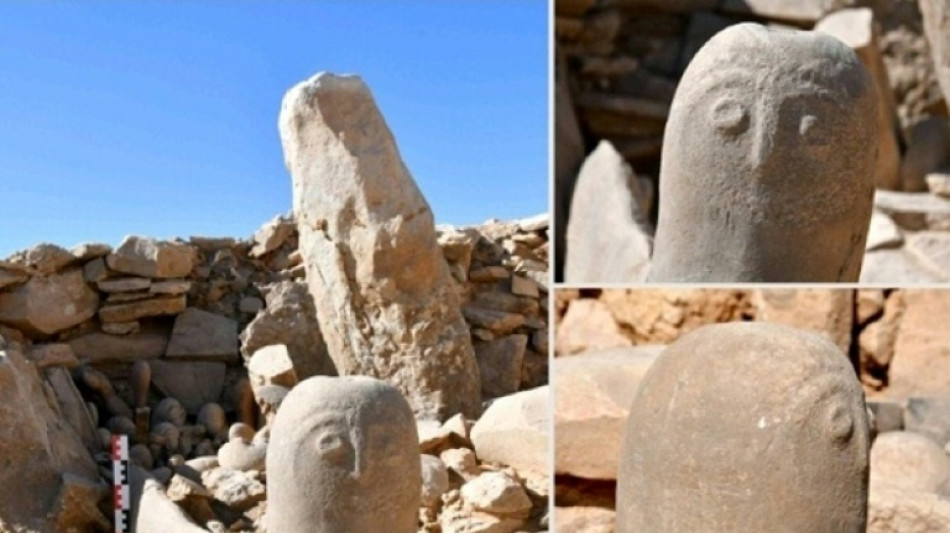
9,000-year-old ritual complex found in Jordan desert

 Wildfires push endangered Sumatran elephants to brink: Indonesian NGO

 Bank of Japan set to raise rates under pressure from inflation, US

 EU chief to unveil social media, gaming curbs for under-15s

 'Resident Evil' film brings video game's ethos to the big screen

 i-payout Expands U.S. Money Transmitter Licensing Footprint and Advances European EMI Strategy

 US Senate crypto bill collapses amid partisan deadlock

 OpenAI, Anthropic and Google are working to create an AI standards body

 Protesting shepherds, farmers clash with Romanian police

 Foundation Lets Ledger Users Switch to Open Source Without Starting Over

 EU to propose curbing social media, online games for under 15s

 FX Junction Reaches 40,600 Members and 26 Million Trades

 'We unleashed the beast': the world's fears and hopes about AI

 Hospitality leaders ask Burnham to halve VAT amid rising costs

 Worcestershire invited to nominate groups for 2027 King’s volunteer award

 Berlin's run-down public spaces at heart of election campaign

 'Widow's Bay' and 'The Pitt' win big at Emmy Awards

 Most markets drop as oil extends gains ahead of expected US rate hike

 Sri Lanka's famed beach shack battles demolition

 Vserv targets ₹1,000 crore revenue by 2030 through AI expansion

 India prohibits bank fees on UPI payments up to ₹2,000

 Brazil's Amazon defender Raoni has cancer

 Trump rejects AI slowdown concerns as UN urges coordinated controls

 Higher wages draw migrant workers to Kashmir despite attacks

 Oil supply concerns and AI warnings weigh on global markets

 'I am the hoax buster': Trump rejects AI danger warnings

Archaeologists deep in the Jordanian desert have discovered a 9,000-year-old ritualistic complex near what is thought to be the earliest known large human-built structure worldwide.
The Stone Age shrine site, excavated last year, was used by gazelle hunters and features carved stone figures, an altar and a miniature model of a large-scale hunting trap.
The giant game traps the model represents -- so-called "desert kites" -- were made of long walls that converge to corral running gazelles into enclosures or holes for slaughter.
Similar structures of two or more stone walls, some several kilometres (miles) long, have been found in deserts across Saudi Arabia, Syria, Turkey and Kazakhstan.
The Neolithic-era ritual site was discovered inside a larger campsite last October by a joint French-Jordanian team called the South Eastern Badia Archaeological Project.
The nearby desert kites in Jibal al-Khashabiyeh are "the earliest large-scale human built structures worldwide known to date," said a statement by the SEBA Project.
It hailed the "spectacular and unprecedented discovery" of the ritualistic site, believed to date to about 7000 BC.
It featured two steles with anthropomorphic features, the taller one 1.12 metres high, other artefacts including animal figurines, flints, and some 150 arranged marine fossils.
The wider, decade-old research project aims to study "the first pastoral nomadic societies, as well as the evolution of specialised subsistence strategies".
The desert kites suggest "extremely sophisticated mass hunting strategies, unexpected in such an early timeframe," said the project's statement.
The sacral symbolism was most likely meant "to invoke the supranatural forces for successful hunts and abundance of prey to capture," it said.
The teams of researchers have also found campsites with circular dwellings and large numbers of gazelle bones.
The project is a collaboration of Jordan's Al Hussein Bin Talal University and the French Institute of the Near East.
French ambassador Veronique Vouland-Aneini hailed the "outcome for both the scientific world and Jordan", saying "it provides us with a priceless testimony of the historical life in the Middle East, its traditions and rituals".
A.Agostinelli--CPN