Phew! Truck-sized asteroid misses Earth / Photo: Laurence SAUBADU - AFP

 Argentine judge orders suspension of Falklands oil project

 US Fed raises rates to tackle 'too high' inflation, irking Trump

 Turkey releases 106 protesters, jails more LGBTQ activists

 Candidate for UN chief calls for AI regulation akin to nuclear weapons

 'We're losing control,' AI pioneer Yoshua Bengio tells AFP

 IR-MED and Dice Technologies Announce collaboration to Evaluate and Advance Pressure-Injury Prevention Platform in Japan

 Watts, Pitt, Cruz to light up Spain's top film festival

 Toogood Gold's Table Mountain Sits in the Shadow of a Nevada Gold Rush

 MEXC July–August Security Report: 38.66M USDT in Risk Funds Intercepted, Futures Insurance Fund Hits 792M USDT

 Emporio Armani names Dario Vitale new creative director

 EU to ban social media for under 13s, curb access until 15

 Wildfires push endangered Sumatran elephants to brink: Indonesian NGO

 Bank of Japan set to raise rates under pressure from inflation, US

 EU chief to unveil social media, gaming curbs for under-15s

 'Resident Evil' film brings video game's ethos to the big screen

 GA-ASI Mojave First UAS To Complete Battlefield Short Field Ops

 Sanders, Bannon warn of AI dangers in rare US left-right alignment

 Empty benches as schools reopen in Venezuela's quake-hit Guaira

 Tiny English village holds 'independence' vote over asylum seeker housing

 US Treasury chief says to meet Chinese counterpart at weekend

 BingX Evolves into a Multi-Asset Trading Platform, Connecting Users to Global Opportunities

 International Trading Institute Expands Professional Trader Development Beyond the Master’s in Trading

 Lake Energy Secures $80 Million for U.S. Renewable Energy Expansion

 Stocks drop, oil climbs and Treasury yields hit 19-year high

 SkySail Strategies Outperforms Wall Street's 30-Year Risk Standard With Proprietary AI Inference Model

Bruce Willis: you can stand down.
A truck-sized asteroid that suddenly loomed out of the darkness a few days ago -- with the Earth in its sights -- sailed harmlessly past us on Thursday, space scientists said.
Despite what we've seen in movies like "Armageddon," no global mission to blow it up or knock it off course with nuclear weapons was required.
Instead, Asteroid 2023 BU whizzed past without incident and back out into the blackness of space.
Phew.
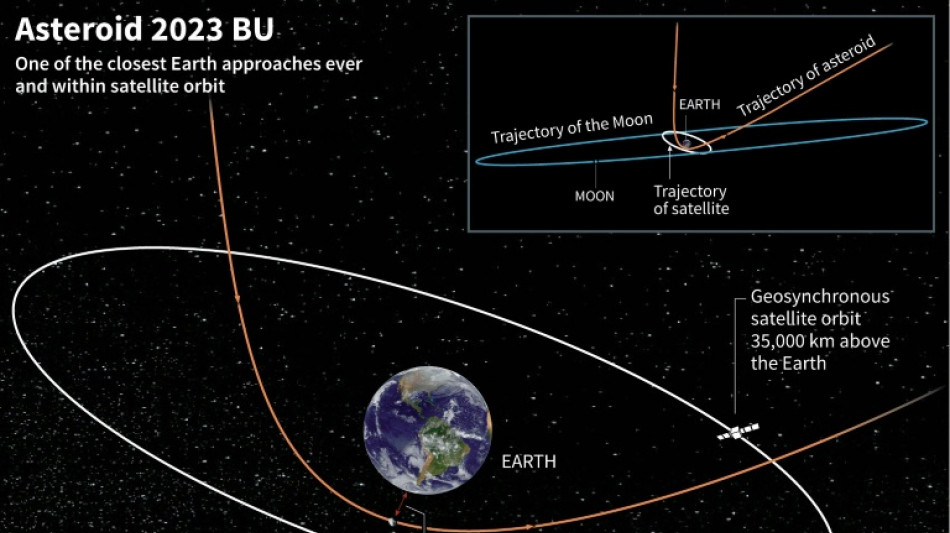
The rock, which was spotted for the first time on Saturday by an amateur stargazer in Crimea, came closest to the southern tip of South America at around 0029 GMT Friday, according to scientists who were tracking it.
At its nearest point, the asteroid was just 2,200 miles (3,600 kilometers) from Earth's surface -- just a quarter of the height of many of the geostationary satellites that make our telephones and car navigation systems work.
Amateur astronomer Gennadiy Borisov, who had already spotted an interstellar comet in 2019, raised the alarm over the weekend, alerting fellow space-watchers to the previously unknown celestial body.
Scientists around the world raced to calculate where it was headed -- and whether we needed to start making last-minute evacuation plans.
But experts using NASA's Scout impact hazard assessment system rapidly determined the alien visitor was coming in peace.
"Scout quickly ruled out 2023 BU as an impactor, but despite the very few observations, it was nonetheless able to predict that the asteroid would make an extraordinarily close approach with Earth," said NASA's Davide Farnocchia, who helped develop Scout.
"In fact, this is one of the closest approaches by a known near-Earth object ever recorded."
If the math had been off, however, humanity would still probably have been alright, scientists say.
At between just 3.5 to 8.5 meters (11 to 28 feet) across, Asteroid 2023 BU is a bit small to cause too much damage, and would have largely burned up as it hurtled through the atmosphere.
The few meteorites that did make it to the ground would have been small, not the city-destroying, tsunami-generating monsters of "Deep Impact."
The close call will leave a more lasting impact on the asteroid itself, NASA's number-crunchers said.
Earth's gravity will affect the object's orbit, lengthening the amount of time it takes for 2023 BU to go around the Sun, from 359 days to a more leisurely 425 days.
D.Philippon--CPN