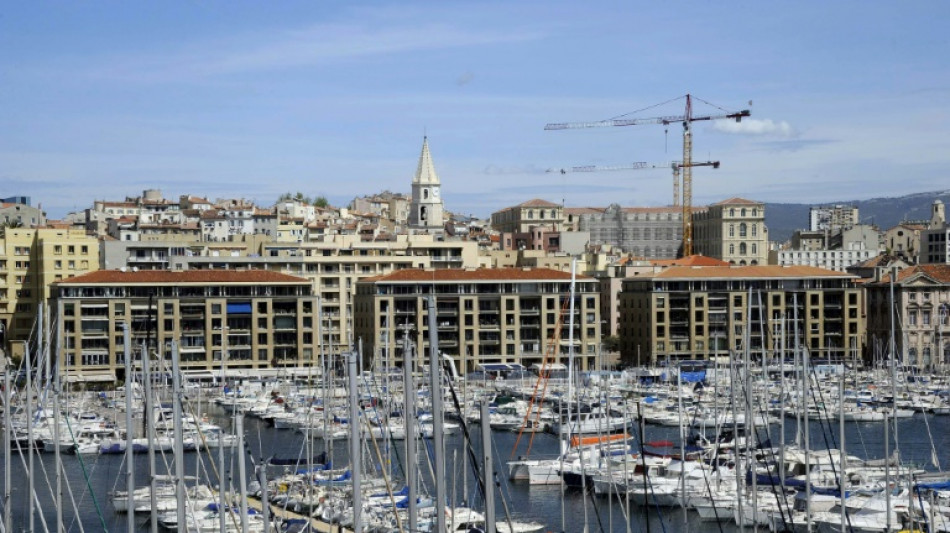
Marseille determined to remember 'forgotten' WWII roundups of Jews / Photo: Anne-Christine POUJOULAT - AFP/File

 Argentine judge orders suspension of Falklands oil project

 US Fed raises rates to tackle 'too high' inflation, irking Trump

 Turkey releases 106 protesters, jails more LGBTQ activists

 Candidate for UN chief calls for AI regulation akin to nuclear weapons

 'We're losing control,' AI pioneer Yoshua Bengio tells AFP

 IR-MED and Dice Technologies Announce collaboration to Evaluate and Advance Pressure-Injury Prevention Platform in Japan

 Watts, Pitt, Cruz to light up Spain's top film festival

 Toogood Gold's Table Mountain Sits in the Shadow of a Nevada Gold Rush

 MEXC July–August Security Report: 38.66M USDT in Risk Funds Intercepted, Futures Insurance Fund Hits 792M USDT

 Emporio Armani names Dario Vitale new creative director

 EU to ban social media for under 13s, curb access until 15

 Wildfires push endangered Sumatran elephants to brink: Indonesian NGO

 Bank of Japan set to raise rates under pressure from inflation, US

 EU chief to unveil social media, gaming curbs for under-15s

 'Resident Evil' film brings video game's ethos to the big screen

 GA-ASI Mojave First UAS To Complete Battlefield Short Field Ops

 Sanders, Bannon warn of AI dangers in rare US left-right alignment

 Empty benches as schools reopen in Venezuela's quake-hit Guaira

 Tiny English village holds 'independence' vote over asylum seeker housing

 US Treasury chief says to meet Chinese counterpart at weekend

 BingX Evolves into a Multi-Asset Trading Platform, Connecting Users to Global Opportunities

 International Trading Institute Expands Professional Trader Development Beyond the Master’s in Trading

 Lake Energy Secures $80 Million for U.S. Renewable Energy Expansion

 Stocks drop, oil climbs and Treasury yields hit 19-year high

 SkySail Strategies Outperforms Wall Street's 30-Year Risk Standard With Proprietary AI Inference Model

It was one of the most shameful yet least known outrages of the Nazi occupation of France during World War II.
One hundred-year-old Albert Corrieri still vividly remembers French and German police evicting and rounding up thousands of people from around Marseille's Old Port, including hundreds of Jews later sent to a death camp.
"I can still see those poor people with their bundles on their backs, after the Germans and French collaborators threw them out into the street in the middle of winter," said Corrieri, who was 20 years old at the time.
After the raids in January 1943, a whole neighbourhood along one side of the Old Port was razed to the ground by the Nazis, who saw it as a hotbed of the French Resistance.
But with witnesses dying out, the city's left-wing mayor Benoit Payan is worried it will be forgotten.
"The story of the destruction of the old quarters and the 1943 roundups isn't even in school books," he wrote this month.
"It has been forgotten in the national retelling of World War II."
Yet it is comparable to the notorious mass arrests of Jews in Paris in July 1942, Payan argued, which is taught in French schools.
In the Velodrome d'Hiver raids, more than 12,000 people, including 4,000 children, were rounded up in the French capital in less than two days.
- Neighbourhood destroyed -
The city of Marseille is organising a series of events this year, including a photo exhibition, to remind people that they had their own roundups too.
In a first raid on the night of January 22, 1943, French police arrested 1,865 men, women and children in an area of the port near the opera house that had a large Jewish community.
The next day German troops encircled a densely-populated low-income district to the north of the old harbour that was home to dockers, including many of Italian origin, as well as bars and brothels.
Berlin considered it a bastion of the Resistance as well as a "pigsty".
French police then moved in and arrested 635 people.
Early on January 24, German soldiers and French police woke up the whole neighbourhood and evacuated 15,000 of its inhabitants by force, transferring them to an abandoned army camp some 140 kilometres (80 miles) east of the city.
The authorities then blew up 1,500 buildings, laying waste to an area the size of 20 football pitches along the harbour.
Images of the aftermath show most of the district, where 20,000 people had lived, reduced to a sea of rubble.
- 'Crimes against humanity' -
Some 800 Jews were crammed into cattle trains after first two days of roundups.
Elie Arditti, who was 19 at the time, described the scene.
"They squashed us in to the point that we had to put our arms up in the air to make room for new arrivals," he said.
Then "they chucked seven loaves of bread and three cans into the wagon, and a worker sealed us in," he told researchers before his death.
When the train started moving, everybody on board was reciting the Kaddish, a Hebrew mourning prayer for the dead, he said.
Arditti managed to escape, but all the other Jews were transported to the Sobibor extermination camp in Nazi-occupied Poland.
Pascal Luongo, a lawyer for the survivors and the descendants of the victims of the Marseille roundups, filed a complaint for "crimes against humanity" with the prosecutor general in Paris in 2019.
He said it is unlikely the probe will find anyone responsible that is still alive, but it's a first step.
"We've come very, very far and just opening an investigation into crimes against humanity has allowed us to revisit these events," said Luongo, whose grandfather was forcibly evacuated from the old harbour quarter.
The next step, he said, would be for the French state to recognise its responsibility in the events, and for the Marseille roundups to be added to the school curriculum.
san-cdc-mk-sm/ah/sjw/fg
D.Philippon--CPN