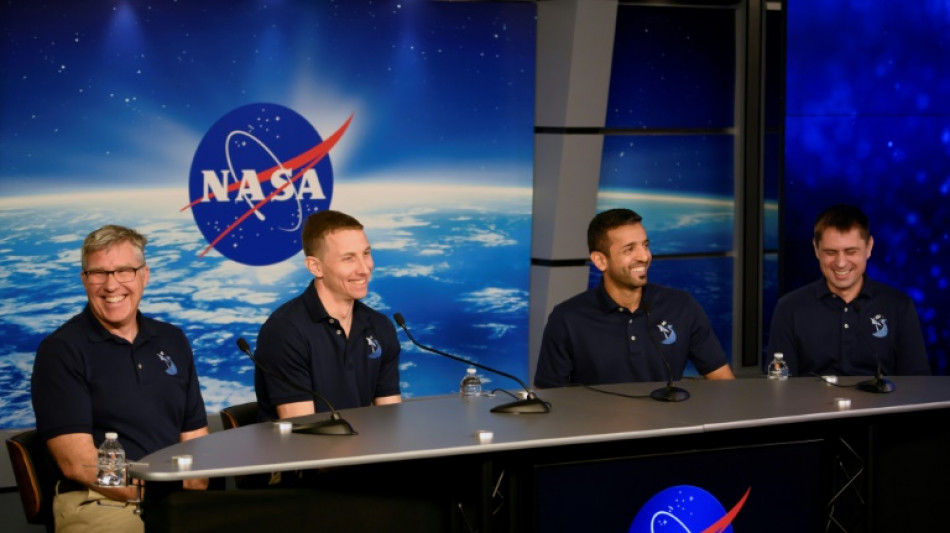
UAE astronaut says not required to fast during Ramadan on ISS / Photo: Mark FELIX - AFP

 Argentine judge orders suspension of Falklands oil project

 US Fed raises rates to tackle 'too high' inflation, irking Trump

 Turkey releases 106 protesters, jails more LGBTQ activists

 Candidate for UN chief calls for AI regulation akin to nuclear weapons

 'We're losing control,' AI pioneer Yoshua Bengio tells AFP

 IR-MED and Dice Technologies Announce collaboration to Evaluate and Advance Pressure-Injury Prevention Platform in Japan

 Watts, Pitt, Cruz to light up Spain's top film festival

 Toogood Gold's Table Mountain Sits in the Shadow of a Nevada Gold Rush

 MEXC July–August Security Report: 38.66M USDT in Risk Funds Intercepted, Futures Insurance Fund Hits 792M USDT

 Emporio Armani names Dario Vitale new creative director

 EU to ban social media for under 13s, curb access until 15

 Wildfires push endangered Sumatran elephants to brink: Indonesian NGO

 Bank of Japan set to raise rates under pressure from inflation, US

 EU chief to unveil social media, gaming curbs for under-15s

 'Resident Evil' film brings video game's ethos to the big screen

 GA-ASI Mojave First UAS To Complete Battlefield Short Field Ops

 Sanders, Bannon warn of AI dangers in rare US left-right alignment

 Empty benches as schools reopen in Venezuela's quake-hit Guaira

 Tiny English village holds 'independence' vote over asylum seeker housing

 US Treasury chief says to meet Chinese counterpart at weekend

 BingX Evolves into a Multi-Asset Trading Platform, Connecting Users to Global Opportunities

 International Trading Institute Expands Professional Trader Development Beyond the Master’s in Trading

 Lake Energy Secures $80 Million for U.S. Renewable Energy Expansion

 Stocks drop, oil climbs and Treasury yields hit 19-year high

 SkySail Strategies Outperforms Wall Street's 30-Year Risk Standard With Proprietary AI Inference Model

Emirati astronaut Sultan al-Neyadi said Wednesday that he will not be required to fast during Ramadan while on his upcoming space mission.
The 41-year-old will become the first Arab astronaut to spend six months in space when he blasts off for the International Space Station (ISS) next month aboard a SpaceX Falcon 9 rocket.
Neyadi, NASA's Stephen Bowen and Warren Hoburg and Russia's Andrey Fedyaev are scheduled to fly to the ISS on February 26 as members of SpaceX Dragon Crew-6.
Asked at a press conference Tuesday how he will observe the holy month of Ramadan, when Muslims typically fast from dawn to sunset, Neyadi said his situation falls under an exception.
"I'm in... the definition of a traveler, and we can actually break fast," Neyadi said. "It's not compulsory."
"Actually fasting is not compulsory if you're... feeling not well," he said.
"So in that regard, anything that can jeopardize the mission, or maybe put the crew members in a risk, we're actually allowed to eat sufficient food."
Neyadi will be the second national from the oil-rich United Arab Emirates to voyage to space.
In September 2019, Hazzaa al-Mansoori spent eight days on the ISS.
The NASA astronauts and Russian cosmonaut were also asked at the Johnson Space center Wednesday whether any of the political tensions on Earth, over Ukraine for example, spilled over into space.
"I've been working and training with cosmonauts for over 20 years now and it's always been amazing," said NASA's Bowen, a veteran of three space shuttle missions.
"Once you get to space, it's just one crew, one vehicle and we all have the same goal."
Fedyaev pointed to the "very long history" of space cooperation between Russia and the United States.
"The life of people in space on the International Space Station is really setting a very good example for how people should be living on Earth," the Russian cosmonaut said.
- Five-day handover -
NASA officials said they expect the members of SpaceX Dragon Crew-6 to have a five-day handover with the four members of Dragon Crew-5, who have been on the ISS since October.
Also currently aboard the ISS are three astronauts whose return vehicle, a Soyuz crew capsule, was damaged by a strike from a tiny meteoroid in December.
Russia plans to send an empty spacecraft to the ISS on February 20 to bring home the trio -- Russian cosmonauts Dmitry Petelin and Sergei Prokopyev and NASA astronaut Frank Rubio.
Their Soyuz MS-22 crew capsule sprang a radiator coolant leak after the meteoroid strike.
MS-22 flew Petelin, Prokopyev and Rubio to the ISS in September after taking off from the Russian-operated Baikonur Cosmodrome in Kazakhstan.
They were scheduled to return home in the same spacecraft in March, but their stay on the ISS will now be extended by several extra months.
Russia has been using the ageing but reliable Soyuz capsules to ferry astronauts into space since the 1960s.
Space has remained a rare venue of cooperation between Moscow and Washington since the start of the Russian offensive in Ukraine.
The ISS was launched in 1998 at a time of increased US-Russia cooperation following the Cold War "Space Race."
A.Samuel--CPN