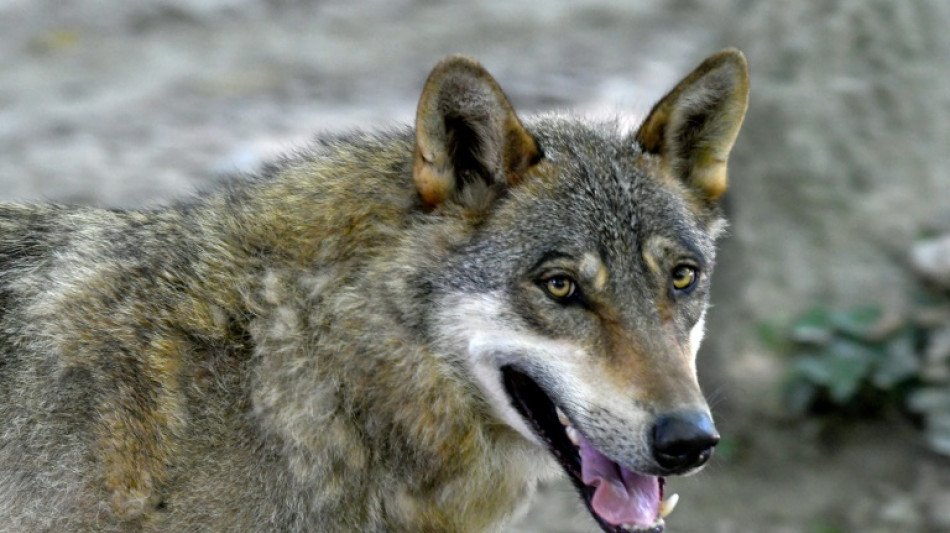
Rapid development is main threat to big carnivores: study / Photo: DENIS LOVROVIC - AFP

 Argentine judge orders suspension of Falklands oil project

 US Fed raises rates to tackle 'too high' inflation, irking Trump

 Turkey releases 106 protesters, jails more LGBTQ activists

 Candidate for UN chief calls for AI regulation akin to nuclear weapons

 'We're losing control,' AI pioneer Yoshua Bengio tells AFP

 IR-MED and Dice Technologies Announce collaboration to Evaluate and Advance Pressure-Injury Prevention Platform in Japan

 Watts, Pitt, Cruz to light up Spain's top film festival

 Toogood Gold's Table Mountain Sits in the Shadow of a Nevada Gold Rush

 MEXC July–August Security Report: 38.66M USDT in Risk Funds Intercepted, Futures Insurance Fund Hits 792M USDT

 Emporio Armani names Dario Vitale new creative director

 EU to ban social media for under 13s, curb access until 15

 Wildfires push endangered Sumatran elephants to brink: Indonesian NGO

 Bank of Japan set to raise rates under pressure from inflation, US

 EU chief to unveil social media, gaming curbs for under-15s

 'Resident Evil' film brings video game's ethos to the big screen

 GA-ASI Mojave First UAS To Complete Battlefield Short Field Ops

 Sanders, Bannon warn of AI dangers in rare US left-right alignment

 Empty benches as schools reopen in Venezuela's quake-hit Guaira

 Tiny English village holds 'independence' vote over asylum seeker housing

 US Treasury chief says to meet Chinese counterpart at weekend

 BingX Evolves into a Multi-Asset Trading Platform, Connecting Users to Global Opportunities

 International Trading Institute Expands Professional Trader Development Beyond the Master’s in Trading

 Lake Energy Secures $80 Million for U.S. Renewable Energy Expansion

 Stocks drop, oil climbs and Treasury yields hit 19-year high

 SkySail Strategies Outperforms Wall Street's 30-Year Risk Standard With Proprietary AI Inference Model

Declines in populations of big carnivores like lions, tigers and wolves may be driven more by rapid human economic development than habitat loss or climate change, according to a new study Tuesday.
The researchers hope the findings could help to improve policies for protecting carnivore populations, which have been driven to the brink of extinction in many parts of the world.
The study found that faster economic development was linked to a quicker decline in carnivore populations.
"In the midst of rapid development, people appear to become less tolerant of carnivores, conflicts explode, and we suspect that incidences of poaching and persecution rocket," lead author Thomas Johnson said in a press release.
Some carnivores are poached for their meat or for the wildlife trade, while others like lions may be killed if they pose a threat to someone's livelihood -- such as their cattle -- or their life, Johnson told AFP.
"These human elements are actually having a far greater impact than the habitat loss elements," Johnson said.
Traditionally, habitat loss has been considered the primary threat to carnivore populations, but the researchers said that was "dwarfed" by human development.
The study, published in Nature Communications, concluded that as human communities become wealthier and socioeconomic growth slows, carnivore populations can recover.
The authors said this was partly due to better habitat protection, but mainly because people start to care more about the animals and have less of a desire -- and need -- to kill them.
"What you want is this growth to slow before [the carnivore population] completely vanishes, so there's at least an opportunity to recover," Johnson said.
- Wolf rebound -
Grey wolf populations have already rebounded in Europe, growing 1,800 percent since the 1960s thanks to an improved quality of life and slower economic development on the continent, according to the researchers from the University of Reading.
That recovery is not only happening in protected parks but also in wild areas.
Brown bears and lynxes are also starting to recover in Europe, Johnson said, while tiger populations in India have similarly started to rebound.
But several parts of Africa did not support the overarching findings -- the continent has not seen rapid development but its carnivore populations have declined -- and Johnson said this may be because much of the population decline occurred decades ago under colonial regimes.
The findings present an inherent tension between prioritising human development versus protecting carnivores, and Johnson suggested that wealthier nations -- responsible for much of large carnivore decline -- could support less developed nations through targeted financial support.
This could include paying communities in biodiversity hotspots enough to earn a living, while promoting conservation.
"If you lock people into poverty, people will never live alongside biodiversity," Johnson said, adding that he hopes policy will move beyond treating carnivore loss as a narrow issue.
"My real hope is we start thinking about this as a socioeconomic problem, as well as an environmental problem."
The work looked at 50 species of carnivores in over 80 countries over the last 50 years.
Carnivore populations have seen dramatic declines globally in the last century, with lions and tigers absent from more than 90 percent of their historic range.
In the United Kingdom, many local carnivore species such as lynx, wolf and bear have already been hunted into extinction.
O.Ignatyev--CPN