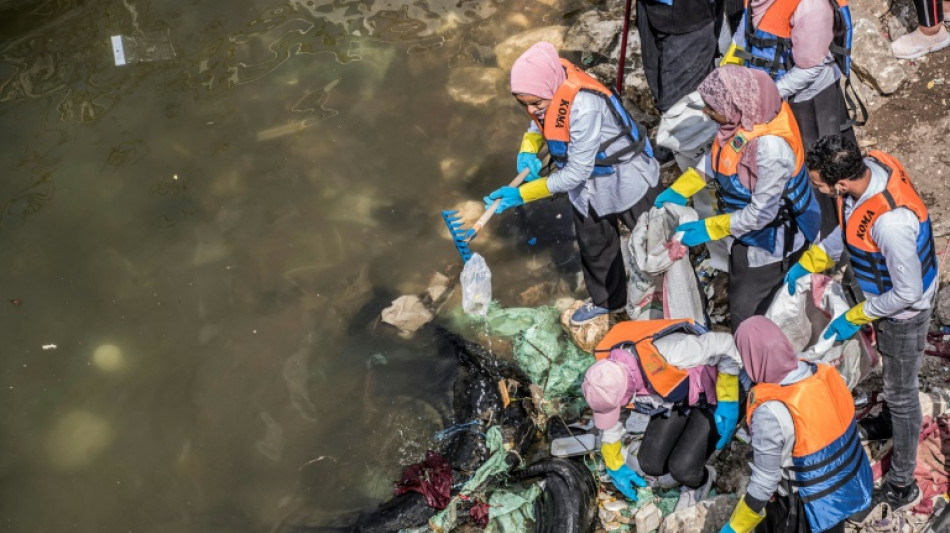
Out of Nile, into tile: Young Egyptians battle plastic plague / Photo: Khaled DESOUKI - AFP/File

 Argentine judge orders suspension of Falklands oil project

 US Fed raises rates to tackle 'too high' inflation, irking Trump

 Turkey releases 106 protesters, jails more LGBTQ activists

 Candidate for UN chief calls for AI regulation akin to nuclear weapons

 'We're losing control,' AI pioneer Yoshua Bengio tells AFP

 IR-MED and Dice Technologies Announce collaboration to Evaluate and Advance Pressure-Injury Prevention Platform in Japan

 Watts, Pitt, Cruz to light up Spain's top film festival

 Toogood Gold's Table Mountain Sits in the Shadow of a Nevada Gold Rush

 MEXC July–August Security Report: 38.66M USDT in Risk Funds Intercepted, Futures Insurance Fund Hits 792M USDT

 Emporio Armani names Dario Vitale new creative director

 EU to ban social media for under 13s, curb access until 15

 Wildfires push endangered Sumatran elephants to brink: Indonesian NGO

 Bank of Japan set to raise rates under pressure from inflation, US

 EU chief to unveil social media, gaming curbs for under-15s

 'Resident Evil' film brings video game's ethos to the big screen

 GA-ASI Mojave First UAS To Complete Battlefield Short Field Ops

 Sanders, Bannon warn of AI dangers in rare US left-right alignment

 Empty benches as schools reopen in Venezuela's quake-hit Guaira

 Tiny English village holds 'independence' vote over asylum seeker housing

 US Treasury chief says to meet Chinese counterpart at weekend

 BingX Evolves into a Multi-Asset Trading Platform, Connecting Users to Global Opportunities

 International Trading Institute Expands Professional Trader Development Beyond the Master’s in Trading

 Lake Energy Secures $80 Million for U.S. Renewable Energy Expansion

 Stocks drop, oil climbs and Treasury yields hit 19-year high

 SkySail Strategies Outperforms Wall Street's 30-Year Risk Standard With Proprietary AI Inference Model

Entrepreneurial young Egyptians are helping combat their country's huge plastic waste problem by recycling junk-food wrappers, water bottles and similar garbage that usually ends up in landfills or the Nile.
At a factory on the outskirts of Cairo, run by their startup TileGreen, noisy machines gobble up huge amounts of plastic scraps of all colours, shred them and turn them into a thick liquid.
The sludge -- made from all kinds of plastic, even single-use shopping bags -- is then moulded into dark, compact bricks that are used as outdoor pavers for walkways and garages.
"They're twice as strong as concrete," boasts co-founder Khaled Raafat, 24, slamming one onto the floor for emphasis.
Each tile takes about "125 plastic bags out of the environment", says his business partner Amr Shalan, 26, raising his voice above the din of the machines.
Raafat said the company uses even low-grade plastics and products "made of many different layers of plastic and aluminium that are nearly impossible to separate and recycle sustainably".
Egypt, the Arab world's most populous country, is also the biggest plastic polluter in the Middle East and Africa, according to a multinational study reported by Science magazine.
The country generates more than three million tonnes of plastic waste per year, much of which piles up in streets and illegal landfills or finds its way into the Nile and the Mediterranean Sea.
Microplastics in the water concentrate in marine life, threatening the health of people who consume seafood and fish caught in Africa's mighty waterway -- mirroring what has become a worldwide environmental scourge.
- 'Their children's future' -
TileGreen, launched in 2021, aims to "recycle three billion to five billion plastic bags by 2025", said Shalan.
The start-up last year started selling its outdoor tiles, of which it has produced some 40,000 so far, and plans to expand into other products usually made from cement.
Egypt, a country of 104 million, has pledged to more than halve its annual consumption of single-use plastics by 2030 and to build multiple new waste management plants.
For now, however, more than two thirds of of Egypt's waste is "inadequately managed", according to the World Bank -- driving an ecological hazard environmental groups have been trying to tackle.
On the shores of the Nile island of Qursaya, some fishermen now collect and sort plastic trash they net from the river as part of an initiative by the group VeryNile.
As the Nile has become more polluted, the fishermen "could see their catches decreasing", said project manager Hany Fawzy, 47. "They knew this was their future and their children's future disappearing."
Over three-quarters of Cairo fish were found to contain microplastics in a 2020 study by a group of Danish and UK-based scientists published in the journal Toxics.
Off the port city of Alexandria, further north, microplastics were detected in 92 percent of fish caught, said a study last year by researchers at Egypt's National Institute of Oceanography and Fisheries.
VeryNile, started five years ago with a series of volunteer clean-up events, buys "between 10 and 12 tonnes of plastic a month" from 65 fishermen, paying them 14 Egyptian pounds (about 50 US cents) per kilogram, Fawzy said.
- 'Good step forward' -
VeryNile then compresses high-value plastic like water bottles and sends it to a recycling plant to be made into pellets.
Low-quality plastics such as food wrappers are incinerated to power a cement factory which, Fawzy said, keeps "the environment clean with air filters and a sensitive monitoring system."
"We can't clean up the environment in one spot just to pollute elsewhere," he said.
The Egyptian programmes are part of a battle against a global scourge.
Less than 10 percent of the world's plastic is recycled, according to the Organisation for Economic Cooperation and Development.
The OECD said last year that annual production of fossil-fuel-based plastics is set to top 1.2 billion tonnes by 2060, with waste exceeding one billion tonnes.
In Egypt, activists have hailed what they see as a youth-led push for sustainability that has created demand for environmentally-minded solutions and products.
But while the change is welcome, they say it remains insufficient.
"What these initiatives have done is find a way to create a value chain, and there's clearly demand," said Mohamed Kamal, co-director of environmental group Greenish.
"Anything that captures value from waste in Egypt is a good step forward. But it's not solving the problem. It can only scratch the surface."
A.Samuel--CPN