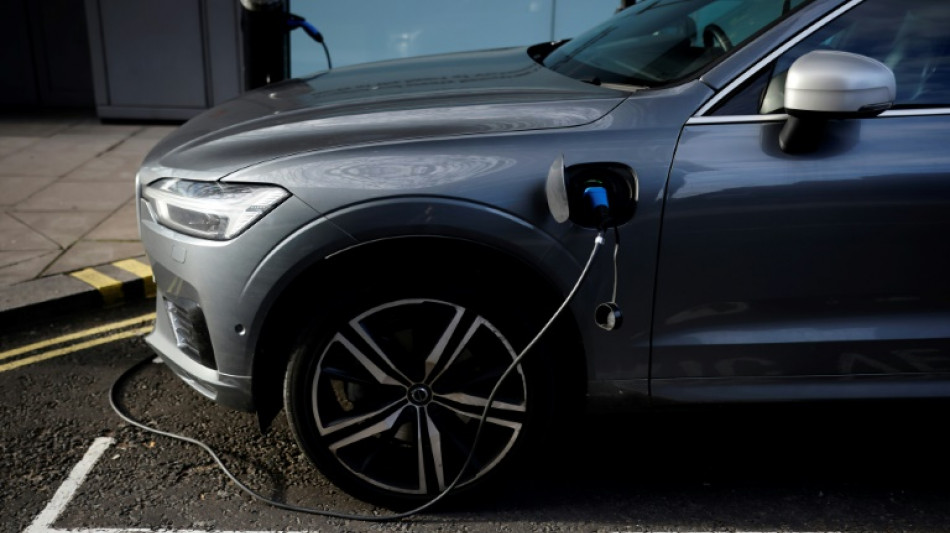
Electric car batteries could be key to boosting energy storage: study / Photo: Tolga Akmen - AFP/File

 Argentine judge orders suspension of Falklands oil project

 US Fed raises rates to tackle 'too high' inflation, irking Trump

 Turkey releases 106 protesters, jails more LGBTQ activists

 Candidate for UN chief calls for AI regulation akin to nuclear weapons

 'We're losing control,' AI pioneer Yoshua Bengio tells AFP

 IR-MED and Dice Technologies Announce collaboration to Evaluate and Advance Pressure-Injury Prevention Platform in Japan

 Watts, Pitt, Cruz to light up Spain's top film festival

 Toogood Gold's Table Mountain Sits in the Shadow of a Nevada Gold Rush

 MEXC July–August Security Report: 38.66M USDT in Risk Funds Intercepted, Futures Insurance Fund Hits 792M USDT

 Emporio Armani names Dario Vitale new creative director

 EU to ban social media for under 13s, curb access until 15

 Wildfires push endangered Sumatran elephants to brink: Indonesian NGO

 Bank of Japan set to raise rates under pressure from inflation, US

 EU chief to unveil social media, gaming curbs for under-15s

 'Resident Evil' film brings video game's ethos to the big screen

 GA-ASI Mojave First UAS To Complete Battlefield Short Field Ops

 Sanders, Bannon warn of AI dangers in rare US left-right alignment

 Empty benches as schools reopen in Venezuela's quake-hit Guaira

 Tiny English village holds 'independence' vote over asylum seeker housing

 US Treasury chief says to meet Chinese counterpart at weekend

 BingX Evolves into a Multi-Asset Trading Platform, Connecting Users to Global Opportunities

 International Trading Institute Expands Professional Trader Development Beyond the Master’s in Trading

 Lake Energy Secures $80 Million for U.S. Renewable Energy Expansion

 Stocks drop, oil climbs and Treasury yields hit 19-year high

 SkySail Strategies Outperforms Wall Street's 30-Year Risk Standard With Proprietary AI Inference Model

Electric car batteries could be used to boost power storage in the future, injecting electricity into the grid during times of scarcity or storing electricity during periods of excess, a new study found Tuesday.
Renewable energy is essential for the Paris Agreement goal of limiting global warming to well below two degrees Celsius, but the need to scale up quickly and the intermittency of wind and solar have raised concerns about meeting electricity demand.
One way to help solve this problem is boosting the storage capacity of electricity grids, so that even when there is no sun or wind energy supply won't be interrupted.
New research published Tuesday found that electric car batteries could help boost short-term grid storage in times of increased demand or lower supply, either by setting up "vehicle-to-grid" or "second use" schemes.
"Harnessing this potential will have critical implications for the energy transition," said the study published in Nature Communications.
A "vehicle-to-grid" approach would allow drivers to connect car batteries to the grid for short term-storage when needed, the authors said.
For example, commercial fleets could inject power into the grid when at a depot.
"Second-use" schemes would allow drivers to sell or donate car batteries once they can no longer be used to power vehicles, which is generally when their capacity falls below 70 to 80 percent.
- Micro-payments -
Even a low level of participation from drivers could make a big difference, the researchers said.
"Low participation rates of 12 to 43 percent are needed to provide short-term grid storage demand globally," study co-author Chengjian Xu, of Leiden University in The Netherlands, told AFP.
"Short-term grid storage demand could be met as early as 2030 across most regions", he added, saying this was a conservative estimate.
By 2050, it would exceed the storage capacity required to help limit global warming to well below 2C, as outlined by the International Renewable Energy Agency.
The work examined global data -- including from the main electric car battery markets in China, India, the European Union and the United States -- taking into consideration average driving distances, driver behaviour and temperature, all of which can affect car battery health.
The authors said governments should introduce incentives and regulations to ensure vehicle-to-grid and second use schemes can take off.
"This can include market-based efforts such as micro-payments for services to the grid," Chengjian said, adding that vehicle-to-grid use would have little harm on battery life.
Some car firms such as Hyundai and Renault are already testing vehicles equipped with vehicle-to-grid technology, while some Teslas are already compatible.
The International Energy Agency (IEA) estimates that there will be some 200 million electric vehicles sold in 2030 -- about 20 percent of all cars sold -- an 11-fold increase from today's numbers.
IEA analyst Luis Lopez told AFP using car batteries as short-term storage was "quite promising but it's not a silver bullet", since it would provide less than one percent of storage needed under a net zero by 2050 scenario.
It would also require proper "communication" between the power system and the electric cars.
"If the power system, EVs (electric vehicles) and charging infrastructure all speak the same language, it is easier to aggregate more vehicles for power system needs".
Y.Ibrahim--CPN