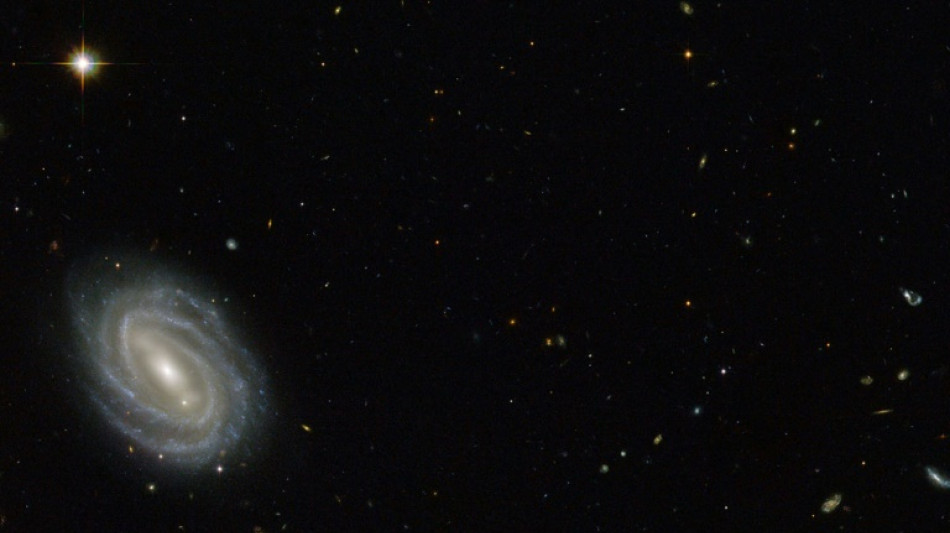
Nuclear reactor experiment rules out one dark matter hope / Photo: Handout - NASA/ESA/HUBBLE/AFP/File

 Argentine judge orders suspension of Falklands oil project

 US Fed raises rates to tackle 'too high' inflation, irking Trump

 Turkey releases 106 protesters, jails more LGBTQ activists

 Candidate for UN chief calls for AI regulation akin to nuclear weapons

 'We're losing control,' AI pioneer Yoshua Bengio tells AFP

 IR-MED and Dice Technologies Announce collaboration to Evaluate and Advance Pressure-Injury Prevention Platform in Japan

 Watts, Pitt, Cruz to light up Spain's top film festival

 Toogood Gold's Table Mountain Sits in the Shadow of a Nevada Gold Rush

 MEXC July–August Security Report: 38.66M USDT in Risk Funds Intercepted, Futures Insurance Fund Hits 792M USDT

 Emporio Armani names Dario Vitale new creative director

 EU to ban social media for under 13s, curb access until 15

 Wildfires push endangered Sumatran elephants to brink: Indonesian NGO

 Bank of Japan set to raise rates under pressure from inflation, US

 EU chief to unveil social media, gaming curbs for under-15s

 'Resident Evil' film brings video game's ethos to the big screen

 GA-ASI Mojave First UAS To Complete Battlefield Short Field Ops

 Sanders, Bannon warn of AI dangers in rare US left-right alignment

 Empty benches as schools reopen in Venezuela's quake-hit Guaira

 Tiny English village holds 'independence' vote over asylum seeker housing

 US Treasury chief says to meet Chinese counterpart at weekend

 BingX Evolves into a Multi-Asset Trading Platform, Connecting Users to Global Opportunities

 International Trading Institute Expands Professional Trader Development Beyond the Master’s in Trading

 Lake Energy Secures $80 Million for U.S. Renewable Energy Expansion

 Stocks drop, oil climbs and Treasury yields hit 19-year high

 SkySail Strategies Outperforms Wall Street's 30-Year Risk Standard With Proprietary AI Inference Model

It was an anomaly detected in the storm of a nuclear reactor so puzzling that physicists hoped it would shine a light on dark matter, one of the universe's greatest mysteries.
However new research has definitively ruled out that this strange measurement signalled the existence of a "sterile neutrino", a hypothetical particle that has long eluded scientists.
Neutrinos are sometimes called "ghost particles" because they barely interact with other matter -- around 100 trillion are estimated to pass through our bodies every second.
Since neutrinos were first theorised in 1930, scientists have been trying to nail down the properties of these shape-shifters, which are one of the most common particles in the universe.
They appear "when the nature of the nucleus of an atom has been changed", physicist David Lhuillier of France's Atomic Energy Commission told AFP.
That could happen when they come together in the furious fusion in the heart of stars like our Sun, or are broken apart in nuclear reactors, he said.
There are three confirmed flavours of neutrino: electron, muon and tau.
However physicists suspect there could be a fourth neutrino, dubbed "sterile" because it does not interact with ordinary matter at all.
In theory, it would only answer to gravity and not the fundamental force of weak interactions, which still hold sway over the other neutrinos.
The sterile neutrino has a place ready for it in theoretical physics, "but there has not yet been a clear demonstration that is exists," he added.
- Dark matter candidate -
So Lhuillier and the rest of the STEREO collaboration, which brings together French and German scientists, set out to find it.
Previous nuclear reactor measurements had found fewer neutrinos than the amount expected by theoretical models, a phenomenon dubbed the "reactor antineutrino anomaly".
It was suggested that the missing neutrinos had changed into the sterile kind, offering a rare chance to prove their existence.
To find out, the STEREO collaboration installed a dedicated detector a few metres away from a nuclear reactor used for research at the Laue–Langevin institute in Grenoble, France.
After four years of observing more than 100,000 neutrinos and two years analysing the data, the verdict was published in the journal Nature on Wednesday.
The anomaly "cannot be explained by sterile neutrinos," Lhuillier said.
But that "does not mean there are none in the universe", he added.
The experiment found that previous predictions of the amount of neutrinos being produced were incorrect.
But it was not a total loss, offering a much clearer picture of neutrinos emitted by nuclear reactors.
This could help not just with future research, but also for monitoring nuclear reactors.
Meanwhile, the search for the sterile neutrino continues. Particle accelerators, which smash atoms, could offer up new leads.
Despite the setback, interest could remain high because sterile neutrinos have been considered a suspect for dark matter, which makes up more than quarter of the universe but remains shrouded in mystery.
Like dark matter, the sterile neutrino does not interact with ordinary matter, making it incredibly difficult to observe.
"It would be a candidate which would explain why we see the effects of dark matter -- and why we cannot see dark matter," Lhuillier said.
H.Cho--CPN